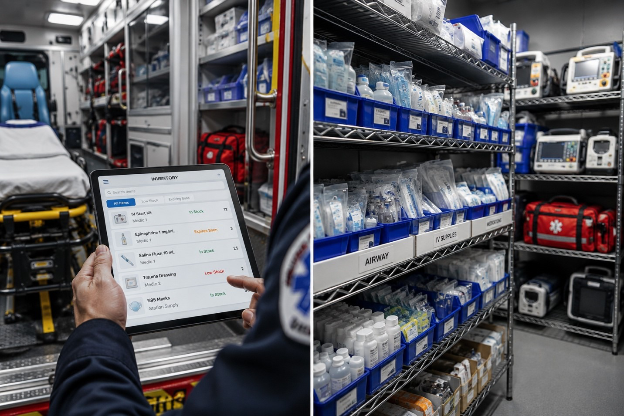
How to Improve EMS Inventory Management at Your Agency
A missing IV kit or expired medication does not always show up on anyone’s radar until a crew needs it. That is the real cost of weak EMS inventory management. It is not simply an administrative problem. It can become a readiness, budgeting, and patient care problem.
EMS agencies manage hundreds or even thousands of supplies across stations, ambulances, apparatus, storage rooms, and response bags. Add expiration dates, equipment maintenance, changing call volumes, supply chain delays, and rising costs, and inventory can quickly become difficult to manage.
For agencies still relying on clipboards, manual counts, or shared spreadsheets, improving inventory management starts with one thing: better visibility.
Here are practical ways to strengthen EMS inventory management and create a more reliable system for keeping crews equipped and ready.
Why EMS Inventory Management Deserves More Attention
Every unit that leaves the station understocked, every expired item discovered too late, and every hour a medic spends manually counting supplies represents a cost to the agency.
The challenge is that inventory is constantly moving.
Supplies are consumed during calls. Equipment moves between apparatus. Medications expire. Items are sent for maintenance. New shipments arrive. Crews restock units. Without a centralized process, it becomes difficult to know exactly what the department has and where it is located.
Effective EMS inventory tracking gives agencies visibility into these movements so they can make better operational and purchasing decisions.
Instead of simply asking, “Do we have enough?” leadership can begin answering more useful questions:
- What do we have?
- Where is it located?
- What are crews using most frequently?
- What needs to be reordered?
- What is approaching expiration?
- What equipment requires inspection or maintenance?
- Are every station and apparatus appropriately stocked?
That visibility creates the foundation for stronger inventory management.
- Standardize Par Levels Across Units and Stations
Every ambulance, apparatus, and response bag should have a defined standard for what it is expected to carry.
Without established par levels, restocking can become inconsistent. One unit may carry significantly more of a particular supply while another routinely runs short.
Establish minimum and preferred quantities for frequently used supplies and apply those standards consistently across similar units.
Standardized par levels make routine checks faster and make shortages easier to identify.
They also give leadership a clearer understanding of how much inventory the department actually needs instead of relying on historical purchasing habits.
- Improve EMS Inventory Tracking for Expiration Dates
Expired medications and medical supplies are among the most preventable sources of inventory waste.
A first-in, first-out inventory process can help departments use older supplies before newer inventory. However, that process becomes much more effective when agencies can actively track expiration dates.
With better EMS inventory tracking, departments can identify supplies approaching expiration and potentially redistribute them to higher-volume units where they are more likely to be used.
Instead of discovering expired products during a cabinet check, agencies can take a more proactive approach to inventory rotation.
That can help:
- Reduce expired inventory
- Control replacement costs
- Improve medication and supply readiness
- Reduce manual expiration checks
- Create greater accountability across stations
The objective is not simply to document expiration dates. It is to use that information to prevent waste before it occurs.
- Use Actual Usage Data to Set Smarter Inventory Levels
Many agencies determine inventory levels based on what they have historically ordered rather than what crews actually use.
Usage data can provide a much better foundation.
Understanding which supplies move fastest, which stations consume the most inventory, and how usage changes over time can help departments establish more appropriate stock levels.
For example, a high-volume EMS unit may need significantly more of a particular medical supply than a lower-volume unit. Maintaining identical quantities at both locations could create shortages at one station and excess inventory at another.
Over time, EMS inventory management software can help agencies identify these patterns and make more informed decisions about purchasing and distribution.
Better inventory data can also support budgeting by helping leadership distinguish between what the department traditionally purchases and what it actually needs.
- Account for Supplier Lead Times and Supply Chain Disruptions
Inventory management does not stop at the station door.
Departments also need to consider how long it takes to replace critical supplies.
A product that normally arrives in three days may suddenly have a multi-week lead time because of manufacturer shortages, transportation issues, or increased demand.
Agencies should identify critical supplies, understand typical supplier lead times, and determine where backup purchasing options may be necessary.
This is particularly important when establishing safety stock.
The goal is not to stockpile everything. It is to maintain enough inventory to protect operational readiness without unnecessarily tying up budget in products that may expire before they are used.
- Restock More Strategically, Not Simply More
More inventory does not necessarily mean better preparedness.
Overstocking can create its own problems, including expired products, crowded storage areas, unnecessary spending, and supplies that become difficult to locate.
More frequent, smaller replenishment cycles may allow departments to maintain appropriate stock while reducing excess inventory.
The right approach will depend on call volume, supplier lead times, storage capacity, and the types of supplies being managed.
The important point is to base replenishment decisions on actual operational data rather than habit.
- Move Beyond Spreadsheets With EMS Inventory Management Software
Spreadsheets are familiar, inexpensive, and easy to create. But as an EMS operation grows, their limitations become increasingly apparent.
A spreadsheet can tell you what someone entered during the last inventory count. It may not provide an accurate picture of what has happened since.
Supplies may have been used, transferred, replaced, or moved between stations without being reflected in the file.
Purpose-built EMS inventory management software gives agencies the opportunity to centralize inventory information and establish a consistent process for managing it.
Instead of maintaining separate files across stations or relying on manual reconciliation, departments can bring inventory information into a system designed around their operational workflows.
For fire and EMS agencies looking to connect inventory with broader equipment and logistics processes, EPR Fireworks Equipment and Logistics provides tools designed specifically for emergency services operations.
EMS Inventory Management Is Not Just About Consumable Supplies
When agencies hear “inventory,” they often think about medications, IV supplies, gauze, airway equipment, and other consumables.
But effective inventory management extends well beyond disposable supplies.
Departments also manage durable equipment such as:
- Cardiac monitors
- Stretchers
- Radios
- SCBA
- PPE
- Medical equipment
- Rescue equipment
- Apparatus-mounted equipment
These assets have their own operational requirements.
Departments need to know where equipment is assigned, whether it is available for service, when it was inspected, and when maintenance may be required.
This is where EMS inventory software and fire department inventory management begin to overlap.
For combined fire and EMS organizations, managing these resources within connected workflows can provide a much clearer picture of department-wide readiness.
- Connect Inventory With Equipment Maintenance
Knowing where a piece of equipment is located is only part of the equation.
Agencies also need to understand its condition.
A piece of equipment can technically be “in inventory” while still being unavailable for operational use because it requires inspection, maintenance, or repair.
Connecting inventory and equipment information with maintenance workflows helps departments distinguish between equipment that is owned and equipment that is actually ready for service.
EPR Fireworks Equipment and Logistics is designed to help fire and EMS agencies manage equipment and logistics information within their broader operational environment.
This creates a more complete view of the resources crews depend on every day.
- Make Inventory Processes Easy for Crews
The best inventory process is one crews will actually use consistently.
If documenting a supply change requires too many steps, personnel may postpone the update until later. Once that happens repeatedly, inventory information becomes less reliable.
When evaluating EMS inventory software, agencies should consider the everyday experience of the people responsible for using it.
Can crews quickly record inventory activity? Can they easily determine what needs attention? Does the process fit naturally into existing checks and operational workflows?
Technology should reduce administrative burden rather than create another task for crews to manage.
The easier it is to maintain accurate information, the more useful that information becomes for everyone across the organization.
Why Fire Department Inventory Management Faces the Same Challenges
Fire departments experience many of the same inventory challenges as EMS agencies.
PPE, SCBA, hose, tools, rescue equipment, and apparatus-mounted equipment all need to be accounted for, inspected, maintained, and eventually replaced.
For departments operating multiple stations and apparatus, that can represent thousands of individual assets.
Fire department inventory software can help centralize this information so departments have greater visibility into equipment across locations.
Instead of maintaining separate systems for EMS supplies, fire equipment, apparatus, and maintenance, agencies can work toward a more connected operational environment.
That becomes increasingly valuable as departments grow and the number of people, stations, apparatus, and assets they manage increases.
- Connect Inventory With the Rest of Your Fire and EMS Operations
One of the biggest opportunities for agencies is to reduce the number of disconnected systems personnel have to manage.
Inventory may live in one application, apparatus information in another, maintenance records somewhere else, and incident and patient care documentation within the RMS.
Each additional system creates another place for information to become disconnected.
A more integrated approach can bring equipment and logistics information closer to the rest of an agency’s operational data.
For fire and EMS departments, that means inventory management becomes part of a larger picture of operational readiness rather than a standalone administrative function.
That is the approach behind EPR Fireworks Equipment and Logistics, which helps agencies manage equipment and logistics within a platform built for fire and EMS operations.
What to Look for in EMS Inventory Management Software
Not every inventory platform is built around emergency services.
When evaluating EMS inventory management software, departments should look beyond basic quantity tracking and consider how the technology fits their actual workflows.
Important capabilities may include:
- Centralized inventory visibility
- Station and apparatus-level organization
- Consumable and durable equipment tracking
- Expiration management
- Equipment inspection history
- Preventive maintenance workflows
- Work order management
- Inventory and equipment assignments
- Reporting and historical information
- Configurable workflows
- Integration with broader fire and EMS operations
The goal should be a system that provides useful information without adding unnecessary administrative work.
From Inventory Tracking to Operational Intelligence
Better inventory data can ultimately provide value beyond restocking.
Over time, departments can begin identifying trends in how equipment and supplies are being used.
Which items are consistently running low? Which stations have the highest consumption? Where is inventory regularly expiring? Which pieces of equipment require frequent maintenance? Are purchasing patterns aligned with actual operational demand?
Those insights can help leadership make better decisions about purchasing, budgeting, equipment replacement, and resource allocation.
That is an important evolution in EMS inventory management: moving from simply recording what the department owns to using inventory data to better understand how the department operates.
Better EMS Inventory Management Supports Better Readiness
Better inventory management does not necessarily require more supplies, a larger budget, or more staff.
It requires better visibility into what the agency has, where it is located, how quickly it is being used, and what needs attention.
By standardizing par levels, improving expiration tracking, using actual consumption data, managing equipment alongside supplies, and replacing fragmented processes with purpose-built EMS inventory software, agencies can create a more efficient and reliable inventory operation.
Most importantly, crews can have greater confidence that the supplies and equipment they need will be ready when the next call comes in.
Explore EPR Fireworks Equipment and Logistics to learn how your agency can bring equipment, inventory, maintenance, and logistics information into a more connected fire and EMS platform.