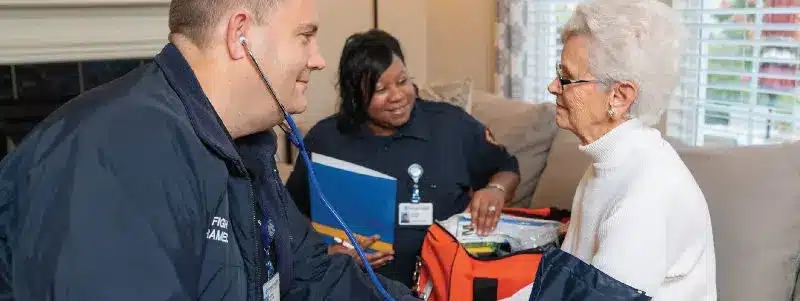
- Community paramedicine uses paramedics and EMTs to deliver care beyond emergency response, often in patients’ homes.
- The goals are better access to primary care and fewer avoidable 911 calls and emergency room visits.
- Community paramedicine and mobile integrated healthcare (MIH) are often used interchangeably; NAEMT treats community paramedicine as the EMS-led services within the wider MIH model.
- A community paramedicine program needs partners, a clear patient group, and records that connect home visits to the rest of the patient’s EMS history.
Many 911 calls are not true emergencies. Some come again and again from the same small group of residents with chronic conditions, unmanaged medications or no regular doctor. Each call ties up an ambulance and often ends in an emergency room visit that did not need to happen.
Community paramedicine is one way fire and EMS agencies respond. This guide explains what community paramedicine is, what community paramedics do, how it relates to MIH, and how departments get a program started.
What Is Community Paramedicine?
Community paramedicine is a model of care in which paramedics and EMTs provide health services beyond traditional emergency response. The Rural Health Information Hub describes its goals as increasing access to primary care and reducing avoidable use of emergency care.
Instead of waiting for a 911 call, a community paramedic schedules a visit. They check on a patient after a hospital stay, review medications, or help someone manage a chronic condition at home.
How Is Community Paramedicine Different From MIH?
The terms overlap, and many agencies use them interchangeably. The National Association of Emergency Medical Technicians (NAEMT) draws a useful line:
- Mobile integrated healthcare (MIH) is patient-centered care delivered outside the hospital by a wide range of healthcare providers working with EMS.
- Community paramedicine is one or more of those services delivered by EMS agencies and their practitioners, working with other parts of the healthcare system.
In short, MIH is the broader model and community paramedicine is the EMS-led part of it. That is why many programs use both names together. For a deeper look at MIH, read How Mobile Integrated Health Supports Community Medical Care.
How Is It Different From a 911 Response?
A 911 response is unscheduled, urgent and usually ends with transport. A community paramedicine visit is planned, follows up on a known patient, and aims to keep that patient out of the ambulance and the emergency room.
What Do Community Paramedics Do?
Community paramedics fill gaps between the emergency room, the doctor’s office and the patient’s home. The Rural Health Information Hub lists services programs commonly offer:
- Post-discharge visits for patients with chronic conditions, to support recovery and avoid readmission.
- Case management for frequent 911 callers, connecting them to primary care, behavioral health, housing and social services.
- Medication reconciliation, checking that what the patient takes matches what was prescribed.
- Chronic disease management, such as checks for heart failure, diabetes or COPD patients.
- Home safety checks, including fall risks.
- Vaccinations and wound care.
- In-home hospice support, to reduce unneeded 911 calls and hospital stays.
- Alternate destinations, such as taking a patient to a mental health crisis center or sobering center instead of an emergency room.
Who Do Community Paramedicine Programs Serve?
Most programs start with a defined group. Common examples are frequent 911 callers, patients recently discharged from the hospital, older adults at risk of falls, and residents far from a primary care provider. Fire departments bring an extra advantage here: crews already know the neighborhoods and often see home hazards that a clinic visit would miss.
Fireworks Mobile Integrated Health
Document Every Home Visit Alongside the ePCR
Client records, scheduled visits, assessments, vitals and medications in one connected record.
How Do You Start a Community Paramedicine Program?
Start small, with one patient group and one partner, and build from there.
- Check your state’s rules. States define community paramedicine differently, and some name it in law while others do not. The National Conference of State Legislatures tracks state definitions.
- Pick a patient group. Use your own call data to find frequent callers, repeat addresses or common call types.
- Find a healthcare partner. Hospitals, primary care clinics, home health agencies and health plans can refer patients and help fund the work. See how to build a home health and EMS partnership.
- Train your team. Community paramedics need skills beyond emergency care, such as chronic disease and care coordination.
- Set up documentation before the first visit. Decide how you will record visits, schedule follow-ups and report results.
How Are Community Paramedicine Programs Funded?
Funding is one of the hardest parts. Programs often combine hospital or health plan partnerships, grants and, in some states, reimbursement for care given without transport. The federal ET3 model, which paid for treatment in place and alternate destinations for Medicare patients, ended early on December 31, 2023, because of lower than expected participation. Check current options with your state EMS office before building a budget.
How Do You Measure Success?
Partners and funders will ask what the program changed. Track the measures you set at the start, such as 911 calls from enrolled patients, emergency room visits and hospital readmissions, before and after enrollment.
That is easier when home visits live in the same system as your 911 calls. Fireworks Mobile Integrated Health is connected to the ePCR, so client records, scheduled visits, assessments, vitals and medications sit alongside the patient’s EMS history. Program dashboards give leadership a view of activity across clients and visits.
Show Your Program’s Impact
Turn Home Visits Into Numbers Your Partners Trust
Program dashboards show activity and patterns across clients and visits, ready for leadership and funders.
Frequently Asked Questions About Community Paramedicine
What is community paramedicine?
Community paramedicine is a model in which paramedics and EMTs provide planned, non-emergency care, often in patients’ homes, to improve access to primary care and reduce avoidable 911 calls and emergency room visits.
What is the difference between community paramedicine and MIH?
Mobile integrated healthcare is the broader model of out-of-hospital care by many types of providers. Community paramedicine is the part delivered by EMS agencies and practitioners. Many agencies use the terms interchangeably.
What does a community paramedic do?
Common services include post-discharge visits, medication reconciliation, chronic disease checks, home safety and fall-risk checks, wound care, vaccinations and connecting frequent 911 callers to other services.
Do fire departments run community paramedicine programs?
Yes. Fire and EMS agencies run many MIH and community paramedicine programs, often with a hospital, clinic or home health partner.
What software does a community paramedicine program need?
At minimum, client records, visit scheduling and assignment, visit documentation and program reporting. Connecting those records to the ePCR keeps home visits and 911 calls in one patient history.
Take the Next Step Beyond the Call
See how Fireworks Mobile Integrated Health keeps community paramedicine visits connected to your ePCR and the rest of your Fire and EMS records.
Reach Beyond the Call
Run Your Community Paramedicine Program in Fireworks
Free personalized demo, no obligation, questions answered by a product expert.