- Tags, passports and accountability boards tell Command who is on scene and where each crew is assigned.
- The incident commander owns accountability but can hand the system to an accountability officer.
- Call a PAR on a set interval and whenever conditions change, and log every one on the ICS 214.
- A digital PAR puts the roll call, the Mayday and the record on every device at once.
Every working fire comes back to one question: is everyone accounted for? In the fire service, accountability boards, name tags and passports have answered it for decades. They still work, but the answer lives on one board, in one place, read by one person.
This guide walks through the whole accountability system. It covers tags and passports, the boards, who runs them, the PAR and the Mayday. Then it looks at what changes when the PAR moves onto every device on scene.
How Do Accountability Boards Work in the Fire Service?
FIRESCOPE's ICS 910, Firefighter Incident Safety and Accountability Guidelines (July 2025), sets the baseline. It says an accountability system "shall be adopted and routinely used" to track resources in hazardous areas. Departments build that system in different ways, but most start with tags and a board.
Tags, Passports and the Riding List
Take one Florida example. Escambia County Fire-Rescue's accountability SOG gives each member a plastic ID card with a name, photo and bar code. At the start of each shift, members place the card on the apparatus accountability board.
In its place, the member wears a passport on the helmet shield. It shows rank and company, and proves the ID card is on the board. The board is labeled by seat position and rides in the cab.
From the Apparatus to the Command Post
On a small incident, each company keeps its own board. As an incident grows, the same SOG has the IC decide whether boards come to the command post. Crews in staging keep theirs until they get a task.
That is the strength of a board: it is simple and it never loses power. It is also the limit. Only the person holding the board sees the full picture.
Who Owns Accountability on the Fireground?
ICS 910 is direct: "The IC shall be responsible for the overall accountability of the incident." It also lists five levels, from personal accountability up to scene and functional accountability. Every member has a part in the system.
Command, Supervisors and Crews
Crews stay under supervision and avoid freelancing. Supervisors track the status, location and function of their crews and report up the chain. Command tracks every resource with its assignment and identifier.
The Accountability Officer and the Safety Officer
ICS 910 lets the IC "delegate the resource accountability system to an appropriate staff member." Many departments call that person the accountability officer. Escambia's SOG requires one on multiple-alarm incidents, reporting to Command and starting PARs at benchmarks.
The incident safety officer checks that the system is working. The Pennsylvania State Fire Academy's Incident Safety Officer I skill stations include the task "Verifies an accountability system is followed." Your SOG decides who holds each job on your scene.
ICS 910 also gives a simple checklist for what accountability must answer about every resource.
| Question | What Command needs to know |
|---|---|
| Who | The member or unit, by name, assignment and agency |
| What | The task or assignment |
| When | Arrival, last check-in (the PAR), reassignment or release |
| Where | Division, group, staging or command post |
| Why | The reason the resource was requested |
| How | How accountability is documented and reported |
When Should Command Call a PAR?
A PAR is a roll call. Each supervisor or company officer confirms, by head count, that every assigned member is present. ICS 910 calls for an accounting "when conditions change, or assignments are complete."
Most departments pair a timed PAR with event-driven ones. Your SOG sets the interval. These triggers are common across departments.
| Trigger | Why it matters |
|---|---|
| Your set interval | Keeps accountability current on long incidents |
| Offensive to defensive | Confirms every crew is out before the strategy changes |
| Collapse, flashover or other sudden change | Finds anyone caught by the change |
| Missing or trapped member reported | Narrows the search to who and where |
| Crews enter or leave a hazard area | Keeps the count matched to who is inside |
| After a Mayday or emergency traffic | Rebuilds the picture once the radio clears |
| Fire under control | Confirms the count before overhaul and release |
Write every PAR down. ICS 910 says supervisor checks "shall be documented on a Unit/Activity Log (ICS Form 214) or similar tool." FEMA publishes the ICS 214 form in that layout.
NIOSH fatality investigations return to this point. In report F2004-10, NIOSH recommends that departments "ensure personnel accountability reports (PAR) are conducted in an efficient, organized manner." Results go directly to the IC.
What Happens to Accountability During a Mayday?
ICS 910 defines Mayday as a member "in a life-threatening situation and in need of immediate assistance." Any member can declare it. Citing NFPA 1550 (2024), which replaced NFPA 1561, ICS 910 has the IC broadcast it with distinctive alert tones.
A Mayday is an accountability event. Command needs to know at once who is missing, which unit and where. A fresh PAR is how Command confirms nobody else is in trouble.
When it ends, ICS 910 has the IC transmit "All clear, resume radio traffic" on all assigned channels. Then the board has to catch up with what just happened.
What Does a Digital PAR Change for Firefighter Accountability?
A digital board does not replace your SOG, your tags or your radio. It changes who can see the answer, and how fast it reaches the record. Fireworks Incident Command is built around that idea.
The Board Starts With the Incident
Incident Command opens from the incident list or the incident's menu, with no second login. Units dispatched in CAD appear on their own. Command can add units CAD missed, including mutual aid units.
Command assigns each unit to a division or group. That matters, because a PAR covers assigned units only. A unit left unassigned is a unit the roll call won't reach.
The PAR Clock Keeps Time
The board counts down to the next PAR and reads PAR OVERDUE when it is late. The incident-type template sets the interval, with 20 minutes as the default. Only a PAR that ends All Clear restarts the clock.
Every Unit Answers on One Screen
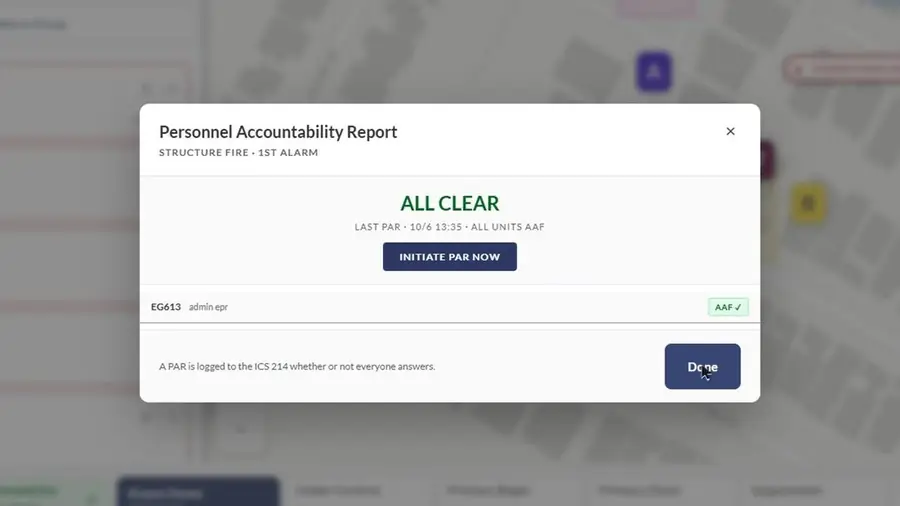
Command starts a PAR with one tap and marks each unit as it reports. A unit that hasn't answered can be re-pinged. If your department allows it, crews answer from their own device and can name anyone missing.
The status reads ALL CLEAR or ACCOUNTING ISSUES. Every PAR is logged to the ICS 214, whether or not everyone answers.
A Mayday Reaches Every Device
Anyone who can edit the board can declare a Mayday. The alarm reaches every device, and a PAR starts for every assigned unit. The unit and its division turn red on the board and the map, with a running clock.
Only Command resolves a Mayday. A crew reporting OK does not clear it. The resolution and how long the Mayday lasted go to the ICS 214 and the after-action report.
The Record Is Already Written
Before command is completed, the board flags any open Mayday, missing members or running PAR. Command can override, and the override is logged. Complete Command then writes benchmark times, completed tactical actions and rehab entries into the incident report.
It never overwrites what the records officer already entered. Mutual aid crews can join with a time-limited guest code, and the board keeps working offline. Learn more on the Incident Command solution page.
What a Digital Board Does Not Do
A firefighter accountability app tracks assignments and answers, not people inside a building. Incident Command has no in-building firefighter tracking and no SCBA monitoring. Keep your tags, your radio PAR and your SOG.
Frequently Asked Questions About Fire Department Accountability Boards
Do we still need tags and passports with a digital board?
Yes. Tags and passports tell you who rode in. The digital board tracks assignments and PAR answers on top of them.
How often should Command call a PAR?
At the interval your SOG sets, and whenever conditions change or assignments are complete.
Who runs accountability on a large incident?
The IC owns it. ICS 910 lets the IC delegate the system to a staff member, often called the accountability officer.
Do mutual aid crews show up on the board?
Yes. CAD units appear on their own, and Command can add mutual aid units. Guest agencies can join with a time-limited code.
Take the Next Step Toward a Digital PAR
Accountability works when everyone sees the same picture and the record keeps up. See how Fireworks Incident Command handles a live PAR and Mayday, or schedule a call with our team.
- FIRESCOPE ICS 910, Firefighter Incident Safety and Accountability Guidelines (July 2025)
- NIOSH FACE F2004-10, Career Fire Fighter Dies Searching For Fire In A Restaurant/Lounge – Missouri
- Escambia County Fire-Rescue SOG 3500.030, Accountability
- Pennsylvania State Fire Academy, Incident Safety Officer I Skill Stations (December 2025)