NERIS Updates
NERIS Updates, Timeline & Cheat Sheets
Every NERIS change in one place, from the switch off NFIRS to NERIS 1.5 and Incident Analysis. Updated whenever FSRI releases something new.
Last updated November 18, 2026NERIS Updates by Date
The Latest NERIS Updates
Newest first. FSRI calls NERIS 1.5 "the start of regular updates," so we add every new release here, with what changed and what it means for your reports.
Latest update
NERIS 1.5.1 through 1.5.3
Since NERIS 1.5 took effect on October 1, FSRI has released three smaller updates. They improve how NERIS works, not what you report.
- 1.5.1 (Oct 19): Clearer incident entry screens in the NERIS portal, more Incident Analysis detail for Outside Fire reports, and security updates.
- 1.5.2 (Oct 28): Stronger checks while entering incidents, a revised incident type picker, more location detail for Incident Analysis integrations, and security updates.
- 1.5.3 (Nov 16): A simpler first step when creating an incident, department maps that show mutual aid partners (neighboring departments that respond to each other's calls) and their coverage areas, and reliability fixes.
No changes in how you report. The 1.5 fields and answer choices are unchanged.
Resources: Full NERIS timeline·NERIS FAQs
Major update
NERIS 1.5 Took Effect
NERIS 1.5 adds new incident types, actions, location types, and fire details that departments asked for after launch. Every change is additive: new fields and new answer choices, with nothing removed and no change to how reports are structured.
Your existing reports stay valid, and the new options make your data more precise.
Resources: NERIS 1.5 Guide·Where It Is in Fireworks (customer PDF)·1.5 cheat sheets·What changed in 1.5
New module
Incident Analysis Goes Live
Incident Analysis is the first NERIS add-on report, built on top of the core incident record. It captures the investigative detail behind a call: origin, cause, loss, and the products, batteries, and vehicles involved.
NERIS 1.5 added new answer choices. Incident Analysis added a whole new layer of data.
Resources: All nine modules·NERIS Maturity Curve·NERIS 1.5 Guide
Free Download
Get the Full NERIS 1.5 Guide
Every 1.5 change, the full timeline, Incident Analysis, and the cheat sheets in one printable PDF for your crews.
Download the Guide Fire Service GuideNERIS 1.5 Is Here: What Changed and What to Do Now
NERIS Timeline
NERIS Timeline: From Launch to Version 1.5
NERIS replaced NFIRS nationwide on January 1, 2026, and FSRI now updates the standard on a regular cycle.
- Nov 4, 2024NERIS Version 1 launchesUSFA announces the launch of NERIS Version 1.
- 2024 to 2025Phased department onboardingFSRI rolls out onboarding in phases by FEMA region, with vendor-led CAD and RMS integrations.
- Jan 1, 2026NERIS replaces NFIRS nationwideNFIRS stops accepting new incident data. All reporting moves to NERIS.
- Feb 2026NFIRS shuts downNFIRS becomes unavailable to all users. Still making the switch?
- Jun 8, 2026Incident Analysis module goes liveThe first NERIS add-on report, for incidents that need investigative detail. See the details.
- Jul to Sep 2026Version 1.4 maintenance releasesReleases 1.4.77 through 1.4.78.4.
- Oct 1, 2026NERIS 1.5.0 takes effectNew incident types, actions, location types, and fire details. See what changed.
- Oct 19, 2026NERIS 1.5.1Clearer incident entry screens, more Incident Analysis detail for Outside Fire reports, and security updates. No changes in how you report.
- Oct 28, 2026NERIS 1.5.2Stronger checks during incident entry, a revised incident type picker, and security updates. No changes in how you report.
- Nov 16, 2026Latest update: NERIS 1.5.3A simpler first step when creating an incident, mutual aid departments on department maps, and reliability fixes. No changes in how you report. See what changed in 1.5.
- Coming nextMore Incident Analysis modulesFSRI says Community Risk Reduction and Health and Safety modules will follow. It has not published a date.
FSRI calls NERIS 1.5 "the start of regular updates." It has not published a date for the next schema version. We update this NERIS timeline as new releases are announced.
NERIS Changes
What Changed in NERIS 1.5
FSRI built version 1.5 from helpdesk tickets, national engagement sessions, and department feedback since launch. Here are the NERIS changes by area.
| Area | What was added or changed | Why it matters |
|---|---|---|
| Incident types | Agricultural vehicle fire; micromobility vehicle collision (e-bikes, scooters, hoverboards); human-powered vehicle collision (bicycles, skateboards, wheelchairs) | Counts these calls separately instead of lumping them into generic types |
| Incident types | Water rescue split into ice rescue, flood, and person in tidal or surf water | Each uses different tactics |
| Incident types | Obstruction or debris removal; private-side water leak or flooding; aviation emergency (Alert 2 standby) | Common calls that had no code of their own |
| Incident base | Yes/no: person experiencing homelessness | Applies to any call type or location |
| Actions | Non-patient EMS support; vehicle, structure, and earth/trench stabilization; vehicle electrical disconnection | Non-patient EMS support was the most requested addition |
| Actions | Rapid intervention team (RIT) established, with a timestamp; ground and aerial ladder use; control utilities; establish landing zone | Work that was buried in narratives becomes countable |
| Fire detail | Aerial master stream; plug-in solar panels as a power hazard; burn ban (local ordinance) flag on outside fires | New suppression option, an emerging hazard, and enforcement data |
| Fire detail | Damage values "Affected" and "Inaccessible"; "Arson fire investigator" renamed "Fire and explosion investigator" | Clearer damage and investigation records |
| Locations | Data center, mega warehouse (200,000+ sq ft), automated storage and retrieval, commercial greenhouse, pool or aquatic facility, fitness center, tidal water | Operationally different from generic categories |
| Locations | Modifiers: short-term rental, hoarding, excessive fuel load | Adds context without changing the occupancy code |
| Modifiers | Civil unrest added; World Cup 2026 retired | Tournament has ended |
| Stations, units | In-service yes/no | Keeps a station or unit's NERIS ID during long outages |
| Analysis | Fuel group for outside fires | Completed during analysis, not by crews on scene |
| Corrections | Spelling fixes to three existing codes: detached single-family dwelling, detached garage, and electrical power line down or arcing | Cleaner values for reports and integrations |
See the 1.5 Updates Live
Book a Demo with Fireworks
See every NERIS 1.5 field in one incident report, built by Fire and EMS personnel.
Book a Demo with FireworksNERIS Cheat Sheets
NERIS 1.5 Cheat Sheets
Quick-reference lists of the new NERIS 1.5 values, grouped the way report writers use them.
NERIS 1.5: Where It Is in Fireworks
Already using Fireworks? Here's exactly where each NERIS 1.5 field lives and what makes it appear, like setting Primary Nature of the Fire to Outside Fire to open the burn ban question. One printable page for your report writers.
New Incident Types
- Agricultural vehicle fire
- Micromobility vehicle collision
- Human-powered vehicle collision
- Ice rescue
- Person in water: flood
- Person in water: tidal or surf
- Obstruction or debris
- Private-side water leak or flood
- Aviation emergency (Alert 2)
New Actions & Tactics
- Non-patient EMS support
- Rapid intervention established (with timestamp)
- Vehicle stabilization
- Structure stabilization
- Earth or trench stabilization
- Vehicle electrical disconnection
- Ground ladder use
- Aerial ladder use
- Control utilities
- Establish landing zone
New Location Types & Modifiers
- Data center
- Mega warehouse (200,000+ sq ft)
- Automated storage and retrieval
- Commercial greenhouse
- Pool or aquatic facility
- Fitness center or gym
- Tidal water (outdoor)
- Modifiers: short-term rental, hoarding, excessive fuel load
- Flag: person experiencing homelessness
Fire Detail, Renamed & Retired Values
- New: aerial master stream
- New: plug-in solar panels (power hazard)
- New: burn ban flag on outside fires
- New: damage values "Affected" and "Inaccessible"
- New: civil unrest modifier
- Renamed: "Arson fire investigator" to "Fire and explosion investigator"
- Retired: World Cup 2026 modifier
The Biggest NERIS Update of 2026
The NERIS Incident Analysis Module
On June 8, 2026, NERIS launched Incident Analysis, the first add-on report built on top of the core incident record. It captures the investigative detail behind a call: origin, cause, loss, and the products, batteries, and vehicles involved.
NERIS 1.5 added new answer choices. Incident Analysis added a whole new layer of data.
Core incident report
What crews did on scene: incident type, location, actions, response times, and outcomes. Closed by the responding crew.
Incident Analysis
Why it happened and what it cost: cause, loss, products, batteries, and human factors. In NERIS, an investigator, fire marshal, or analyst can complete it on their own timeline.
Nine modules, opened only when a call needs them
Routine calls don't need Incident Analysis. When one does, a single incident can open several modules.
Structure Fire
Origin, cause, and damage for fires in a structure.
Structure Detail
Each structure and property affected, with structure and contents value and loss.
Outdoor Fire
How an outdoor fire spread, including the new 1.5 fuel group.
Batteries
Battery chemistry, charging status, thermal runaway, and suppression effort.
Consumer Products
Each consumer product involved in the incident.
Vehicles
Vehicle details such as make and model.
Human Factors
Human factors that contributed to the incident.
Hazardous Situation
Hazardous materials and situations involved.
Narrative
An analysis narrative to go with the investigative record.
Why Incident Analysis matters
- Cause and loss data that compares locally, statewide, and nationally in one structure.
- National battery incident data, aggregated for the first time.
- Evidence to inform building codes, product safety research, recalls, and prevention.
- Faster operational reports, because investigative work runs on its own track.
NERIS 1.5 then synced Incident Analysis with the new location modifiers, location types, "Affected" and "Inaccessible" damage values, and burn ban flag, and added fuel group for outside fires. FSRI says Community Risk Reduction and Health and Safety modules will follow. It has not published a date.
How Incident Analysis works in Fireworks
No separate record, role, or approval. The analysis fields are built right into the incident report your crews already complete.
Answer the Incident Flags
Say Yes to the flags that apply to the call.
The right tabs open
Properties, Products, Fire analysis, or Emerging Hazards appear as needed.
Validate Incident
Analysis fields are checked with the rest of the report.
Approve once
The incident and its analysis go to NERIS together.
See Incident Analysis Live
Book a Demo with Fireworks
Watch one incident report capture the call, the cause, and the loss, and send it all to NERIS together.
Book a Demo with FireworksThe NERIS Maturity Curve
Incident Analysis Moves You Up the Curve
Most departments start at Stage 1, reporting to satisfy a requirement. Cause, loss, and product data from Incident Analysis is what powers the later stages: analytics, dashboards, and predictive insight.
Find your department's stage, and the one move that gets you to the next.
See the NERIS Maturity Curve
NFIRS to NERIS
Still Moving from NFIRS to NERIS?
NFIRS is no longer available, so every department now reports in NERIS. If your department hasn't finished the switch, here is where things stand and what to do next.
- Get onboarded to NERIS. FSRI manages NERIS onboarding. Start with the NERIS onboarding page.
- Choose reporting software that supports NERIS. Your RMS submits incidents to NERIS for you, including new versions like 1.5.
- Keep your historical NFIRS records. USFA advises keeping your NFIRS data in an RMS or other storage that meets your state or local retention policy.
- Learn the new codes. NERIS incident types replace NFIRS codes. Our NERIS incident types guide has the full code list and an NFIRS to NERIS crosswalk.
- Ask your state for help. USFA can no longer provide local or state NFIRS data, so contact your state NFIRS program manager with questions.
New Standard. Your Data Stays Yours.
You don't lose your history when you move to Fireworks
Standard migrations keep only the data NERIS requires. Fireworks migrates your complete historical incident data, so your reporting record stays intact, backed by implementation and support from people who have worked the call.
See NERIS Reporting in Fireworks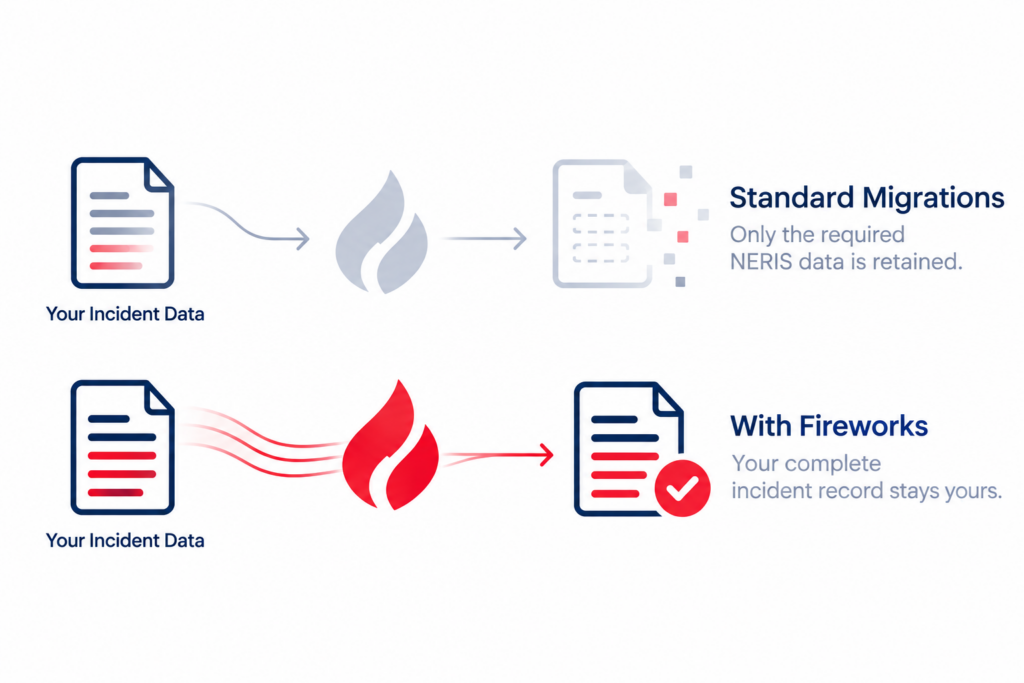
NERIS FAQs
Common Questions About NERIS Updates
What is NERIS?
NERIS, the National Emergency Response Information System, is the national system fire departments use to report incidents. The U.S. Fire Administration leads it, and the Fire Safety Research Institute (FSRI) develops and maintains the data standard.
When did NERIS replace NFIRS?
NERIS fully launched across the United States and territories in January 2026, replacing the legacy NFIRS system.
Can my department still report to NFIRS?
No. NFIRS stopped accepting new incident data on January 1, 2026, and became unavailable to all users in February 2026. All incidents are now reported in NERIS.
What changed in NERIS 1.5?
NERIS 1.5 took effect October 1, 2026. It added new incident types, actions and tactics, location types and modifiers, and fire detail values. Nothing was removed.
Are the NERIS 1.5 fields required?
No. FSRI states the 1.5 changes are additive and no new field is required, so existing reports stay valid.
What is the next NERIS update?
The latest release is NERIS 1.5.3 (Nov 16, 2026), which improved incident entry, department maps and security with no new reporting fields. FSRI says Community Risk Reduction and Health and Safety Incident Analysis modules will follow, but it has not published a date for them or for the next schema version. We update this page when new releases are announced.
See the 1.5 Updates Live
Book a Demo with Fireworks
NERIS 1.5, Incident Analysis, and your full history in one incident report, with support from people who have worked the call.
More NERIS resources: NERIS Software & Incident Reporting · NERIS Data Maturity Curve · NERIS On-Demand Webinar
Sources: