Key Takeaways
Mastering NERIS incident types is essential for accurate fire department reporting, successful grant applications, and meaningful data analysis that drives operational improvements.
- NERIS incident types use a modernized classification hierarchy that expands beyond traditional NFIRS codes to capture all-hazards emergency response documentation
- Accurate incident type selection directly impacts ISO ratings, grant eligibility through programs like AFG and SAFER, and community risk assessment accuracy
- The system distinguishes between primary incident types, secondary classifications, and situational modifiers that provide granular detail for trend analysis
- Departments leveraging fire department software with built-in NERIS compatibility can automate incident type selection through intelligent prompts
Fire chiefs who train personnel on proper NERIS incident types classification position their departments for compliance success and data-driven decision making.
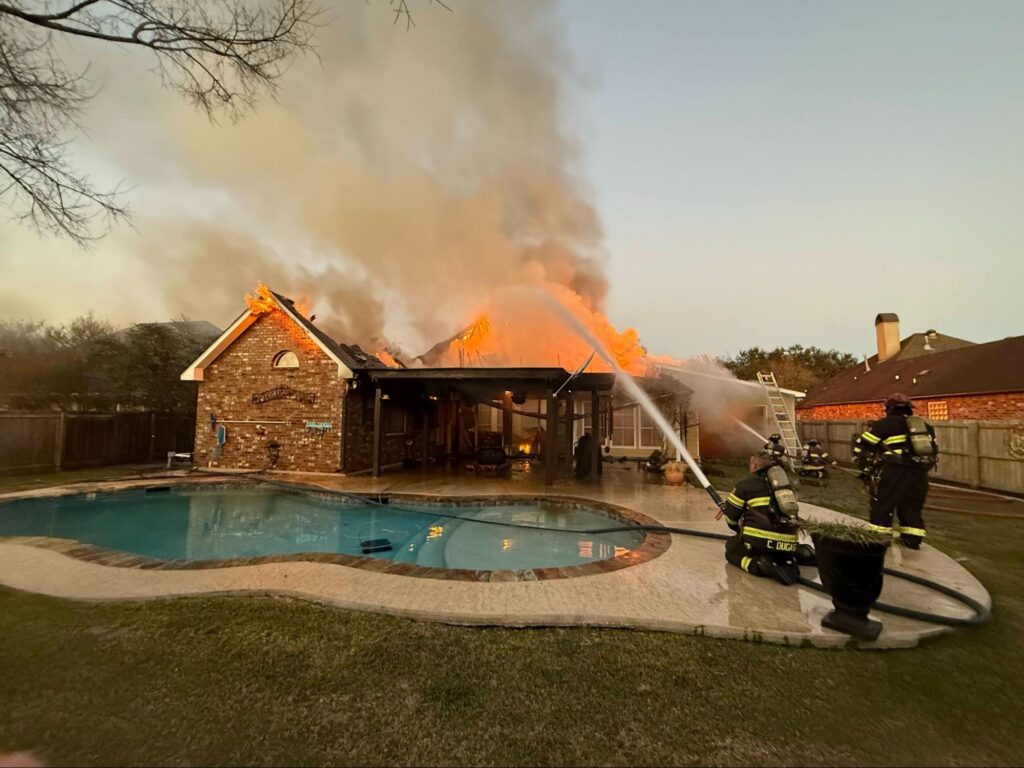
Every emergency response generates documentation, and at the heart of that documentation sits a critical choice: which incident type code best represents what actually happened. The transition to the National Emergency Response Information System brought significant changes to how fire departments categorize and report their emergency responses. Understanding NERIS incident types helps ensure accurate records, successful grant applications, and meaningful analytics that inform everything from staffing decisions to apparatus placement.
According to the U.S. Fire Administration, proper incident classification serves as the foundation for national-level fire data analysis and resource allocation decisions. When departments select incorrect codes, the ripple effects extend far beyond local records into state and federal datasets that influence policy and funding.
How Do NERIS Incident Types Differ from Legacy NFIRS Codes?
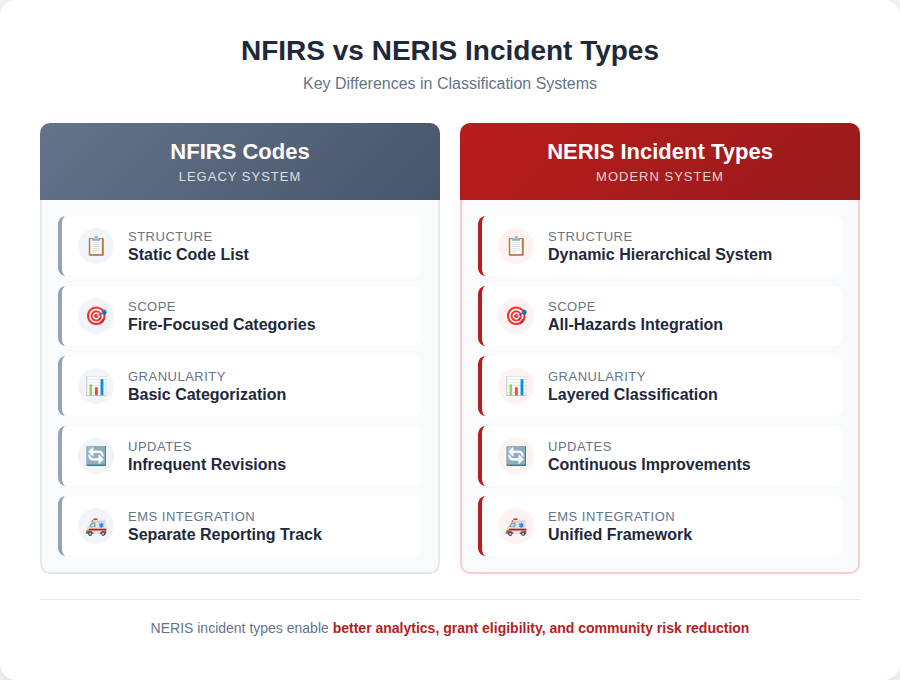
The classification structure within NERIS incident types represents a fundamental evolution from the previous NFIRS coding system. While NFIRS used a relatively static code list developed decades ago, NERIS implements a dynamic hierarchy designed for modern all-hazards emergency response documentation.
NFIRS grouped incidents into basic categories with limited granularity. A structure fire was a structure fire, with minimal differentiation for building type, occupancy, or specific fire behavior patterns. The new system provides layered classification that captures context essential for meaningful analysis.
Hierarchical Classification Structure
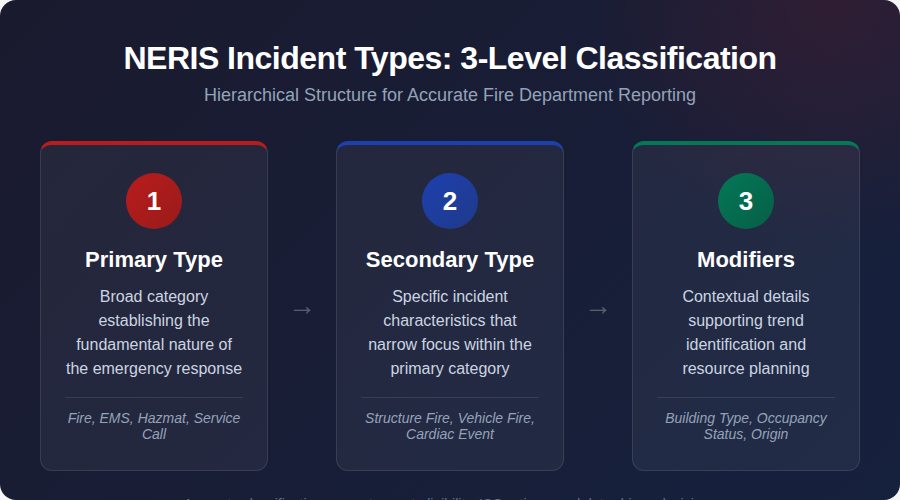
NERIS incident types operate on three levels. The primary classification establishes the broad category such as fire, EMS, hazardous condition, or service call. Secondary classifications narrow the focus to specific incident characteristics. Situational modifiers add contextual detail that supports trend identification and resource planning.
This hierarchy allows for both standardized reporting at the national level and granular analysis at the department level. A residential structure fire now carries additional classification data about building construction, occupancy status, fire origin, and spread patterns. This detail supports community risk reduction planning and modern RMS capabilities that rely on accurate incident characterization.
All-Hazards Integration
Previous reporting systems maintained separate frameworks for fire incidents and EMS responses. NERIS incident types unify these categories under a single classification structure. Departments running combined fire and EMS operations can now generate integrated reports showing response patterns across all emergency types.
| Aspect | NFIRS Codes | NERIS Incident Types |
| Structure | Static code list | Dynamic hierarchical system |
| Scope | Fire-focused categories | All-hazards integration |
| Granularity | Basic categorization | Layered classification with modifiers |
| Updates | Infrequent revisions | Continuous system improvements |
| EMS Integration | Separate reporting track | Unified classification framework |
| Analytics | Limited cross-referencing | Built-in trend analysis support |
What Are the Primary NERIS Incident Types Categories?
The NERIS incident types framework organizes emergency responses into major groupings that reflect the full spectrum of fire department activities. Understanding these categories helps personnel select appropriate codes during incident documentation.
Fire incidents encompass structure fires, vehicle fires, outdoor fires, and other combustion events. The classification captures fire type, building occupancy, fire behavior, and suppression methods employed. Accurate fire incident typing supports ISO grading evaluations and NERIS fire reporting requirements that influence insurance classifications across your jurisdiction.
Emergency Medical Services Types
EMS incident types within NERIS capture the full range of medical emergencies fire departments respond to. Classifications distinguish between traumatic injuries, medical conditions, cardiac events, and other health emergencies. The system integrates with ePCR documentation to maintain consistency between dispatch records and patient care reports.
NERIS incident reporting for medical calls includes response disposition codes that track patient outcomes and transport decisions. This data supports EMS system performance analysis and protocol effectiveness reviews that drive continuous improvement in patient care.
Hazardous Conditions and Technical Rescue
Hazmat incidents receive detailed classification within NERIS incident types. Categories differentiate between chemical spills, gas leaks, radiological events, and biological hazards. The granularity supports regulatory compliance reporting and resource allocation planning for specialized response capabilities.
Technical rescue incidents include categories for water rescue, confined space operations, structural collapse, and high-angle situations. Proper classification of these complex incidents ensures accurate documentation that supports personnel credentialing, equipment inventory decisions, and mutual aid coordination.
Service Calls and Good Intent Responses
The system includes classifications for non-emergency service calls that fire departments routinely handle. Public assist requests, lockouts, water problems, and similar calls receive appropriate incident type codes that distinguish them from emergency responses in workload analysis.
Good intent calls and false alarms also receive specific classification. Tracking these incident types helps departments identify patterns in automatic alarm activations, prank calls, or system malfunctions that may require community education or code enforcement intervention.
How Does Accurate NERIS Incident Reporting Affect Grant Eligibility?
Federal grant programs including Assistance to Firefighters grants and SAFER funding rely on incident data submitted through NERIS. Applications undergo review processes that examine department activity levels, response patterns, and community risk factors documented through incident reports.
Inaccurate NERIS incident types selection can undermine grant applications in several ways. Undercounting certain incident categories may suggest lower activity levels than reality reflects. Miscategorized incidents may not trigger appropriate risk factors that strengthen applications. Incomplete reporting creates data gaps that reviewers interpret unfavorably.
The National Fire Protection Association emphasizes the connection between accurate incident documentation and effective fire service funding. Departments that invest in proper NERIS incident reporting build data profiles that support compelling grant narratives backed by verified statistics.
Data Quality and Validation
NERIS implements point-of-entry validation that helps prevent common incident type errors. The system prompts users when selected codes may conflict with other incident details or when required fields remain incomplete. This real-time feedback improves data quality compared to legacy systems that only flagged errors during batch uploads.
Departments should establish quality assurance protocols that include periodic review of incident type selection patterns. Identifying common errors or inconsistencies allows targeted training that improves documentation accuracy across all shifts.
What Training Requirements Support NERIS Incident Types Proficiency?
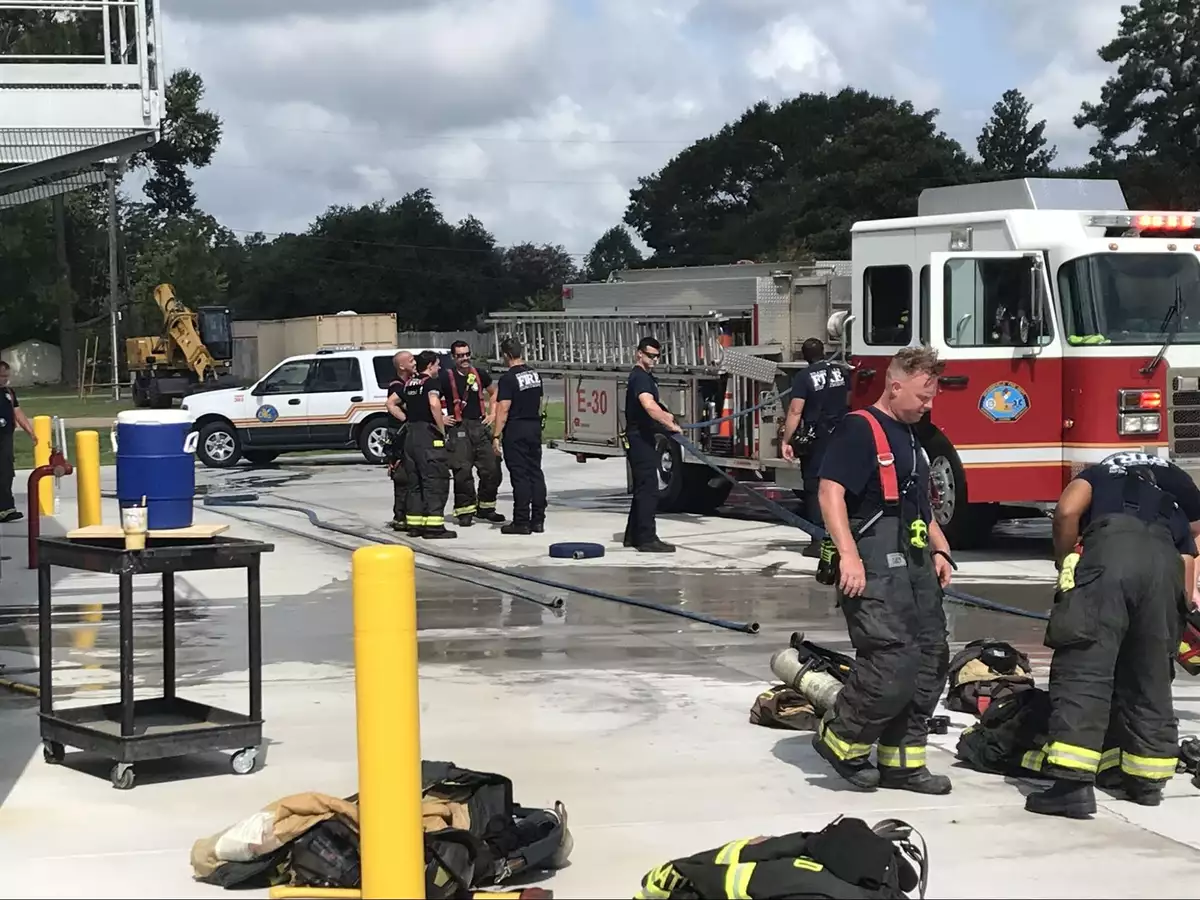
Personnel responsible for incident documentation need specific training on the NERIS classification structure. This goes beyond basic data entry instruction to include understanding of how incident type selection affects reporting accuracy and downstream data utilization.
Initial training should cover the hierarchical structure of NERIS incident types, helping users understand relationships between primary categories, secondary classifications, and situational modifiers. Scenario-based exercises that present complex incidents help build decision-making skills for ambiguous situations where multiple incident types might apply.
Essential Training Components
- Primary category recognition and selection criteria
- Secondary classification logic and modifier application
- Multi-incident scenarios requiring primary and secondary typing
- Common error patterns and correction procedures
- Quality assurance review processes
- Integration with CAD and RMS workflows
Ongoing education matters as much as initial training. The NERIS system continues evolving, with periodic updates to incident type codes and classification guidance. Departments should integrate NERIS incident reporting updates into regular training schedules using comprehensive training platforms that track completion and competency.
Officer-Level Responsibilities
Company officers and incident commanders bear ultimate responsibility for incident documentation accuracy. Their training should address supervisory review of incident reports, quality control checkpoints, and escalation procedures for unusual incidents that may require administrative input on appropriate classification.
According to Fire Engineering, successful NERIS implementation requires leadership engagement that extends beyond delegating data entry to administrative staff. Officers who understand incident classification can ensure accurate documentation occurs in the field where details remain fresh.
What Tools Help Departments Master NERIS Incident Types?
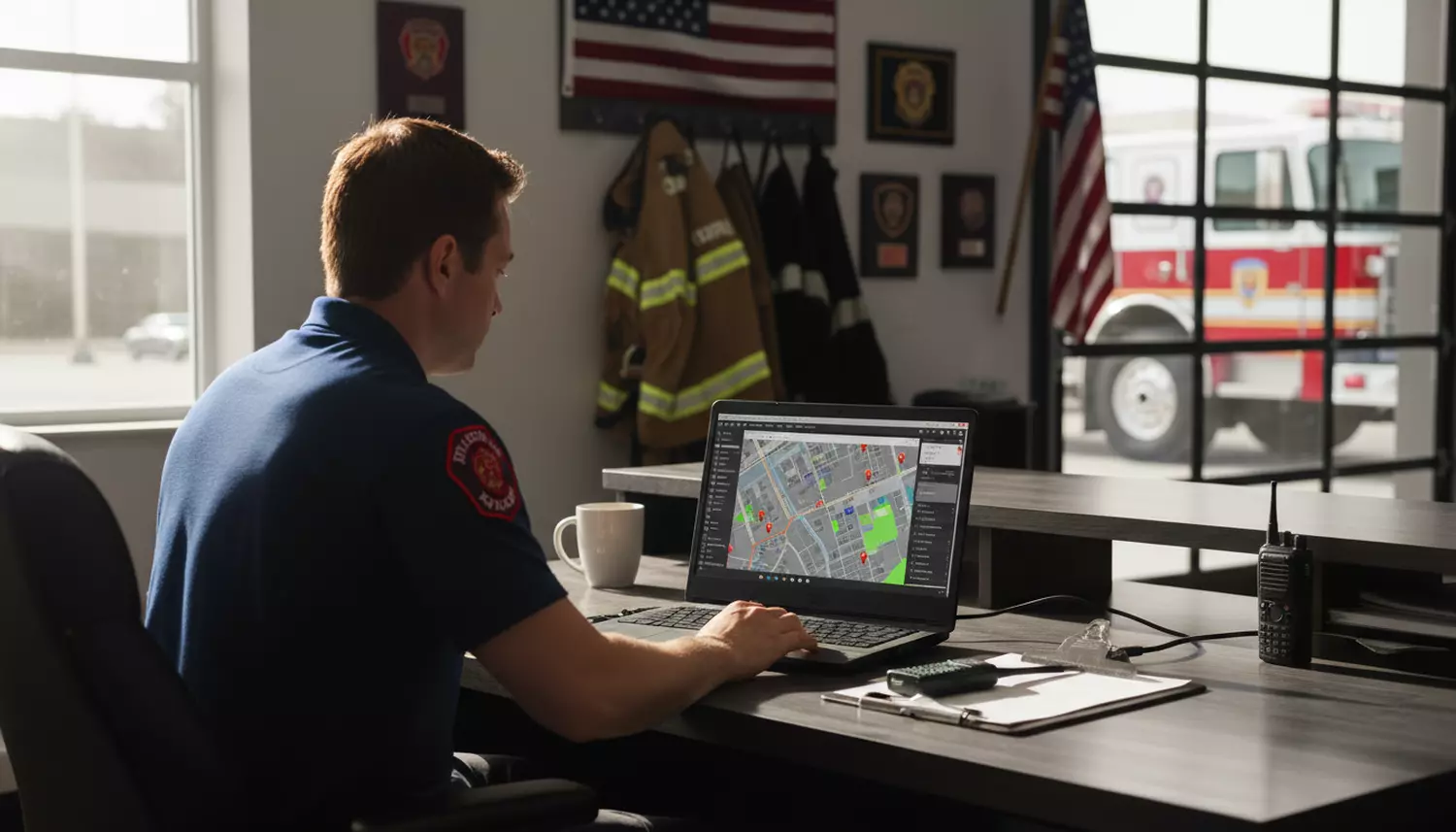
Modern RMS platforms include features designed to support accurate NERIS incident types selection. Intelligent lookup tools, context-sensitive prompts, and validation rules guide users toward appropriate classifications while flagging potential errors before record submission.
Integration between CAD systems and RMS platforms can pre-populate incident type suggestions based on dispatch information. While these suggestions require human verification, they reduce data entry time and ensure consistency between dispatch records and final incident reports.
Key Software Features for NERIS Compliance
| Feature | Benefit |
| Hierarchical code lookup | Navigates classification structure efficiently |
| Context-sensitive validation | Flags inconsistent selections in real-time |
| CAD integration | Pre-populates incident type suggestions |
| Batch error reporting | Identifies patterns requiring training intervention |
| Custom reporting templates | Supports quality assurance reviews |
| Version tracking | Maintains audit trail for corrections |
Departments evaluating RMS platforms should verify NERIS incident types compatibility as a core requirement. Systems designed around legacy NFIRS codes may require workarounds or manual processes that introduce error opportunities and increase administrative burden.
How Do NERIS Incident Types Support Community Risk Reduction?
Accurate incident classification creates the data foundation for effective community risk reduction planning. Geographic analysis of incident patterns, temporal trending of response types, and correlation between incidents and community characteristics all depend on consistent NERIS incident reporting.
Fire prevention priorities emerge from analysis of fire incident type patterns. Areas showing elevated residential fire activity may warrant targeted smoke detector programs. Commercial occupancies with repeated hazmat classifications might benefit from enhanced inspection schedules. The analytical possibilities expand when incident type data achieves high accuracy and consistency.
Strategic Planning Applications
Staffing models increasingly incorporate workload analysis based on incident type distributions. Understanding the mix of fire, EMS, and service calls helps department leaders make informed decisions about crew configurations, apparatus deployment, and specialty training investments.
Response time analysis becomes more meaningful when filtered by incident type. Priority levels appropriately vary between structure fire responses and non-emergency service calls. NERIS incident types enable nuanced performance measurement that reflects actual operational demands rather than averaging all responses together.
What Common Mistakes Should Departments Avoid?
Experience with early NERIS implementation reveals common errors that departments should work to prevent. Selecting overly general incident types when more specific options exist reduces data value for analysis. Defaulting to familiar categories without exploring the full classification structure perpetuates habits developed under NFIRS.
Multi-incident scenarios present particular challenges. When units respond to a motor vehicle accident with fire and extrication, which incident type takes precedence? NERIS provides guidance on primary and secondary incident typing that captures the full scope of response activities.
Error Prevention Strategies
Rushed documentation during shift changes often introduces incident type errors. Establishing protected time for report completion and review helps ensure accuracy. Officer sign-off requirements create accountability checkpoints that catch errors before record finalization.
Periodic audits comparing incident type selections against narrative descriptions can reveal training gaps or system confusion. When narratives describe one type of incident but codes reflect something different, investigation determines whether the issue represents data entry error or classification misunderstanding requiring additional training.
FAQ: NERIS Incident Types for Fire Departments
What happens if our department selects incorrect NERIS incident types?
Incorrect incident type selection affects data quality in state and federal databases, potentially impacting grant eligibility and accurate national fire statistics. Most errors can be corrected through system amendment processes, but prevention through proper training remains the preferred approach.
How often do NERIS incident types codes change or update?
The NERIS system undergoes periodic updates that may include new incident type codes, modified classification guidance, or retired categories. Departments should monitor USFA communications and ensure their RMS vendor provides timely system updates that reflect current standards.
Can departments create custom incident types for local tracking?
NERIS requires standardized incident type submission for federal reporting. However, many RMS platforms support supplemental local codes or tags that departments can use for internal tracking without affecting state and federal data submissions.
How do mutual aid incidents get classified?
The primary jurisdiction typically reports the incident using their NERIS incident reporting. Mutual aid departments may submit supplemental reports or exposure reports depending on their level of involvement and state reporting requirements.
Position Your Department for NERIS Incident Reporting Success
Mastering NERIS incident types requires commitment to training, quality assurance, and technology that supports accurate classification. The investment pays dividends through improved grant competitiveness, meaningful analytics, and compliance confidence that reduces administrative concerns. EPR Fireworks provides NERIS-compliant fire department software with intelligent incident typing features that guide users toward accurate classifications. Schedule a call to explore how integrated RMS solutions support your department’s NERIS incident reporting requirements.