Key Takeaways
Fire departments navigating the transition from NFIRS to NERIS face significant changes in how incident data gets captured, validated, and submitted.
- The National Emergency Response Information System replaces 50-year-old NFIRS infrastructure with cloud-native technology supporting real-time data exchange and modern integrations
- NERIS expands reporting scope beyond fire incidents to encompass all-hazards emergency response documentation including EMS, hazmat, and technical rescue
- Data validation happens at point of entry rather than after submission, improving accuracy and reducing compliance issues that delayed grant applications
- Departments using integrated fire department software platforms can automate much of the transition through built-in NERIS compatibility
Successful transitions require understanding both systems’ requirements and selecting RMS platforms that support seamless data migration.
The National Fire Incident Reporting System served American fire departments for five decades, creating a standardized approach to incident documentation that enabled national-level analysis of fire patterns, resource allocation, and safety trends. That foundational system has now reached end-of-life status, with the U.S. Fire Administration transitioning all reporting to the National Emergency Response Information System. Understanding NERIS vs NFIRS differences helps department leaders make informed decisions about software investments, training requirements, and compliance strategies.
For fire chiefs and administrative officers managing this transition, the comparison between these systems reveals more than technical specifications. It reflects fundamental shifts in how emergency services data supports strategic planning, grant applications, and community risk reduction efforts.
What Are the Key Differences Between NERIS vs NFIRS?
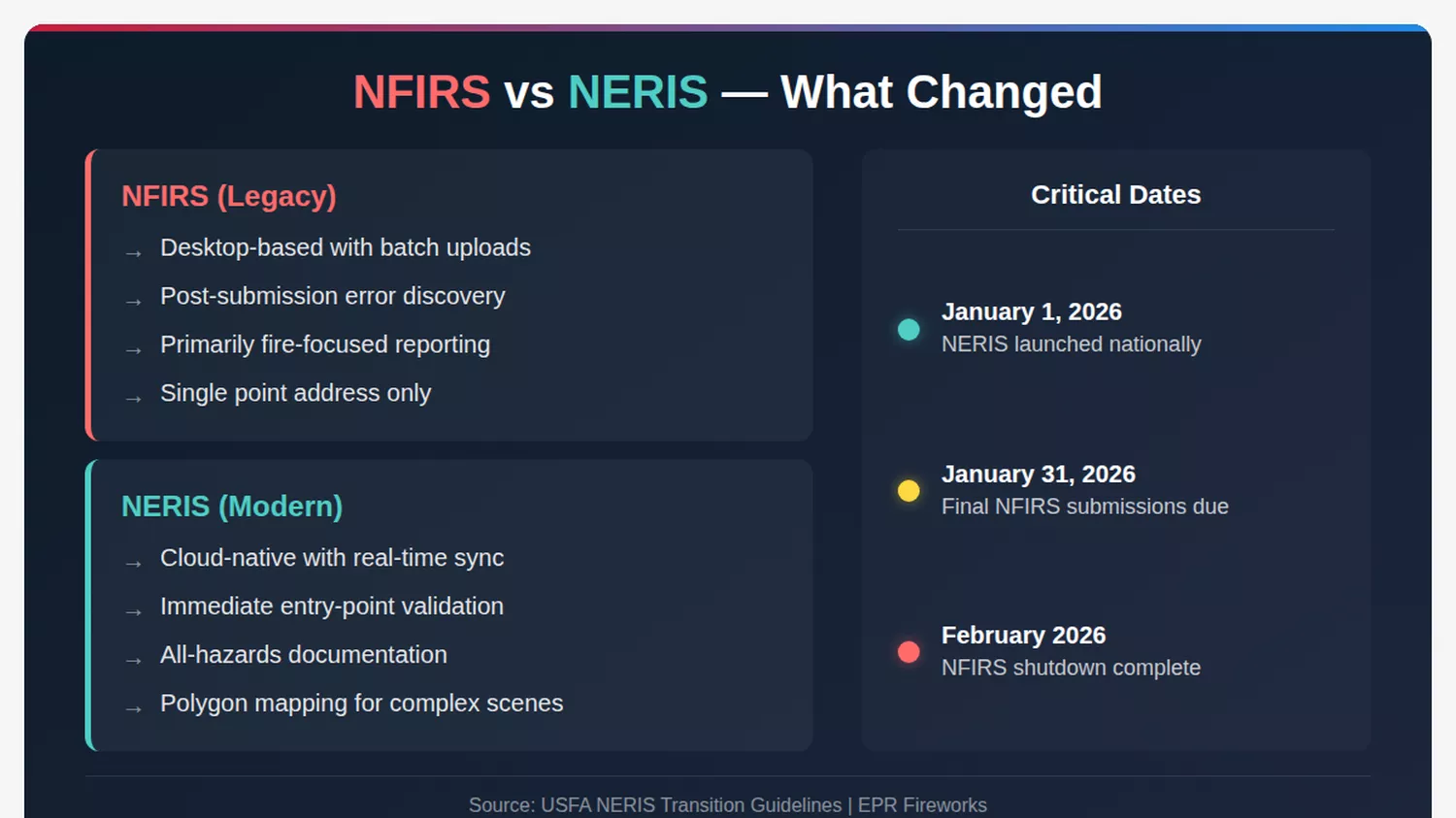
When evaluating NERIS vs NFIRS side by side, several foundational differences become apparent. The legacy system relied on desktop-based data entry with batch processing that created delays between incident occurrence and data availability at state and federal levels. Departments often discovered validation errors weeks after initial submission, requiring time-consuming corrections that diverted administrative resources.
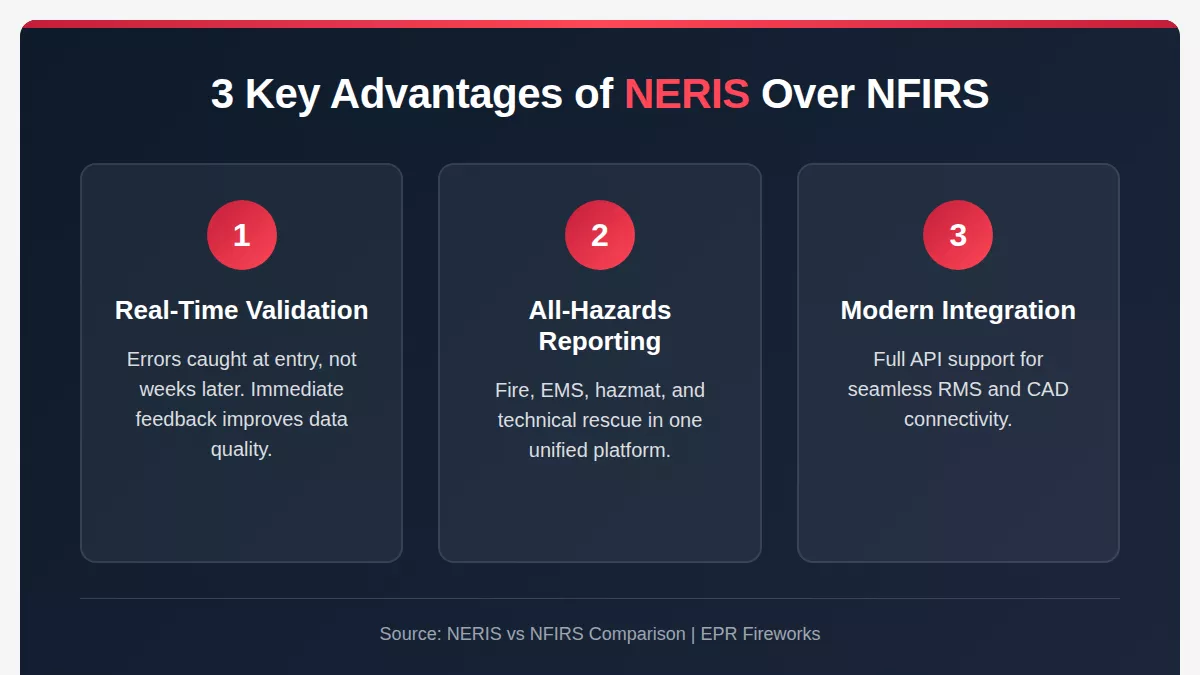
The NERIS architecture takes a fundamentally different approach. Cloud-native infrastructure enables real-time data exchange with immediate validation feedback. When personnel enter incident information, the system checks for errors, inconsistencies, and missing fields before accepting the submission. This shift from reactive to proactive quality control addresses one of the most persistent challenges departments faced under the legacy framework.
| Comparison Area | NFIRS (Legacy) | NERIS (Modern) |
| System Architecture | Desktop-based with batch uploads | Cloud-native with real-time sync |
| Data Validation | Post-submission error discovery | Immediate entry-point validation |
| Incident Scope | Primarily fire-focused reporting | All-hazards emergency documentation |
| Geographic Capture | Single point address only | Polygon mapping for complex scenes |
| Integration Support | Limited third-party connectivity | Full API support for RMS/CAD |
| Mobile Access | Minimal mobile functionality | Mobile-optimized responsive design |
| Analytics Capabilities | Basic static reports | Dynamic dashboards with trend analysis |

Expanded Incident Type Coverage
The NFIRS to NERIS transition significantly expands what gets reported. While NFIRS focused primarily on fire incidents, the new platform captures all-hazards emergency response data. This includes EMS calls, technical rescue operations, hazmat responses, and public service calls that previously fell outside standardized reporting frameworks.
This expansion means departments gain comprehensive operational visibility across their entire response portfolio. Analysis that once required pulling data from multiple disconnected systems now happens within a unified platform. For agencies providing both fire and EMS services, this integration eliminates data silos that obscured true operational patterns.
Geographic Data Enhancements
One limitation that frustrated departments using NFIRS involved geographic documentation. The legacy system required specific street addresses, creating challenges for wildland fires spanning multiple parcels, water rescue incidents, or emergencies in areas with ambiguous addressing. NERIS reporting addresses this through polygon mapping capabilities that allow incidents to be documented by geographic area rather than single points.
This enhancement proves particularly valuable for fire incident reporting software solutions that integrate GIS mapping. Departments can now accurately document sprawling wildland-urban interface fires, multi-structure incidents, or complex emergency scenes without forcing artificial address assignments that misrepresent actual incident locations.
How Does the NERIS Transition Timeline Affect Fire Departments?
The transition from NFIRS to NERIS follows a structured timeline that departments must understand for compliance planning. January 2026 marked the official NERIS launch, with the legacy NFIRS system scheduled for complete shutdown by early February 2026. This compressed window created urgency for departments that delayed preparation.
Several states implemented early adoption programs, transitioning their agencies before the federal deadline. These early movers provided valuable implementation lessons that informed national rollout strategies. Departments in states with mandatory early adoption gained additional compliance runway while others faced tighter timelines.
Critical Compliance Dates
Fire departments should understand these key milestones for the NERIS transition:
- January 1, 2026: NERIS system launched nationally for all participating agencies
- January 31, 2026: Final deadline for NFIRS data submissions covering 2025 incidents
- February 2026: Complete NFIRS shutdown with no further legacy submissions accepted
- Ongoing: State-specific requirements may impose additional reporting mandates beyond federal minimums
Agencies that missed preparation windows now face accelerated implementation timelines. The USFA provides technical resources for departments navigating late transitions, though compressed schedules increase implementation risk and staff burden.
What Software Requirements Support NERIS vs NFIRS Compliance?
The NERIS transition fundamentally changes software requirements for fire department records management. Legacy RMS platforms built around NFIRS data structures may require significant updates, complete replacement, or middleware solutions to achieve compliance. Understanding these requirements helps departments evaluate their current technology investments.
Modern fire department RMS platforms designed with NERIS compatibility handle the transition more smoothly. These systems incorporate the expanded data elements, validation rules, and API connectivity that NERIS requires. Departments using older software face decisions about upgrade paths, replacement timelines, and data migration strategies.
Essential RMS Capabilities for NERIS
When evaluating whether existing software meets NERIS requirements, departments should assess several key capabilities:
- Real-time validation engines that check data accuracy during entry rather than after batch submission
- All-hazards incident modules supporting fire, EMS, hazmat, technical rescue, and public service documentation
- API connectivity enabling automated data exchange with state and federal NERIS endpoints
- Polygon mapping support for accurate geographic documentation of complex incident scenes
- Mobile-responsive interfaces allowing field-based data entry on tablets and smartphones
- Integrated analytics dashboards providing the trend analysis and reporting capabilities NERIS enables
Departments discovering gaps in their current systems should prioritize vendors demonstrating proven NERIS compatibility. The transition timeline leaves limited room for vendors still developing compliance features.
Why Does NERIS Reporting Improve Data Quality?
One significant advantage in the NERIS vs NFIRS comparison involves data quality improvements built into the modern platform. NFIRS data quality challenges were well-documented, with inconsistent entries, missing fields, and validation errors creating downstream problems for analysis and grant applications.
The NERIS architecture addresses these challenges through multiple mechanisms. Entry-point validation prevents bad data from entering the system rather than flagging problems after submission. Standardized code sets align with contemporary emergency response terminology rather than outdated operational models. Real-time feedback helps personnel understand and correct issues immediately.
Impact on Grant Applications
For many departments, data quality directly affects funding opportunities. Federal grants including Assistance to Firefighters Grants and Staffing for Adequate Fire and Emergency Response programs require accurate incident data demonstrating community risk and resource needs. According to FEMA grant program guidance, data quality significantly influences competitive scoring for funding applications.
Departments with consistent, validated NERIS reporting build stronger cases for federal funding. The improved data quality reduces application rejections based on data inconsistencies while providing the analytical foundation for compelling needs demonstrations. This connection between reporting quality and funding success makes the NERIS transition strategically important beyond basic compliance.
| Data Quality Factor | NFIRS Challenge | NERIS Improvement |
| Field Completeness | Errors discovered post-submission | Required fields enforced at entry |
| Code Consistency | Outdated terminology mismatches | Updated standardized code sets |
| Geographic Accuracy | Address-only limitations | Polygon mapping capabilities |
| Temporal Precision | Batch processing delays | Real-time data exchange |
| Cross-Agency Alignment | Inconsistent state implementations | Federal standardization |
What Training Do Departments Need for the NFIRS to NERIS Shift?
The transition requires personnel training that goes beyond simple interface orientation. While the NERIS platform features more modern, intuitive design than its predecessor, the expanded data requirements and validation processes demand updated procedures and skills development.
Administrative staff responsible for incident documentation need comprehensive training on new data elements, validation requirements, and submission workflows. Officers reviewing reports before submission require understanding of quality standards and common error patterns. Even field personnel benefit from awareness training explaining how their incident documentation supports department analytics and funding applications.
Building Internal Expertise
Successful departments approach NERIS transition training systematically. This includes identifying power users who develop deep platform expertise and can support colleagues through implementation challenges. Regular refresher sessions address common issues discovered during initial rollout periods. Documentation of department-specific procedures helps standardize practices across shifts and stations.
Many departments leverage integrated learning management systems that track training completion and certification status. This approach ensures all personnel receive required training while maintaining documentation for compliance audits.
5 Steps Fire Departments Should Take for NERIS Transition Success
Departments still navigating their transition or optimizing early implementations should follow structured approaches that address technical, procedural, and personnel readiness.
- Audit current RMS capabilities against NERIS technical requirements, identifying gaps requiring vendor updates, supplemental tools, or platform replacement
- Develop data migration strategies ensuring historical NFIRS data transfers accurately to NERIS-compatible formats without losing analytical continuity
- Establish validation workflows incorporating quality checks into standard operating procedures so data accuracy becomes routine rather than afterthought
- Create training schedules covering all personnel roles from field responders understanding documentation importance to administrators managing submission processes
- Build analytics capabilities leveraging NERIS enhanced reporting features to inform strategic planning, resource allocation, and community risk reduction programs
Frequently Asked Questions
Is NERIS mandatory for all fire departments?
NERIS participation requirements vary by state and local mandates. Federal requirements apply to departments receiving certain grant funding or participating in national data programs. Many states have implemented mandatory participation regardless of federal funding status. Departments should verify requirements with their state fire marshal or emergency management agency.
Can departments still access historical NFIRS data after the transition?
Historical NFIRS data remains accessible through archive systems maintained by USFA and state agencies. Departments should confirm data export and migration processes with current RMS vendors to ensure continuity of analytical capabilities spanning both reporting eras.
How long does a typical NERIS implementation take?
Implementation timelines vary based on current system compatibility, department size, and training requirements. Departments with modern RMS platforms featuring built-in NERIS support often complete transitions within weeks. Those requiring software replacement or significant workflow changes may need several months for full implementation.
What happens if a department misses NERIS compliance deadlines?
Non-compliance consequences depend on state and federal requirements applicable to each department. Potential impacts include ineligibility for federal grant programs, state reporting violations, and loss of access to aggregated national data resources. Departments facing compliance challenges should contact their state fire data coordinator for guidance.
Position Your Department for NERIS Success
The shift from NFIRS to NERIS represents more than a technical upgrade. It reflects evolving expectations for emergency services data that supports strategic decision-making, demonstrates community impact, and justifies resource investments. Departments approaching this transition thoughtfully position themselves for long-term operational excellence.
EPR Fireworks provides integrated fire department software with built-in NERIS V1 compatibility, helping departments navigate the transition while maintaining comprehensive incident documentation across fire and EMS operations. Schedule a call to discuss how our cloud-based platform supports your department’s compliance requirements and analytical goals.