Key Takeaways
Accurate NERIS data directly supports faster emergency response and better operational decisions for fire departments nationwide.
- Standardized data collection through NERIS eliminates inconsistencies that plagued legacy reporting systems for decades
- Real-time validation catches errors at the point of entry, reducing correction cycles and improving data quality from day one
- Fire departments with clean, reliable NERIS data can identify response time patterns and make evidence-based improvements
- Integration between incident reporting and CAD systems creates a feedback loop that continuously refines dispatch protocols
Fire chiefs who prioritize NERIS data quality position their departments to leverage analytics for measurable operational improvements.
Fire departments generate enormous amounts of operational data every day. Incident reports, response timestamps, resource allocations, and patient care records all contribute to a detailed picture of how your department performs. The challenge has always been turning this raw information into actionable insights. The National Emergency Response Information System represents a fundamental shift in how fire service data gets collected, validated, and analyzed at the national level.
The transition from NFIRS to NERIS brings immediate benefits for departments willing to embrace better data practices. According to the U.S. Fire Administration, the legacy system suffered from inconsistent reporting standards that made meaningful comparisons between departments nearly impossible. NERIS data standards address these historical shortcomings by implementing uniform field definitions, mandatory validation rules, and improved incident type classifications.
This matters because every data point influences decisions that affect both firefighter safety and community protection.
What Makes NERIS Data Different from Legacy Fire Reporting?
The differences between NERIS and NFIRS extend far beyond updated field names. NERIS fundamentally reimagines how fire departments capture and submit incident information to create a more reliable national dataset.

Standardized Field Definitions Eliminate Guesswork
Under NFIRS, departments often interpreted field requirements differently. One department might classify a vehicle fire in a parking garage as a structure fire, while another logged it as a vehicle fire. These inconsistencies accumulated over decades, making aggregate data unreliable for policy decisions and resource allocation.
NERIS data standards eliminate this ambiguity through precise field definitions and examples. Each data element includes clear guidance on proper classification, reducing interpretation errors. When every department applies the same rules, the resulting dataset becomes genuinely comparable across jurisdictions.
Real-Time Validation Catches Errors Immediately
Perhaps the most significant improvement involves validation logic built directly into NERIS-compliant software. Rather than discovering data problems weeks or months after submission, departments receive immediate feedback when entries don’t meet requirements.
This real-time validation fundamentally changes the correction process. Instead of hunting through old reports to fix rejected submissions, personnel correct issues while incident details remain fresh. The practical benefits of NERIS compliance extend to every aspect of data quality management.
Enhanced Incident Classification
NERIS introduces refined incident type categories that better reflect modern fire service operations. The classification system captures nuances that NFIRS couldn’t accommodate, providing richer detail about what departments actually encounter in the field.
| Classification Element | NFIRS Approach | NERIS Approach |
| Incident Types | Broad categories, limited subtypes | Detailed hierarchical classification |
| Property Use Codes | Static list, rarely updated | Expandable structure supporting new property types |
| Action Taken | General descriptions | Specific operational details |
| Resource Tracking | Basic unit counts | Detailed apparatus and personnel data |
| Geolocation | Optional, inconsistent format | Standardized coordinates required |
How Does Accurate NERIS Data Improve Response Times?
Accurate incident data creates a foundation for meaningful performance analysis. When departments can trust their numbers, they can identify patterns, test hypotheses, and implement changes with confidence that results reflect reality rather than data artifacts.
Identifying Bottlenecks in Dispatch Processes
NERIS data includes timestamp fields that track each phase of incident response. From initial call receipt through unit arrival, these timestamps create a detailed timeline that reveals exactly where delays occur.
Departments analyzing this NERIS data often discover surprises. Sometimes the problem isn’t travel time but rather dispatch processing delays. Other departments find that turnout time varies significantly by shift or station. Without reliable data, these patterns remain hidden within aggregate averages that mask actionable insights.
Optimizing Station Coverage and Unit Deployment
Geographic analysis of NERIS incident data helps departments evaluate whether current station locations and unit distributions match actual demand patterns. Population shifts, new development, and changing community demographics all affect where incidents occur most frequently.
Fire chiefs using data-driven decision making can identify coverage gaps before response time problems become apparent to the public or elected officials. Proactive adjustments based on solid NERIS data analysis demonstrate professional management that builds community trust.
Building Evidence for Resource Requests
Budget conversations go more smoothly when supported by comprehensive data. NERIS fire data provides the documentation needed to justify staffing requests, apparatus purchases, and station construction projects.
When department leadership can demonstrate specific response time impacts tied to current resource levels, budget decision-makers have concrete information rather than abstract concerns. This evidence-based approach proves particularly valuable when competing for limited municipal funding.
What Are the Key Components of High-Quality NERIS Data?
Data quality encompasses several dimensions that departments must address systematically. Technical compliance with NERIS specifications represents just the starting point.
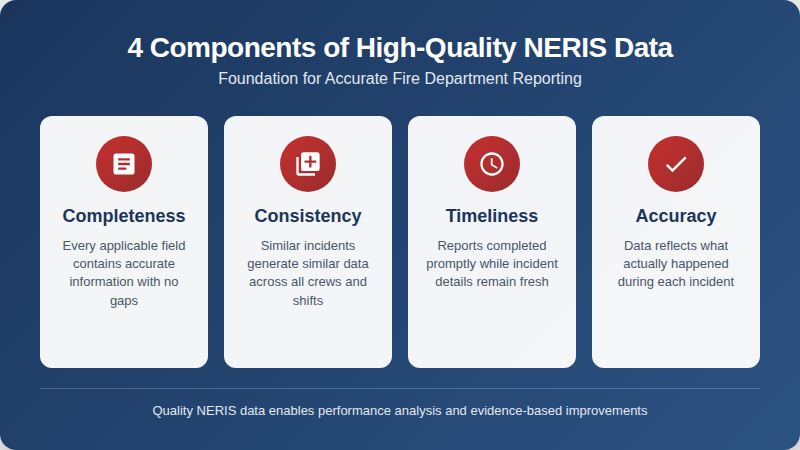
Completeness
Every applicable field should contain accurate information. Incomplete records create gaps that undermine analysis and may trigger compliance issues. Training personnel to understand why complete documentation matters helps overcome resistance to detailed data entry.
Consistency
Similar incidents should generate similar data. When two crews responding to comparable events produce dramatically different reports, something has gone wrong in either training or process. Regular data audits help identify consistency problems before they corrupt trend analysis.
Timeliness
NERIS data loses value when reports lag weeks behind incidents. Memories fade, details blur, and the opportunity for real-time quality feedback disappears. Departments with strong incident reporting workflows complete documentation promptly while information remains fresh.
Accuracy
Data should reflect what actually happened during each incident. Accuracy depends on proper training, clear field definitions, and validation systems that catch obvious errors. It also requires a culture that values truthful reporting over making numbers look favorable.
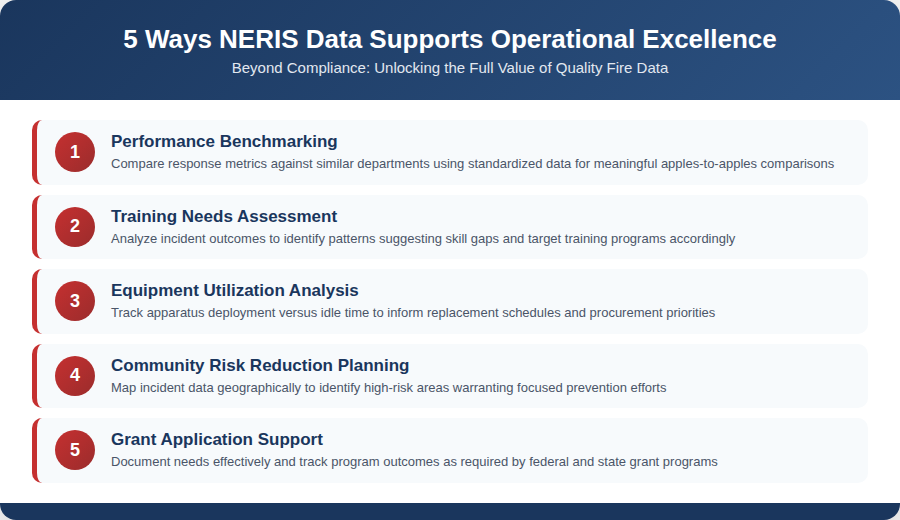
5 Ways NERIS Data Supports Operational Excellence
Beyond compliance requirements, quality NERIS data enables capabilities that directly benefit department operations:
- Performance Benchmarking: Compare your response metrics against similar departments using standardized data that ensures apples-to-apples comparisons rather than misleading statistics based on inconsistent definitions.
- Training Needs Assessment: Analyze incident outcomes and identify patterns suggesting specific skill gaps. If certain incident types consistently require mutual aid or extended operations, targeted training programs can address underlying capability shortfalls.
- Equipment Utilization Analysis: Track which apparatus and equipment actually get deployed versus what sits idle. This informs replacement schedules, specialty unit staffing, and procurement priorities.
- Community Risk Reduction Planning: Map incident data geographically to identify high-risk areas warranting focused prevention efforts. NERIS data supports community risk reduction strategies by providing the foundational analysis.
- Grant Application Support: Federal and state grant programs increasingly require demonstrated data capabilities. Departments with mature NERIS reporting processes can document needs more effectively and track program outcomes as required by funders.
What Role Does Software Play in NERIS Data Quality?
The connection between software capabilities and data quality cannot be overstated. Manual processes introduce errors, create delays, and burden personnel who should focus on operational duties rather than paperwork.
Automated Field Population
Modern RMS platforms pull information automatically from multiple sources. CAD integration populates response timestamps, unit assignments, and incident locations without manual entry. Personnel databases supply crew information. GIS systems provide property details.
This automation eliminates transcription errors while dramatically reducing documentation time. Personnel complete required fields rather than re-entering data that already exists elsewhere in department systems.
Built-In Validation Logic
Software incorporating NERIS validation rules catches problems immediately. Invalid combinations, out-of-range values, and missing required fields generate alerts before reports can be finalized. This prevents the frustration of rejected submissions and ensures clean data from the start.
| Validation Feature | Impact on Data Quality |
| Required Field Enforcement | Ensures completeness |
| Range Checking | Prevents obviously incorrect values |
| Cross-Field Logic | Catches inconsistent combinations |
| Format Validation | Standardizes addresses, times, codes |
| Duplicate Detection | Prevents redundant records |
Reporting and Analytics Tools
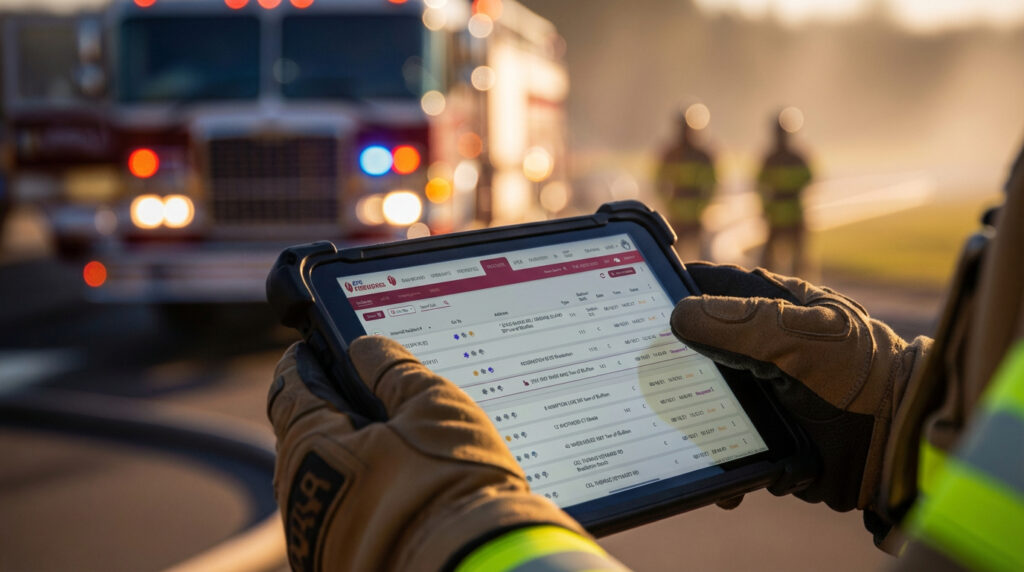
Quality data only delivers value when departments can access it effectively. Dashboard visualizations, trend reports, and mapping tools transform raw NERIS data into insights leadership can act upon.
Industry research consistently shows that departments using data-driven approaches achieve better operational outcomes than those relying on institutional memory alone. Software platforms that include robust analytics capabilities help departments extract maximum value from their reporting investments.
How Should Departments Approach NERIS Data Quality Improvement?
Improving data quality requires sustained attention rather than one-time fixes. Departments achieving excellent results typically follow a structured approach.
Establish Baseline Metrics
Before implementing changes, measure current performance. What percentage of reports submit successfully on first attempt? How many require corrections? What’s the average time from incident to completed report? These baseline measurements enable objective assessment of improvement efforts.
Invest in Training
Personnel who understand why data matters produce better results than those who view documentation as bureaucratic burden. Training should cover both technical NERIS requirements and the operational benefits that flow from quality incident data.
Create Accountability Systems
Supervisory review of incident reports should be standard practice. Quality checks need not be burdensome, but some level of oversight ensures consistent standards across shifts and stations. Performance metrics for data quality can be incorporated into regular evaluations.
Leverage Technology Appropriately
Software tools support but cannot replace human judgment and commitment. Departments should evaluate whether current systems provide adequate NERIS support and consider upgrades if validation capabilities fall short of requirements.
Ready to Improve Your Department’s NERIS Data Quality?
The fire service stands at an inflection point where data quality increasingly determines operational effectiveness. Departments that master NERIS incident reporting gain advantages in performance optimization, resource allocation, and community protection.
Building these capabilities requires the right combination of trained personnel, effective processes, and supporting technology. EPR Fireworks provides cloud-based fire and EMS software built specifically to support NERIS compliance while streamlining daily operations for departments of all sizes. Schedule a conversation to learn how modern records management can transform your department’s data capabilities.