Key Takeaways
Fire departments now operating under NERIS face predictable data submission challenges that can compromise compliance, funding, and operational analytics.
- Incomplete incident type mapping from legacy NFIRS codes causes significant data rejection rates during NERIS data submission
- Missing geolocation coordinates and property details account for a large portion of validation errors in early adopter reports
- Timestamp inconsistencies between CAD systems and manual entries create cascading data quality issues
- Staff training gaps remain the most overlooked factor in successful NERIS reporting requirements compliance
Invest in structured validation protocols and staff education now to avoid costly corrections as your department establishes its NERIS reporting rhythm.
Fire departments across the country are now navigating one of the most significant fire incident reporting transitions in decades. With NERIS now live as of January 1, 2026, departments that began early submissions have provided valuable lessons about what goes wrong during NERIS data submission. According to the U.S. Fire Administration, all calendar year 2026 incident data must be submitted exclusively through NERIS, with NFIRS becoming unavailable in February 2026.
The good news is that most submission errors fall into predictable categories. Understanding these pitfalls gives your department a significant advantage in achieving NERIS compliance from day one.
What Are the Most Common NERIS Data Submission Errors?
When departments submit incident data to NERIS, certain error patterns emerge consistently. Understanding these categories helps prioritize training and system configuration efforts while submission routines are still being established.
Incident Type Mapping Failures
The shift from NFIRS incident codes to the new NERIS classification system has proven more complex than many departments anticipated. Legacy RMS platforms often contain years of data coded under the old system, and automatic mapping tools don’t always translate correctly. Departments frequently discover that certain incident types they’ve recorded for years don’t have direct equivalents in the NERIS framework. This requires manual review and reclassification decisions that should be addressed immediately as your team adapts to the new system.
The NERIS incident classification system includes expanded categories that better reflect modern fire service operations, including detailed EMS integration codes and specialized rescue classifications. Departments that take time to understand these new categories avoid frustrating back-and-forth when their submissions get rejected for invalid incident codes.
Geolocation Data Problems
NERIS places much greater emphasis on precise geographic data than NFIRS ever did. Approximate addresses or missing GPS coordinates that might have passed validation under the old system now trigger rejection notices. The Fire Safety Research Institute has noted that accurate geolocation data is essential for the risk mapping and resource allocation analytics that NERIS enables at the national level.
Many departments discover their existing address databases contain inconsistencies that never caused problems before. Street name abbreviations, missing apartment numbers, and outdated property records all create friction during NERIS data submission validation.
Timestamp Synchronization Issues
NERIS requires consistent timestamp formatting and logical sequencing that exposes gaps in how departments have historically recorded incident timelines. When dispatch, arrival, and clear times come from different systems with different time sources, the resulting data often contains impossible sequences or formatting inconsistencies.
Departments using cloud-based fire RMS platforms with integrated CAD connections generally face fewer timestamp issues because their systems already maintain synchronized time sources across modules.
How Do Validation Requirements Differ from NFIRS?
Understanding the technical differences between NFIRS and NERIS validation helps explain why departments are experiencing more rejections than they expected during the transition period.
| Validation Area | NFIRS Approach | NERIS Requirements |
| Geographic Data | Address sufficient | GPS coordinates required for most incidents |
| Incident Types | 100+ categories | 200+ categories with mandatory subcodes |
| Time Fields | Basic sequence check | Logical validation across all timestamps |
| Property Details | Many optional fields | Expanded required occupancy data |
| Personnel Records | Basic exposure tracking | Detailed PPE and certification validation |
| Mutual Aid | Simple coding | Multi-agency incident linking required |
The table above illustrates why NERIS reporting requirements represent more than a simple format change. The underlying data model expects more detailed, more accurate, and more consistently formatted information than most departments have been collecting.
Required Field Expansion
Fields that were optional under NFIRS are now mandatory for NERIS compliance. Property occupancy classifications, building construction types, and detailed fire behavior data must be captured at the scene rather than estimated later. Departments that update their incident reporting workflows to capture this information in real-time avoid the data quality problems that come from post-incident guesswork.
This expansion reflects the fire service’s growing need for accurate data to support everything from ISO ratings to community risk reduction planning. The information NERIS collects will shape national fire prevention strategies for years to come.
Cross-Reference Validation
NERIS validates submitted data against multiple reference datasets that NFIRS never accessed. Property records, census data, and national infrastructure databases all inform the validation process. This means that errors in your local property database can cause NERIS rejections even when your incident report is technically complete.
Departments should audit their property and occupancy databases as soon as possible. Identifying and correcting discrepancies proactively prevents frustrating back-and-forth with validation systems during actual reporting periods.
What Internal Processes Create Submission Problems?
Technical system issues account for only part of NERIS data submission failures. Many problems originate in departmental workflows and training gaps that technology alone cannot solve.
Inconsistent Data Entry Practices
Different personnel often record the same types of information in different ways. One crew might enter detailed narrative descriptions while another relies heavily on coded fields. One station might round response times while another records exact timestamps. These variations, invisible under NFIRS, create validation failures under the stricter NERIS framework.
Standardizing data entry procedures across all stations and shifts requires documented protocols and regular training refreshers. Fire chiefs who assume existing personnel will naturally adapt to new requirements often discover significant compliance gaps during their first submission cycles.
Delayed Report Completion
NERIS validation includes freshness checks that flag reports submitted long after the incident occurred. While the specific timeframes vary by report type, the system clearly favors near-real-time data submission over end-of-month batch uploads. Departments accustomed to completing reports days or weeks after incidents need to restructure their documentation workflows now.
Modern RMS platforms with mobile incident reporting capabilities make real-time documentation practical even during active operations. Crews can begin narrative entries at the scene and complete technical details immediately upon returning to quarters.
Quality Review Gaps
Effective NERIS compliance requires systematic review processes that catch errors before submission. Departments without designated quality assurance personnel or automated validation tools submit data blind, discovering problems only when rejection notices arrive. Building review checkpoints into your reporting workflow catches most common errors before they become compliance issues.
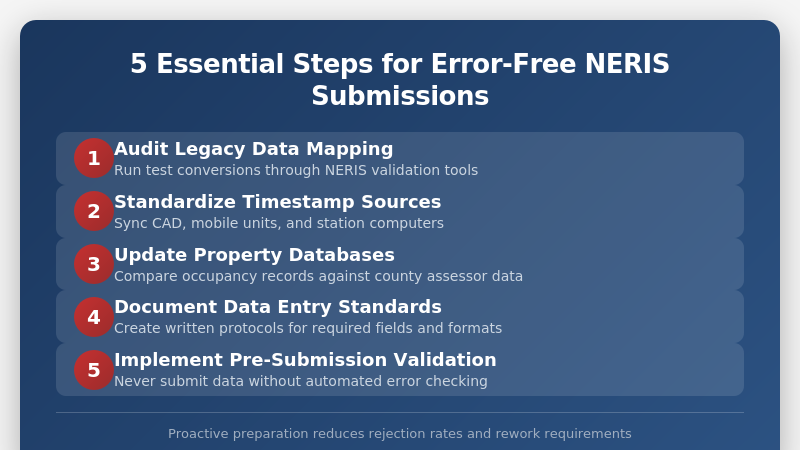
5 Essential Steps for Error-Free NERIS Submissions
Departments achieving high first-time acceptance rates share common preparation strategies. Implementing these practices now dramatically reduces rejection rates and rework requirements.
- Audit your legacy data mapping by running test conversions of historical incident records through NERIS validation tools. Identify systematic translation problems before they affect ongoing submissions.
- Standardize timestamp sources across all systems that feed into your incident reports. Ensure CAD, mobile units, and station computers all synchronize to the same authoritative time source.
- Update property databases by comparing your occupancy records against county assessor data and correcting discrepancies. Pay special attention to commercial properties and multi-unit residential buildings.
- Document data entry standards in written protocols that every crew member can reference. Include specific guidance on required fields, acceptable abbreviations, and narrative content expectations.
- Implement pre-submission validation using either built-in RMS tools or standalone validation utilities. Never submit data without automated error checking.
These steps require upfront investment but dramatically reduce the frustration and rework associated with failed NERIS data submission cycles.
How Can Departments Prepare Staff for New Requirements?
Technology solutions only work when personnel understand both the requirements and the tools. Training programs that address NERIS compliance from multiple angles produce better results than purely technical instruction.
Understanding the Purpose Behind Requirements
Staff who understand why NERIS collects specific data points make better judgment calls during incident documentation. Training should explain how national fire data shapes policy decisions, resource allocation, and fire department analytics at every level. Personnel who see the connection between their documentation and department funding tend to take data accuracy more seriously.
Hands-On System Training
Classroom instruction about NERIS requirements must include practical exercises using your actual RMS platform. Simulated incidents that walk crews through complete documentation workflows reveal confusion points before real incidents create compliance problems. Regular refresher sessions keep skills current as system updates and requirement changes occur.
Creating Accessible Reference Resources
Even well-trained personnel need quick-reference materials during actual incident documentation. Laminated pocket guides, tablet shortcuts, or wall-mounted quick-reference sheets help crews capture required information without lengthy manual consultation. Investing in these resources pays dividends in data quality and completion speed.
What Technology Features Support NERIS Compliance?
RMS platforms vary significantly in their NERIS readiness and support for compliant data collection. Departments should evaluate their current systems against specific capability requirements.
| Feature | Impact on NERIS Compliance |
| Built-in validation | Catches errors before submission |
| GPS auto-capture | Eliminates manual coordinate entry errors |
| CAD integration | Ensures timestamp consistency |
| Required field enforcement | Prevents incomplete submissions |
| Offline capability | Maintains data collection during connectivity gaps |
| Audit logging | Supports quality review processes |
Departments whose current RMS lacks these features face difficult decisions about system upgrades versus manual compliance workarounds. The cost of maintaining NERIS compliance on outdated platforms often exceeds the investment required for modern solutions.
Integration Requirements
NERIS data submission depends on information flowing accurately between multiple department systems. CAD systems, mobile reporting tools, personnel databases, and property records must all communicate effectively. Departments with fragmented technology environments often discover integration gaps only when validation errors reveal data inconsistencies.
FAQ
What happens if my department submits invalid NERIS data?
Invalid submissions are rejected with error reports indicating specific problems. Departments must correct and resubmit affected records before they count toward compliance. Repeated invalid submissions may trigger additional oversight from state reporting authorities.
Can I convert my old NFIRS data to NERIS format?
Historical NFIRS data can be converted to NERIS format, but the process requires careful mapping and often reveals data quality issues in legacy records. Many departments focus NERIS compliance efforts on new incidents rather than attempting comprehensive historical conversion.
How often must departments submit NERIS data?
Submission frequency requirements vary by state and reporting agreements. Most jurisdictions require quarterly submissions at minimum, with some moving toward monthly or near-real-time reporting expectations.
Do volunteer departments face the same NERIS requirements as career departments? NERIS reporting requirements apply based on incident volume and state participation agreements rather than department staffing models. Volunteer departments that meet reporting thresholds face identical compliance obligations to career departments.
Take Control of Your NERIS Compliance Today
The transition to NERIS represents both a challenge and an opportunity for fire departments. Departments that master NERIS data submission early gain access to powerful analytics capabilities while those that struggle with compliance face ongoing data quality battles that consume administrative resources.
Most common pitfalls have straightforward solutions when addressed proactively. Audit your data, standardize your processes, train your personnel, and implement validation tools now rather than waiting for rejection notices to force reactive scrambling. The investment in proper preparation pays dividends in operational efficiency and compliance confidence.
EPR Fireworks provides comprehensive NERIS-ready RMS solutions designed specifically for fire and EMS agencies navigating this transition. Schedule a consultation to learn how streamlined NERIS data submission can strengthen your department’s reporting capabilities.