Key Takeaways
NERIS represents the most significant modernization of fire incident reporting in over four decades, replacing the legacy NFIRS system with a cloud-based platform designed for real-time data exchange and advanced analytics.
- The National Emergency Response Information System (NERIS) introduces all-hazards reporting capabilities, moving beyond fire-only documentation to comprehensive emergency response data
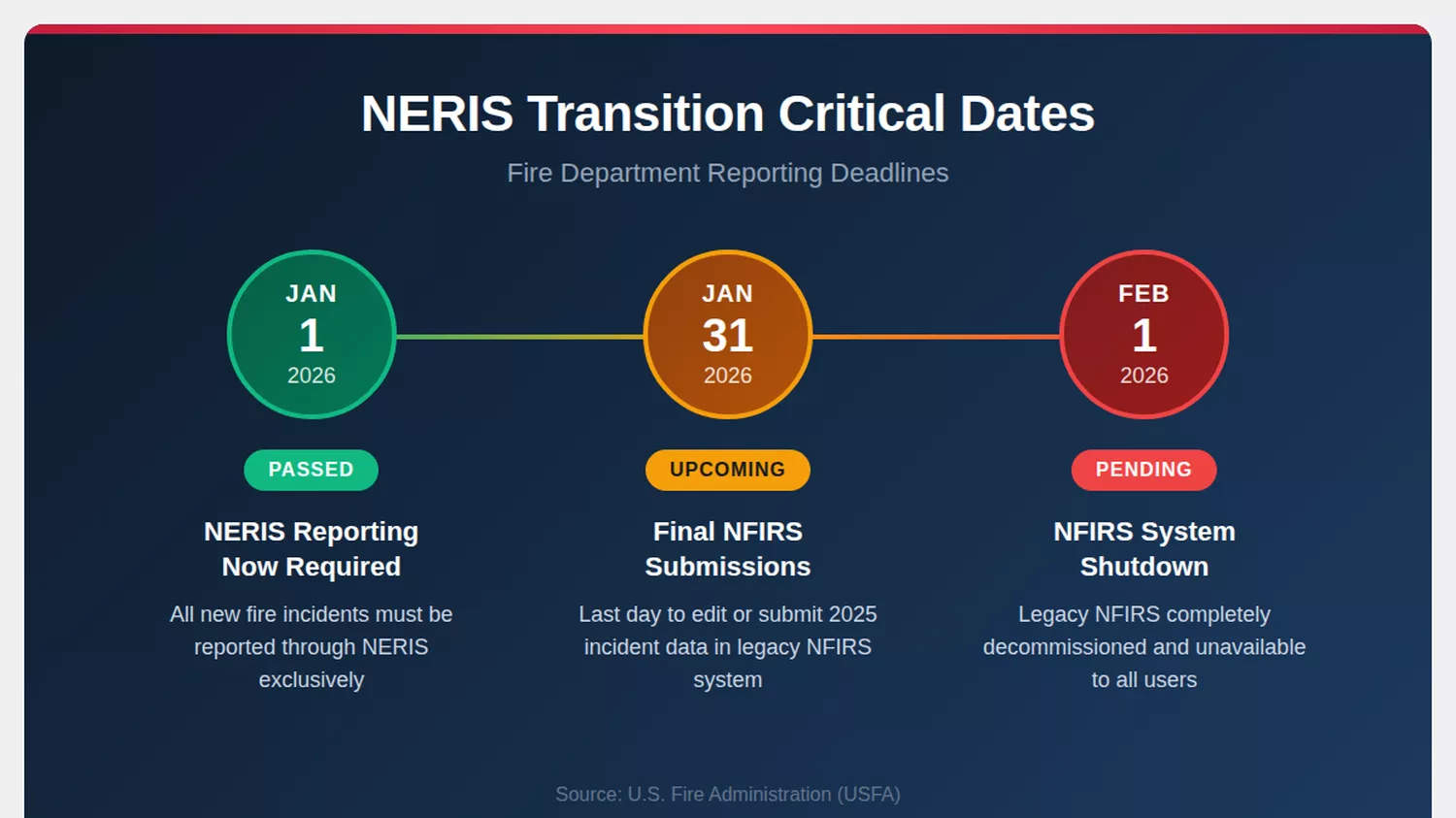
- Fire departments should now be reporting through NERIS, with final NFIRS data submissions due by January 31, 2026, before complete system shutdown in February
- Modern NERIS fire reporting integrates seamlessly with CAD and RMS platforms, enabling automated data capture that reduces administrative burden while improving accuracy
- Departments using NERIS-compatible software position themselves for enhanced grant applications, improved ISO ratings, and data-driven operational improvements
Fire leaders who understand the NERIS definition and optimize their use of the platform will gain competitive advantages through better data utilization.
Fire department leaders across the country are asking the same question: what exactly is NERIS, and why does it matter for their operations? The answer affects everything from daily incident documentation to long-term strategic planning and funding opportunities.
The National Emergency Response Information System, known as NERIS, represents a complete overhaul of how fire departments report, analyze, and utilize incident data. Understanding this transformation is essential for chiefs, administrative officers, and IT directors now operating under the new reporting requirements.
According to the U.S. Fire Administration, NERIS now serves as the single national repository for fire and emergency services data, replacing a system that remained largely unchanged since its introduction in 1975. This transition affects the nation’s approximately 29,000 fire departments and has fundamentally changed incident documentation workflows.
What Is the Official NERIS Definition and Purpose?
NERIS stands for the National Emergency Response Information System, a modernized data collection and analysis platform developed by the U.S. Fire Administration in partnership with the fire service community. The NERIS definition encompasses more than simple incident reporting, representing a comprehensive ecosystem for emergency response data management.
At its core, NERIS serves three primary functions that distinguish it from predecessor systems. First, it provides standardized incident documentation that captures detailed information about emergency responses across all hazard types. Second, it enables real-time data sharing between departments, states, and federal agencies. Third, it delivers analytical tools that transform raw incident data into actionable operational insights.
The system architecture reflects lessons learned from decades of NFIRS limitations. Where the legacy system required manual data entry with minimal integration capabilities, NERIS incident reporting connects directly with existing department technologies through modern application programming interfaces. This connectivity eliminates redundant data entry and ensures information consistency across platforms.
Beyond Fire-Only Documentation
One fundamental shift in the NERIS definition involves expanding beyond traditional fire incident categories. The platform supports comprehensive all-hazards reporting that includes emergency medical services responses, technical rescue operations, hazardous materials incidents, and natural disaster documentation.
This expanded scope provides fire departments with unified reporting across their entire response portfolio. Rather than maintaining separate documentation systems for different incident types, departments can manage all emergency response data within a single framework that maintains consistent standards and enables cross-functional analysis.
How Does NERIS Fire Reporting Differ From Legacy NFIRS?
Understanding the differences between NFIRS and NERIS fire reporting helps department leaders appreciate the magnitude of this transition and maximize the benefits of the new platform.
The National Fire Incident Reporting System (NFIRS) served the fire service well since its establishment, creating foundational standards for incident documentation that enabled national-level analysis and informed policy decisions. However, the system’s age meant it could not leverage modern technologies or support contemporary operational requirements.
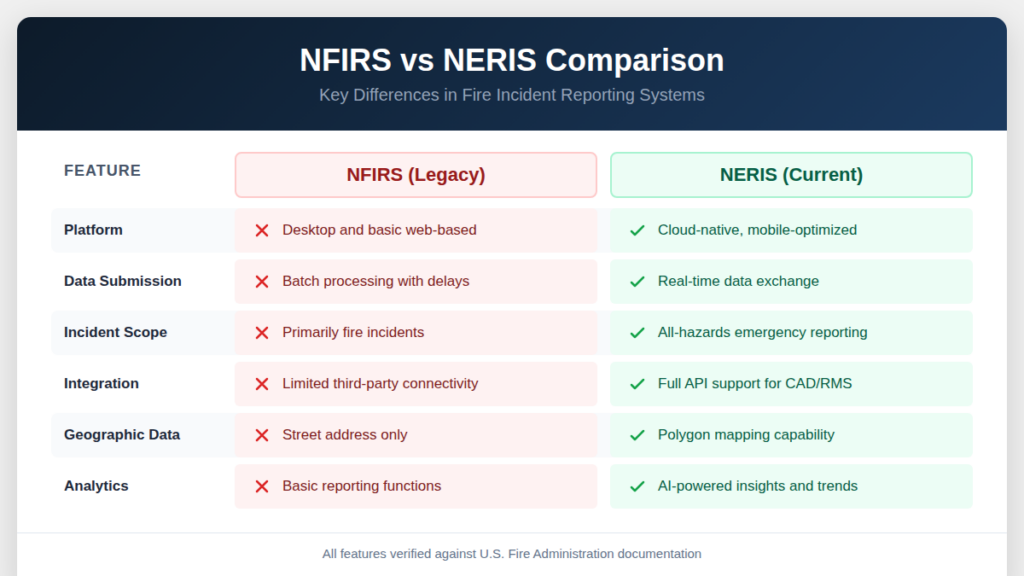
| Feature | NFIRS (Legacy) | NERIS (Current) |
| Platform Architecture | Desktop and basic web-based | Cloud-native, mobile-optimized |
| Data Submission | Batch processing with delays | Real-time data exchange |
| Incident Scope | Primarily fire incidents | All-hazards emergency reporting |
| System Integration | Limited third-party connectivity | Full API support for CAD/RMS platforms |
| Geographic Data | Street address only | Polygon mapping for complex incidents |
| Analytics | Basic reporting functions | AI-powered insights and trend analysis |
| User Interface | Dated, manual-entry focused | Modern, automated data capture |
Technical differences extend to how geographic information gets captured and utilized. Legacy NFIRS reporting required specific street addresses, creating challenges for wildland fires, large-scale emergencies, or incidents in areas with unclear addressing. NERIS fire reporting introduces polygon mapping capabilities that allow incidents to be documented by geographic area rather than single points.
Data Quality and Consistency Improvements
NERIS incident reporting addresses long-standing data quality challenges that plagued the legacy system. Built-in validation rules catch errors during initial entry rather than allowing inconsistent data to propagate through state and federal systems. Real-time feedback helps personnel correct mistakes immediately, improving overall data integrity.
The platform also introduces standardized code sets that align with contemporary emergency response terminology. These updates ensure NERIS definition elements match how departments actually operate today, rather than reflecting outdated operational models that no longer apply to modern fire and EMS services.
Why Are Fire Departments Required to Use NERIS?
The mandatory NERIS transition stemmed from both technical necessity and strategic opportunity. The aging NFIRS infrastructure reached end-of-life status, requiring complete replacement rather than incremental updates that would extend an outdated platform.
Beyond technical factors, the transition reflects evolving requirements for fire service data utilization. Grant programs, including the Assistance to Firefighters Grant (AFG) and SAFER, increasingly emphasize data-driven applications that demonstrate need through comprehensive incident documentation. According to FEMA’s AFG program guidelines, departments receiving federal funding must meet incident reporting requirements through NERIS.
Insurance Service Office ratings similarly depend on documented department performance and response data. NERIS provides the detailed incident information that supports improved ISO classifications, directly benefiting community members through potential insurance premium reductions.
Critical dates department leaders must understand:
- January 1, 2026: All new fire incident reporting now occurs through NERIS exclusively
- January 31, 2026: Final deadline for NFIRS data edits and submissions for 2025 incidents
- February 2026: NFIRS system completely decommissioned and unavailable
Departments that have not yet completed their transition should treat this as an urgent priority, as only weeks remain before legacy system access ends permanently.
What Features Make NERIS Incident Reporting More Effective?
Modern NERIS fire reporting introduces capabilities that fundamentally change how departments interact with incident data. These features reflect input from fire service professionals who identified specific pain points in legacy workflows.
Seven Key NERIS Capabilities
- Real-Time Data Submission: Incident information transmits immediately rather than waiting for batch processing, enabling faster analysis and response to emerging trends
- Mobile-First Design: Personnel can complete documentation from apparatus, scene, or station using smartphones and tablets with intuitive interfaces
- Automated Data Capture: Integration with CAD systems pre-populates incident records with dispatch information, reducing manual entry requirements
- Enhanced Geocoding: Polygon mapping supports complex incidents without requiring specific street addresses
- Cross-Agency Sharing: Mutual aid responses and multi-jurisdictional incidents can be documented collaboratively in real-time
- Advanced Analytics: Built-in analytical tools identify patterns, trends, and operational improvement opportunities within department data
- Customizable Reporting: Departments can generate reports tailored to specific requirements including grant applications, accreditation processes, and governing body presentations
These capabilities combine to reduce administrative burden while improving data quality and analytical value. Field personnel spend less time on paperwork, while department leadership gains better insights into operational performance.
How Should Departments Optimize Their NERIS Implementation?
Whether your department transitioned smoothly or is still working through challenges, optimizing NERIS implementation requires attention to technical, operational, and personnel considerations.
Technical Optimization Steps
Software compatibility remains the most critical technical consideration. Departments must verify their fire department records management system carries NERIS V1 Data Exchange Compatible certification. This designation confirms the vendor has completed required testing and can transmit data directly to the national system.
Departments still using non-compatible software face urgent decisions. With the NFIRS shutdown weeks away, selecting and implementing a NERIS-compatible solution has become a critical priority rather than a future planning item.
| Optimization Area | Key Actions | Priority |
| Software Assessment | Verify RMS vendor NERIS V1 certification | Critical/Immediate |
| Data Migration | Complete all 2025 NFIRS submissions before January 31 | Urgent |
| Integration Testing | Validate CAD-to-RMS data flows for accuracy | High |
| Staff Training | Continue vendor and USFA training programs | Ongoing |
| Documentation Update | Finalize SOGs for NERIS reporting workflows | High |
Personnel Training Requirements
Technology changes require corresponding updates to personnel knowledge and skills. The NERIS interface differs significantly from legacy systems, and even experienced users benefit from ongoing training on workflows and capabilities.
Many vendors provide comprehensive training programs specific to their NERIS-compatible platforms. These programs address both technical operation and data quality standards that ensure submissions meet validation requirements.
State fire marshal offices and regional training coordinators continue offering NERIS-specific sessions. Departments should identify these opportunities and ensure appropriate personnel attend, particularly those still building confidence with the new system.
What Benefits Does NERIS Provide Beyond Basic Compliance?
While compliance drove the transition timeline, forward-thinking department leaders now recognize NERIS as an opportunity for operational improvement rather than simply a mandate to satisfy.
The analytical capabilities built into NERIS enable business intelligence approaches that were previously impossible or required significant additional investment. Departments can identify response time trends, resource utilization patterns, and workload distributions that inform staffing decisions and strategic planning.
Real-time data sharing supports improved mutual aid coordination and regional planning initiatives. As more departments actively utilize NERIS, aggregated data provides increasingly comprehensive views of regional emergency response that benefit everyone.
The platform also supports community risk reduction initiatives by documenting prevention activities, public education efforts, and inspection findings alongside emergency responses. This comprehensive view enables departments to demonstrate their full range of community protection services.
Frequently Asked Questions About NERIS
What does NERIS stand for and what is its primary purpose?
NERIS stands for the National Emergency Response Information System. Its primary purpose is modernizing fire incident reporting through a cloud-based platform that supports real-time data exchange, all-hazards documentation, and advanced analytics that transform incident data into operational insights.
What is the current status of the NFIRS to NERIS transition?
As of January 2026, all new fire incident reporting should occur through NERIS. The legacy NFIRS system remains available only for editing and submitting 2025 incident data until January 31, 2026, after which it will be completely decommissioned in February 2026.
How can departments verify their software supports NERIS fire reporting?
Departments should confirm their RMS vendor holds the “NERIS V1 Data Exchange Compatible” certification. Vendors without this certification cannot transmit data directly to the national system.
Will historical NFIRS data remain accessible after the transition?
Historical NFIRS data from 1980 through 2025 will remain available through OpenFEMA’s Public Data Release. However, this data will not integrate directly with NERIS systems, so departments should ensure their RMS platforms maintain local historical records.
What training resources exist for departments working with NERIS?
Training resources include vendor-specific programs, USFA webinars, state fire marshal office sessions, and educational materials from fire service organizations. Most states continue offering training opportunities to support departments optimizing their NERIS implementation.
Position Your Department for Success With Modern Reporting Tools
The NERIS transition represents both a compliance milestone and an ongoing opportunity to modernize incident documentation practices. Departments that optimize their implementation, select appropriate software partners, and continue training personnel will maximize the analytical capabilities this new platform provides.
Fire departments seeking NERIS-compatible solutions that integrate incident reporting with comprehensive records management, training documentation, and community risk reduction tools should explore what EPR Fireworks offers. Schedule a conversation to discuss how their platform can support your department’s ongoing operational excellence.