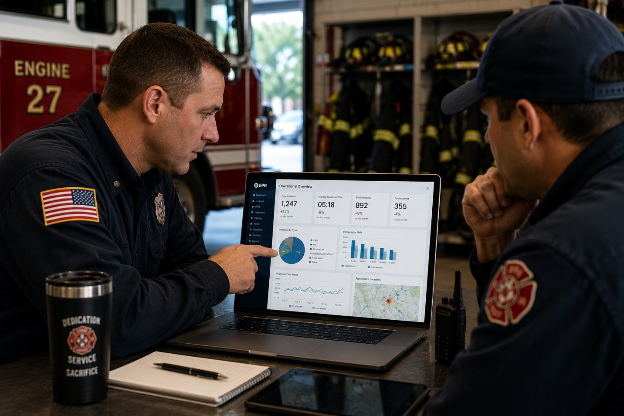
How Records, Reporting, Analytics, and AI Are Transforming Modern Fire and EMS Operations
Ready to simplify reporting and turn your department’s data into actionable insight? Read the blog to earn how EPR Fireworks can connect your fire and EMS operations in one configurable records management platform.
Short Answer
Fire department data management is the process of collecting, organizing, securing, validating, and analyzing information from incident reports, EMS documentation, inspections, training, personnel activity, apparatus, hydrants, and other department operations.
A modern Fire and EMS Records Management System, or RMS, brings this information together in one centralized platform. This helps departments improve reporting accuracy, simplify NERIS and NEMSIS submissions, reduce duplicate data entry, strengthen operational planning, and give leadership a more complete view of department performance.
Table of Contents
- What Is Fire Department Data Management?
- Why Fire Department Data Management Matters More Than Ever
- The Core Components of Fire Department Data Management
- How Fire Department Data Analysis Supports Better Decisions
- How AI Is Changing Fire Department Reporting
- How Operational Intelligence Turns Data Into Decisions
- Common Fire Department Data Management Challenges
- How to Build a Strong Data Governance Strategy
- Best Practices for Fire Department Record Keeping
- How to Choose Fire Department Data Management Software
- A Real-World Data Management Example
- The Future of Fire Department Data Management
- Frequently Asked Questions
- Final Thoughts
Every emergency response generates valuable information.
Dispatch times, incident details, patient care reports, apparatus usage, inspections, training records, personnel activity, hydrant testing, and response metrics all create data that tells the story of how a department operates.
The challenge is not collecting data. Fire departments already generate enormous amounts of it every day.
The challenge is turning that information into something useful.
Modern fire department data management helps agencies organize, validate, analyze, and report operational information. With accurate and accessible data, leaders can improve response planning, demonstrate performance, support funding requests, and meet evolving reporting requirements.
Instead of spending hours searching for records, reconciling spreadsheets, or correcting submission errors, departments with strong data management practices can make decisions using reliable information.
As reporting standards continue to evolve and agencies face growing expectations from local governments, grant programs, accreditation organizations, and federal reporting systems, fire department data management has become an operational necessity.
What Is Fire Department Data Management?
Fire department data management is the process of collecting, storing, maintaining, securing, validating, and analyzing information generated throughout daily operations.
This information may include:
- Incident reports
- Electronic patient care reports
- Personnel records
- Training certifications
- Fire inspections
- Pre-incident plans
- Apparatus maintenance
- Asset and inventory records
- Hydrant testing
- Response time metrics
- Community risk reduction activities
- Scheduling and staffing information
A modern records management system connects these data sources within one centralized platform instead of scattering information across paper files, spreadsheets, stand-alone applications, and disconnected databases.
The objective is to create one trusted source of operational information that supports emergency response, compliance, planning, reporting, and leadership decision-making.
Fireworks Insight
Fire department data becomes more valuable when it is connected. Integrating incident reporting, ePCR, inspections, training, assets, personnel, and analytics gives leaders a more complete operational picture than separate systems can provide.
Why Fire Department Data Management Matters More Than Ever
Fire departments have always relied on accurate records. Today, those records influence nearly every operational, administrative, and financial decision.
Reporting Requirements Continue to Change
The transition from NFIRS to NERIS represents one of the most significant changes in national fire reporting in decades.
Departments must maintain accurate incident records while preparing for updated data structures, validation requirements, submission workflows, and reporting expectations.
Agencies with organized fire department record-keeping practices are better positioned to manage this transition than departments relying on fragmented systems and manual processes.
A modern NERIS-ready platform can help departments:
- Validate required information before submission
- Reduce duplicate data entry
- Standardize reporting across personnel and shifts
- Preserve accessible historical records
- Adapt workflows as reporting requirements change
- Connect incident data with other department operations
Fireworks Insight
NERIS readiness involves more than exporting a report. Departments need configurable workflows, accurate validation, accessible historical data, and a system that can adapt as national requirements continue to develop.
Data Supports Funding and Resource Decisions
City managers, elected officials, grant reviewers, and other stakeholders increasingly expect fire departments to support requests with measurable information.
Departments may need accurate data to demonstrate:
- Changes in call volume
- Response time trends
- Staffing requirements
- Apparatus utilization
- Training compliance
- Inspection activity
- Community risk reduction efforts
- Geographic service demand
- Equipment and replacement needs
Reliable reporting gives department leaders objective evidence when requesting additional personnel, equipment, technology, or funding.
It can also strengthen grant applications by clearly documenting service demand, operational gaps, and community needs.
EMS Data Is a Critical Part of the Operational Picture
For many agencies, EMS responses represent a significant share of emergency activity.
That makes EMS data management just as important as fire incident reporting.
Patient care documentation supports:
- Clinical quality assurance
- NEMSIS reporting
- State data submissions
- Reimbursement
- Medical director review
- Protocol evaluation
- Operational planning
- Patient outcome analysis
When ePCR and fire incident reporting operate separately, personnel may need to enter the same information more than once. This increases administrative work and creates additional opportunities for inconsistent documentation.
An integrated system can synchronize fire and EMS information while preserving the specific documentation requirements of each report.
Fireworks Insight
Connecting ePCR with fire incident reporting helps agencies reduce duplicate entry and create a more complete record of each response. EPR Fireworks unifies fire and EMS workflows while supporting the distinct reporting needs of both operations.

The Core Components of Fire Department Data Management
Effective data management extends across the entire department. It is not limited to incident reporting.
Records Management
A records management system serves as the operational backbone of a fire department.
It can store and connect:
- Incident reports
- EMS records
- Inspections
- Preplans
- Personnel information
- Training records
- Assets
- Inventory
- Work orders
- Permits
- Hydrant records
- Operational history
Modern systems do more than store information. They can guide users through reporting workflows, require critical fields, identify missing information, and validate records before submission.
This improves the quality of each report while reducing the time supervisors spend correcting incomplete documentation.
Regulatory Reporting
Fire and EMS agencies may report information to several organizations at the local, state, and federal levels.
These may include:
- NERIS
- NEMSIS
- State reporting agencies
- Local governments
- Accreditation organizations
- Grant administrators
- Medical oversight organizations
A modern incident reporting platform should support these requirements without forcing personnel to repeatedly enter the same information.
It should also allow departments to configure fields, validations, workflows, and reporting rules based on their specific operational needs.
EMS Documentation
Accurate EMS documentation supports patient care while helping agencies meet NEMSIS and state reporting requirements.
An integrated ePCR platform can help departments:
- Capture patient assessments and vital signs
- Document treatments and medications
- Import information from cardiac monitors
- Reduce duplicate entry
- Track validation errors
- Support quality assurance reviews
- Maintain synchronization between EMS and fire reports
EPR Fireworks connects ePCR with the broader Fire RMS, allowing EMS data to remain part of the department’s complete operational environment rather than functioning as a stand-alone data source.
Inspections and Preplans
Inspection and preplan data helps departments support prevention, preparedness, and emergency response.
Connected property and preplan records can include:
- Floor plans
- Site diagrams
- Fire protection systems
- Hazard information
- Hydrant locations
- Access points
- Occupancy details
- Inspection history
- Violations
- Images and attachments
- Emergency contact information
When inspections and preplans are integrated, updates made to a property record can remain consistent across prevention and response workflows.
Fireworks Insight
Prevention data should not remain isolated in an inspection application. Connecting properties, inspections, preplans, hydrants, and incident history gives responding crews access to more complete information when it matters most.
Training and Personnel Data
Training records help departments monitor qualifications, certifications, continuing education, and operational readiness.
A connected learning management system can support:
- Custom courses
- Testing
- Certification tracking
- Continuing education
- Multi-role training attribution
- User-submitted training
- Approval and validation workflows
- Compliance reporting
When training data connects with personnel and operational records, leadership can identify gaps before they affect staffing or readiness.
Asset Management and Maintenance
Fire departments rely on vehicles, protective equipment, medical devices, station equipment, and other assets that must remain ready for service.
Asset management may include:
- Apparatus records
- Equipment inventory
- Maintenance schedules
- Work orders
- Inspection history
- Warranty information
- Cost tracking
- Time-to-resolution reporting
- Warehouse and apparatus inventory
A centralized system improves visibility into equipment status and helps departments document maintenance activity throughout the asset lifecycle.
How Fire Department Data Analysis Supports Better Decisions
Collecting information is only the beginning.
The greater value comes from fire department data analysis, which transforms raw records into operational insight.
Leadership teams can use connected data to evaluate:
- Response time trends
- Call volume by station
- High-demand service areas
- Peak staffing periods
- Unit utilization
- Apparatus reliability
- Inspection completion rates
- Training compliance
- Community risk patterns
- Overtime activity
- EMS and fire response trends
Instead of reacting to problems after they become visible, departments can identify patterns earlier and make more informed operational decisions.
For example, a chief may identify increasing service demand within a specific area. A training officer may find recurring documentation issues across multiple shifts. A prevention leader may see declining inspection completion rates before deadlines are missed.
Accurate analysis gives departments the ability to move from reactive management to proactive planning.
Fireworks Insight
Reporting explains what happened. Analytics helps departments understand why it happened, where patterns are forming, and what actions leadership may need to consider next.
How AI Is Changing Fire Department Reporting
Artificial intelligence is becoming an increasingly valuable tool for modern fire and EMS agencies.
For decades, firefighters and EMS professionals have spent significant time completing reports after demanding incidents and long shifts. Administrative work can take time away from training, equipment readiness, and community service.
AI-assisted reporting can help reduce that burden.
Modern platforms may use artificial intelligence to:
- Draft incident narratives
- Recommend standardized terminology
- Identify incomplete documentation
- Flag inconsistent information
- Suggest relevant report details
- Validate records before submission
- Summarize lengthy narratives for supervisors
- Support quality assurance and quality control
AI is not intended to replace the judgment or experience of fire and EMS professionals.
Instead, it can help personnel create more complete, consistent, and accurate documentation while reducing repetitive administrative work.
The user remains responsible for reviewing and approving information before it becomes part of an official record.
Fireworks Insight
AI should support professional judgment, not replace it. AI-assisted narratives and validation can help crews document incidents more efficiently while keeping personnel in control of the final report.
How Operational Intelligence Turns Data Into Decisions
Collecting information is important. Understanding what the information means is where its strategic value begins.
Operational intelligence combines historical records, live dashboards, geographic information, and analytics to help command staff make informed decisions.
Instead of waiting until the end of the month to review static reports, leaders can monitor relevant activity as records are completed.
Operational dashboards may include:
- Incident volume by station
- Average turnout and response times
- EMS versus fire call trends
- Unit utilization
- Apparatus availability
- Inspection completion rates
- Training compliance
- Overtime activity
- Geographic service demand
- Hydrant and property information
Role-based dashboards can also give different users access to the information most relevant to their responsibilities.
Command staff may need department-wide performance trends. Prevention staff may focus on inspections and properties. EMS leaders may review patient care documentation and QA/QC activity.
Permission-based controls can help protect dashboards and prevent unauthorized changes.
Fireworks Insight
EPR Fireworks dashboards can be configured by role, shared for visibility, and protected with permission-based controls. This gives users access to meaningful information without forcing every department or position into the same reporting layout.
A chief can use documented call volume to support a staffing discussion.
Training officers can identify recurring reporting or certification gaps.
Administrative personnel can prepare reports for city leadership without spending days combining spreadsheets.
Data becomes a strategic asset rather than simply a historical record.
Common Fire Department Data Management Challenges
Fire and EMS agencies often encounter similar data management challenges, regardless of department size.
Disconnected Systems
CAD, RMS, inspections, scheduling, training, maintenance, and EMS reporting may operate independently.
This forces personnel to enter the same information multiple times and increases the risk of inconsistent records.
Disconnected applications can also make it difficult for leadership to create a complete view of department activity.
Inconsistent Documentation
Reports completed after difficult incidents may contain incomplete or inconsistent information.
Without built-in validation and standardized workflows, errors can accumulate over time and affect reporting quality.
Limited Operational Visibility
Many departments collect large amounts of data but lack dashboards and reporting tools that help leaders interpret performance.
Information may exist, but finding and analyzing it requires manual exports or spreadsheet work.
Security and Compliance
Fire and EMS records may contain sensitive operational, personnel, and patient information.
Departments should evaluate controls such as:
- Role-based permissions
- Secure authentication
- Encryption
- Audit logs
- Secure backups
- Record retention policies
- Access monitoring
- Data ownership procedures
Growing Data Volume
Departments generate thousands of new records over time.
Their data management software must continue to support fast searches, accurate reporting, reliable exports, and long-term historical access as the amount of stored information grows.
How to Build a Strong Data Governance Strategy
Technology alone does not guarantee reliable information.
Every department also needs clear data governance practices that define how information is created, reviewed, secured, retained, and used.
Data governance establishes the policies and responsibilities that help keep records accurate, consistent, accessible, and secure.
A strong fire department data governance strategy should address:
- Documentation standards
- Required data fields
- Data ownership
- User permissions
- Record retention
- Quality assurance reviews
- Historical data access
- Reporting responsibilities
- Data export procedures
- Security and privacy requirements
Departments should also identify who is responsible for monitoring data quality.
Depending on the organization, that responsibility may involve command staff, records administrators, training officers, EMS leadership, prevention personnel, or information technology teams.
Clear ownership reduces the risk that incomplete records, duplicate data, or inconsistent documentation will continue unnoticed.
Standardize Documentation
Departments should define how common information is entered across shifts, stations, and operational areas.
This may include standards for:
- Incident narratives
- Apparatus designations
- Property records
- Inspection findings
- Patient care documentation
- Training activities
- Personnel credentials
- Asset descriptions
Standardized information is easier to search, analyze, compare, and report.
Establish Review Processes
Departments should regularly review the quality of submitted records.
Review processes may include:
- Supervisor approval
- Automated validation
- EMS QA/QC workflows
- Monthly reporting audits
- Training record reviews
- Inspection completion checks
- Certification expiration alerts
Consistent review helps departments identify recurring documentation problems before they affect compliance or operational reporting.
Protect Sensitive Information
Fire and EMS departments manage sensitive operational, personnel, and patient information.
Access should be based on job responsibilities rather than providing every user with the same permissions.
Departments should evaluate whether their systems support:
- Role-based access controls
- Secure user authentication
- Audit trails
- Data encryption
- Controlled exports
- Secure backups
- Permission-based dashboards
- Record retention settings
Fireworks Insight
Good data governance depends on both policy and technology. Configurable permissions, validation rules, audit trails, and approval workflows help departments apply their standards consistently across the organization.
Best Practices for Fire Department Record Keeping
Strong fire department record keeping begins with consistent processes.
Successful agencies often follow several common practices.
Complete Reports Promptly
Reports should be completed as close to the incident or activity as practical.
Delays can make it harder for personnel to remember details and may increase the risk of incomplete documentation.
Mobile reporting can help crews begin or complete records while information is still fresh.
Require Critical Information
Departments should identify which fields are essential for compliance, operational analysis, and future reporting.
Required fields and built-in validations can prevent incomplete records from being submitted.
Reduce Duplicate Entry
Information that already exists in CAD, personnel, property, or apparatus records should flow into related reports when appropriate.
Reducing duplicate entry saves time and lowers the risk of inconsistent information.
Review Data Quality Regularly
Departments should not wait for a rejected submission or external audit to identify reporting problems.
Regular quality reviews can uncover:
- Missing information
- Inconsistent terminology
- Incorrect classifications
- Duplicate records
- Expired certifications
- Incomplete inspections
- Unresolved validation errors
Train Personnel on Reporting Standards
Every new employee should understand how accurate documentation supports the department.
Training should explain:
- What information must be recorded
- Why specific fields matter
- How records affect reporting
- How documentation supports funding and planning
- When supervisors should be contacted
- How errors should be corrected
Maintain Secure Retention and Backup Practices
Departments should establish policies for retaining historical records and protecting them from loss.
They should also confirm that records can be accessed and exported when required.
Fireworks Insight
Better record keeping does not come from adding more administrative work. It comes from making accurate documentation easier through guided workflows, validation, automation, and connected data.
How to Choose Fire Department Data Management Software
Every department has different operational needs, staffing structures, and reporting responsibilities.
However, agencies should evaluate several core capabilities when selecting fire department data management software.
One Connected Platform
Incident reporting, ePCR, inspections, preplans, training, personnel, assets, maintenance, hydrants, and analytics should work together.
An integrated platform reduces duplicate entry and gives leadership a more complete view of department activity.
EPR Fireworks delivers an all-in-one Fire and EMS RMS designed to connect these operational areas within a configurable system.
NERIS and NEMSIS Readiness
Reporting requirements continue to evolve.
Departments should choose a vendor that actively supports current standards and updates its platform as requirements change.
The system should help personnel identify validation errors before submission rather than discovering them after the report has already been sent.
Configurable Workflows
Departments do not all operate the same way.
Software should support configurable:
- Forms
- Fields
- Validations
- Approval processes
- Dashboards
- Permissions
- Narratives
- Scenarios
- Reports
Configuration allows departments to align the system with their workflow instead of forcing personnel to adapt to rigid software.
CAD Integration
CAD integration can automatically populate important incident details, reducing manual entry and improving report accuracy.
Departments should review how information flows from dispatch into incident and EMS records.
Built-In Validation
Validation should occur while reports are being completed.
The system should help users identify missing, inconsistent, or invalid information before submission.
This can reduce rejected reports and save supervisors time during quality reviews.
Operational Dashboards
Leadership should have immediate access to meaningful information without relying on repeated spreadsheet exports.
Dashboards should support different roles and allow departments to display information relevant to command, prevention, EMS, training, and administrative staff.
Mobile Access
Personnel should be able to complete appropriate tasks from the field.
Mobile access can support:
- Incident reporting
- Inspections
- Preplans
- Hydrant work
- Asset updates
- Training submissions
- EMS documentation
Offline functionality may also be important for inspections or operations in locations with limited connectivity.
Analytics and Reporting
Departments should evaluate whether the platform provides pre-built reports, dashboards, and flexible analytics tools.
Users should be able to review operational information without depending on a vendor for every reporting change.
Support and Implementation
Technology is only part of a successful RMS implementation.
Departments should evaluate:
- Implementation support
- Data migration assistance
- User training
- Ongoing customer support
- Product update communication
- Knowledge of fire and EMS operations
EPR Fireworks provides support from U.S.-based specialists who understand fire and EMS workflows.
Fireworks Insight
A feature checklist does not tell the whole story. Departments should evaluate how well the platform connects data, adapts to their workflows, supports reporting changes, and provides help after implementation.
A Real-World Fire Department Data Management Example
Imagine two neighboring fire departments with similar staffing and call volume. Department A uses separate systems for incident reporting, EMS documentation, inspections, training, and maintenance.Personnel enter similar information into multiple applications. Monthly reports require staff to export spreadsheets, compare records, and correct inconsistent data. Reporting errors are often discovered after submission. When city leadership asks for response time trends, apparatus utilization, or inspection activity, administrative personnel may spend hours gathering the information.
Department B uses an integrated Fire and EMS Records Management System. CAD information automatically populates relevant fields. Firefighters and EMS personnel complete reports through connected workflows. Validation rules identify missing information before submission. Inspection records connect with properties and pre-plans. Training information connects with personnel records. Apparatus and maintenance information remains accessible within the same platform. Operational dashboards update as new records are completed. When leadership requests staffing, response, or service-demand information, Department B can access reliable data without manually combining several disconnected sources.
The difference is not simply that Department B uses newer software. The difference is confidence. Department B has greater confidence that its information is accurate, accessible, and ready to support decisions.
The Future of Fire Department Data Management
Fire department data management continues to evolve. Artificial intelligence, automation, connected systems, operational dashboards, and advanced analytics are changing how agencies document activity and use information. Departments with organized, accurate, and connected data will be better positioned to benefit from these technologies.
More Automated Reporting
Future systems will continue reducing repetitive entry by sharing information across CAD, RMS, ePCR, inspections, training, and asset workflows. Automation can help personnel spend less time transferring information between systems.
Expanded AI Assistance
AI may support additional reporting and review functions, including:
- Narrative assistance
- Missing information detection
- Classification recommendations
- Quality assurance summaries
- Trend identification
- Supervisor review support
Human review will remain essential for ensuring that official records are complete and accurate.
Predictive and Geographic Analysis
Connected historical and geographic information may help departments identify:
- Emerging demand areas
- Repeated property risks
- Apparatus reliability patterns
- Inspection priorities
- Staffing pressure
- Community risk trends
These insights can support planning, but they should be reviewed within the department’s operational and community context.
Greater Interoperability
Departments increasingly expect information to move securely between public safety systems. Future-ready platforms will need to support integrations, data exchange, and evolving reporting frameworks while protecting sensitive records.
Stronger Operational Intelligence
Leadership teams will continue moving from static monthly reports toward configurable dashboards and continuously updated operational views. This can help departments identify changes earlier and respond with better information.
Fireworks Insight
The future value of AI and predictive analytics depends on the quality of the underlying data. Departments that improve data consistency and connectivity today are building the foundation for more advanced capabilities tomorrow.
Frequently Asked Questions
What Is Fire Department Data Management?
Fire department data management is the process of collecting, organizing, maintaining, securing, validating, and analyzing information created through fire and EMS operations. This may include incident reports, patient care records, inspections, training, personnel activity, apparatus maintenance, hydrants, and response metrics.
Why Is Fire Department Data Management Important?
Effective data management helps departments improve reporting accuracy, support operational decisions, meet regulatory requirements, justify resources, strengthen grant applications, and reduce administrative workload.
What Is a Fire Records Management System?
A fire records management system is software used to store and manage department information such as incident reports, inspections, personnel records, training, assets, preplans, and analytics. A modern RMS connects these functions so departments can work from a more complete operational record.
How Does NERIS Affect Fire Department Reporting?
NERIS is changing how fire and emergency response data is collected and reported nationally. Departments need systems and processes that support accurate data entry, validation, historical access, and evolving reporting requirements.
How Can AI Improve Fire Department Reporting?
AI can assist with incident narratives, standardized terminology, missing information detection, validation, summaries, and QA/QC review. Personnel should still review and approve all information before it becomes part of an official record.
What Should Departments Look for in Fire Department Data Management Software?
Departments should look for an integrated and configurable platform that supports incident reporting, ePCR, inspections, preplans, training, personnel, assets, analytics, mobile access, CAD integration, validation, security, and current reporting standards.
How Does an Integrated RMS Reduce Duplicate Data Entry?
An integrated RMS allows information from CAD, personnel records, properties, apparatus, and other modules to flow into related workflows. This reduces the need for users to repeatedly enter the same information in separate systems.
How Does EPR Fireworks Support Fire Department Data Management?
EPR Fireworks connects Fire and EMS records management, including incident reporting, ePCR, inspections, preplans, training, assets, maintenance, hydrants, dashboards, and analytics, within one configurable platform. It is designed to support departments ranging from single-station agencies to large, multi-station organizations.
Final Thoughts
Modern fire department data management is no longer limited to record storage or regulatory compliance. It is the foundation for accurate reporting, informed leadership, efficient workflows, and better operational visibility.
Departments that connect incident reporting, EMS, inspections, training, assets, personnel, and analytics can create a more complete picture of how their organization operates. They can spend less time searching for records, correcting errors, and combining spreadsheets. They can spend more time using reliable information to support readiness, planning, accountability, and community service.
Whether your agency is preparing for NERIS, improving fire department record keeping, strengthening EMS data management, or expanding fire department data analysis, a connected RMS provides the foundation for smarter operations.
EPR Fireworks delivers an integrated Fire and EMS Records Management System built to simplify reporting, improve data accuracy, and keep crews focused on what matters most, saving lives.
Ready to bring your department’s records, reporting, and operational intelligence together? Complete the form to learn how EPR Fireworks can support your agency with one configurable Fire and EMS RMS.