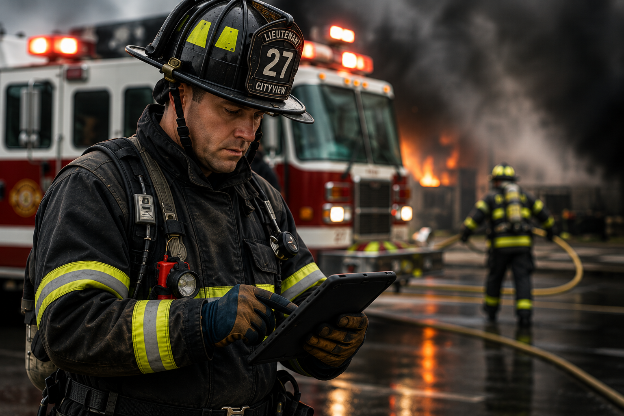
Short Answer: AI is transforming fire department operations by streamlining documentation, improving data quality, supporting NERIS reporting, and helping leaders make faster, more informed operational decisions. When integrated into a modern Fire & EMS Records Management System, AI reduces administrative burden while enhancing reporting, compliance, and operational intelligence.
Table of Contents
- The Documentation Burden Fire & EMS Crews Face
- AI EMS Report Automation Is Changing Documentation
- AI Is Only as Good as the Data Behind It
- AI for EMS Is Improving Patient Documentation
- AI in EMS Goes Beyond Documentation
- Choosing AI Solutions for EMS Reporting
- Why Operational Intelligence Matters
- The Future of AI for Emergency Services
How AI for Emergency Services Is Changing Fire Department Operations
Fire and EMS crews have always relied on two things: speed and accuracy. For decades, both depended almost entirely on people from dispatchers making split second decisions, medics documenting patient care after exhausting shifts, and company officers reconstructing incident timelines long after the scene was cleared.
That’s beginning to change.
Today, AI for emergency services is transforming how Fire & EMS agencies collect information, complete documentation, analyze operations, and prepare for the next call. The goal isn’t to replace firefighters or paramedics with algorithms. It’s to reduce administrative burden, improve data quality, and give department leaders the operational intelligence they need to make better decisions.
For agencies embracing modern records management, AI is quickly becoming another tool that helps crews spend less time behind a keyboard and more time serving their communities.
The Documentation Burden Fire & EMS Crews Face
Ask almost any firefighter, paramedic, or company officer what takes them away from the work they enjoy most, and documentation is usually near the top of the list.
A single EMS response can generate dozens of required data fields, patient assessments, medication records, treatment timelines, billing information, and narrative documentation. Fire incidents require equally detailed reporting to support compliance, investigations, inspections, community risk reduction efforts, and operational analysis.
Multiply that across an entire shift, and departments often spend hours completing reports instead of training, inspecting buildings, preparing equipment, or recovering between calls.
Reducing that administrative burden is where AI is creating some of its most immediate value.
💡 Fireworks Insight: Documentation is one of the biggest administrative burdens facing Fire & EMS agencies today. AI helps reduce repetitive work so responders can focus more on serving their communities.
AI EMS Report Automation Is Changing Documentation
One of the fastest growing applications of AI in public safety is AI EMS report automation.
Instead of asking responders to reconstruct an incident from memory after the call, AI assisted documentation tools can organize dispatch information, CAD data, responder input, timestamps, and incident details into a structured first draft.
Rather than replacing the responder, AI helps organize information that already exists, allowing crews to spend less time typing and more time reviewing, validating, and finalizing reports.
For departments, the benefits extend beyond convenience:
- Faster report completion
- More consistent documentation
- Reduced manual data entry
- Improved compliance
- Better quality assurance
- Stronger operational data
- Cleaner data doesn’t just improve reporting it creates the foundation for better analytics and more informed decision making across the department.
💡 Fireworks Insight: AI organizes information faster, but responders remain responsible for reviewing and approving every report.
AI Is Only as Good as the Data Behind It
One of the biggest misconceptions about artificial intelligence is that it creates intelligence on its own.
It doesn’t.
AI depends entirely on the quality, consistency, and completeness of the data it analyzes.
For Fire & EMS agencies, that means AI is only as valuable as the records management system supporting it. Departments that maintain standardized incident reports, inspections, training records, and operational data are building the foundation that allows AI to deliver meaningful insights.
As agencies transition to the National Emergency Response Information System (NERIS), this becomes even more important. Richer, standardized operational data creates new opportunities for analytics, automation, and operational intelligence that simply weren’t possible before.
The future of AI begins with trusted data.
💡 Fireworks Insight: Better Data Creates Better AI. Better AI Creates Better Decisions.

AI for EMS Is Improving Patient Documentation
Advancements in AI for EMS are helping agencies improve one of the most time intensive aspects of emergency response: patient documentation.
Modern EMS AI patient documentation solutions can assist with organizing narratives, identifying missing information, improving consistency, and reducing repetitive data entry.
Instead of starting with a blank screen, clinicians review, edit, and approve AI assisted documentation allowing them to focus on accuracy rather than repetitive administrative tasks.
Human oversight remains essential. AI should support clinical judgment, not replace it. The most effective implementations treat AI as an assistant that improves documentation quality while ensuring every patient record is reviewed and approved by the provider responsible for care.
💡 Fireworks Insight: AI supports clinicians by improving documentation quality while preserving human oversight and clinical judgment.
AI in EMS Goes Beyond Documentation
Documentation is only the beginning.
The next generation of AI in EMS is helping departments better understand their operations through analytics, forecasting, and operational intelligence.
Agencies are beginning to explore AI to support:
- Predictive staffing based on historical call demand
- Response time trend analysis
- Apparatus utilization
- Community risk reduction initiatives
- Inspection prioritization
- Training recommendations
- Resource allocation
- Command dashboards
- Performance benchmarking
Rather than simply generating reports, AI can help leaders answer larger operational questions:
- Where are response times increasing?
- Which stations experience the highest call volume?
- Are staffing levels aligned with demand?
- Which apparatus are most heavily utilized?
- Where should inspections be prioritized?
- Which operational trends deserve leadership attention?
These are the kinds of insights that transform historical reporting into operational intelligence.
💡 Fireworks Insight: The greatest opportunity for AI isn’t writing reports. It’s helping leaders uncover operational trends that improve decision-making.
Choosing AI Solutions for EMS Reporting
As agencies evaluate AI solutions for EMS reporting, it’s important to look beyond features alone.
The most effective platforms should:
- Integrate seamlessly with existing CAD and records management systems.
- Support standardized reporting requirements, including NERIS and NEMSIS.
- Keep responders in control with human review before reports are finalized.
- Protect sensitive information through strong security and privacy controls.
- Connect documentation with analytics, dashboards, inspections, training, and compliance.
Departments gain the greatest long term value when AI is part of a connected operational platform rather than a standalone documentation tool.
💡 Fireworks Insight: The most valuable AI solutions are integrated into your Records Management System, not separate tools that create additional silos.
Why Operational Intelligence Matters
Artificial intelligence doesn’t create better departments by itself.
The real advantage comes from connecting incident reporting, inspections, training, compliance, GIS mapping, analytics, and operational data into one complete picture.
When leaders have access to trusted operational intelligence, they can identify trends earlier, allocate resources more effectively, improve compliance, strengthen performance, and make more informed decisions for both responders and the communities they serve.
At Fireworks, we believe that’s where AI creates its greatest value not simply by helping complete reports faster, but by helping departments understand their operations in entirely new ways.
Through Fireworks Analytics & Compliance, agencies can transform operational data into interactive dashboards, GIS mapping, business intelligence, compliance reporting, and actionable insights that support smarter decision making every day.
💡 Fireworks Insight: Analytics turns data into intelligence. AI helps departments understand that intelligence faster.
The Future of AI for Emergency Services
Artificial intelligence isn’t replacing firefighters, paramedics, dispatchers, or command staff.
It’s giving them better information.
As Fire & EMS agencies continue their transition to NERIS, departments with modern records management systems and trusted operational data will be best positioned to take advantage of AI’s next generation of capabilities.
The agencies that will benefit most won’t necessarily be the ones with the newest AI tools. They’ll be the ones with the strongest data foundation.
At Fireworks, we believe the future of public safety is built on trusted data, connected operations, and actionable operational intelligence. AI is simply the next step in helping Fire & EMS agencies work smarter, reduce administrative burden, strengthen compliance, and better serve their communities.
Ready to Prepare for the Future?
Artificial intelligence is changing how Fire & EMS agencies document incidents, analyze performance, and make operational decisions. The question is no longer whether AI will shape emergency services,it’s how prepared your department will be to take advantage of it.
Ready to unlock the full value of your operational data? Discover how Fireworks AI Solutions helps Fire & EMS agencies move beyond compliance reporting, prepare for NERIS, and build the trusted data foundation that powers the future of AI.