- The incident command system gives every fireground one commander, one structure and one common language.
- ICS structure grows only as needed, with divisions for areas and groups for functions.
- FEMA treats one supervisor to five subordinates as the optimal span of control, but only as a guideline.
- Digital command logs PARs and benchmarks as they happen, so the ICS 214 is ready at the end.
Fire departments use the incident command system on calls of every size, from a car fire to a third alarm. It gives the scene one commander, one structure and one way to talk. Many officers learn it in class, then run it from memory, a radio and a tactical worksheet.
This guide explains what ICS is and how its structure grows. It covers incident command system roles on a fireground, transfer of command and the key ICS forms. It ends with what changes when you run command on a tablet instead of a clipboard.
What Is the Incident Command System?
FEMA's NIMS doctrine calls ICS "a standardized approach to the command, control, and coordination of on-scene incident management." It gives crews from different agencies one common hierarchy. That shared structure is what lets a mutual-aid engine fit into your fireground.
ICS is part of the National Incident Management System (NIMS). The doctrine lists five major functional areas, staffed as needed. They are Command, Operations, Planning, Logistics and Finance/Administration.
NIMS also says using ICS for every incident helps keep the skills sharp. A routine room-and-contents fire is practice for the big one. The same structure scales up as the incident grows.
What Does the Incident Command System Structure Look Like?
The incident command structure is modular. It builds from the top down and grows only as the incident needs it. FEMA's doctrine puts it plainly: if one person can manage every function, no further organization is needed.
Command and the Command Staff
The Incident Commander (IC) is responsible for the whole incident. The IC can activate Command Staff officers as the incident grows. NIMS names three: the Public Information Officer, the Safety Officer and the Liaison Officer.
The General Staff Sections
The General Staff is made up of four section chiefs. Each one runs a major function, and the IC keeps any function nobody has been assigned. NIMS says a non-activated function is performed at the next higher level.
| Position | What it does on a fire incident |
|---|---|
| Incident Commander | Sets objectives and strategy, and owns the whole incident |
| Safety Officer | Monitors operations, advises the IC on safety and can stop unsafe work |
| Public Information Officer | Shares incident information with the public and media |
| Liaison Officer | Acts as the contact for assisting and cooperating agencies |
| Operations Section Chief | Directs the tactical work through divisions and groups |
| Planning Section Chief | Collects and shares incident information and prepares the Incident Action Plan |
| Logistics Section Chief | Provides facilities, services and material support |
| Finance/Administration Section Chief | Handles the administrative and financial side of the incident |
NIMS also describes an Intelligence/Investigations function. It can sit in Planning, in Operations, in the Command Staff or as its own section.
Branches, Divisions and Groups
Under Operations, the incident command system structure splits work two ways. NIMS defines a division as responsibility for operations "within a defined geographic area." A group is a functional area, "not necessarily within a single geographic area."
On a structure fire, divisions are often the sides of the building or the floors. Groups are jobs like ventilation, RIT, water supply or medical. When there are too many divisions and groups, branches sit between them and the Operations Section Chief.
Span of Control and Unity of Command
FEMA's NIMS doctrine says the optimal span of control is one supervisor to five subordinates. It calls the 1:5 ratio a guideline, not a hard rule. Hazards, the type of task and supervisor experience all change the right number.
Unity of command means each person reports to only one supervisor. NIMS says this reduces confusion from conflicting orders. On a fireground, it means a crew in Division C answers to the Division C supervisor.
What Are the Incident Command System Roles on a Fireground?
Most incidents never need a full General Staff. A first-due officer often holds command alone. Roles get handed out as the incident grows past what one person can track.
Incident Commander
The IC sets the objectives, picks the strategy and keeps track of every unit on scene. On a working fire, the IC also calls for more resources and decides when to change tactics.
Division and Group Supervisors
Supervisors run one area or one function. They keep the IC's span of control manageable. The IC talks to a few supervisors instead of every company officer.
Accountability on Scene
NIMS lists the principles of accountability. They include check-in and check-out, unity of command, span of control and resource tracking. Many fire departments add a personnel accountability report (PAR) to confirm where every crew is.
Transfer of Command
Command changes hands as senior officers arrive. NIMS says the transfer includes a briefing with "essential information for continuing safe and effective operations." It also says everyone on the incident must be notified of the change.
A clean transfer covers the situation, the objectives, the organization and where every unit is. A rushed one can leave the new IC unsure where crews are working.
Which ICS Forms Do Fire Departments Use Most?
FEMA's ICS Resource Center publishes the standard ICS forms. Two of them matter most for command on a fire incident.
ICS 201 Incident Briefing
The ICS 201 gives the IC "basic information regarding the incident situation and the resources allocated to the incident." Per FEMA's instructions, the current IC prepares it for the incoming IC, along with an oral briefing. It also serves as a permanent record of the initial response.
ICS 214 Activity Log
Per FEMA's instructions, the ICS 214 "records details of notable activities at any ICS level." The logs are basic incident documentation and a reference for any after-action report. You can download the blank form from FEMA.
FEMA's list also includes the ICS 202 Incident Objectives, ICS 203 Organization Assignment List and ICS 211 Incident Check-In List.
How Do You Take the Incident Command System Digital?
Paper and radios work, but they leave gaps. Times get written down late. The worksheet and the incident report become two separate records that someone has to match up after the call.
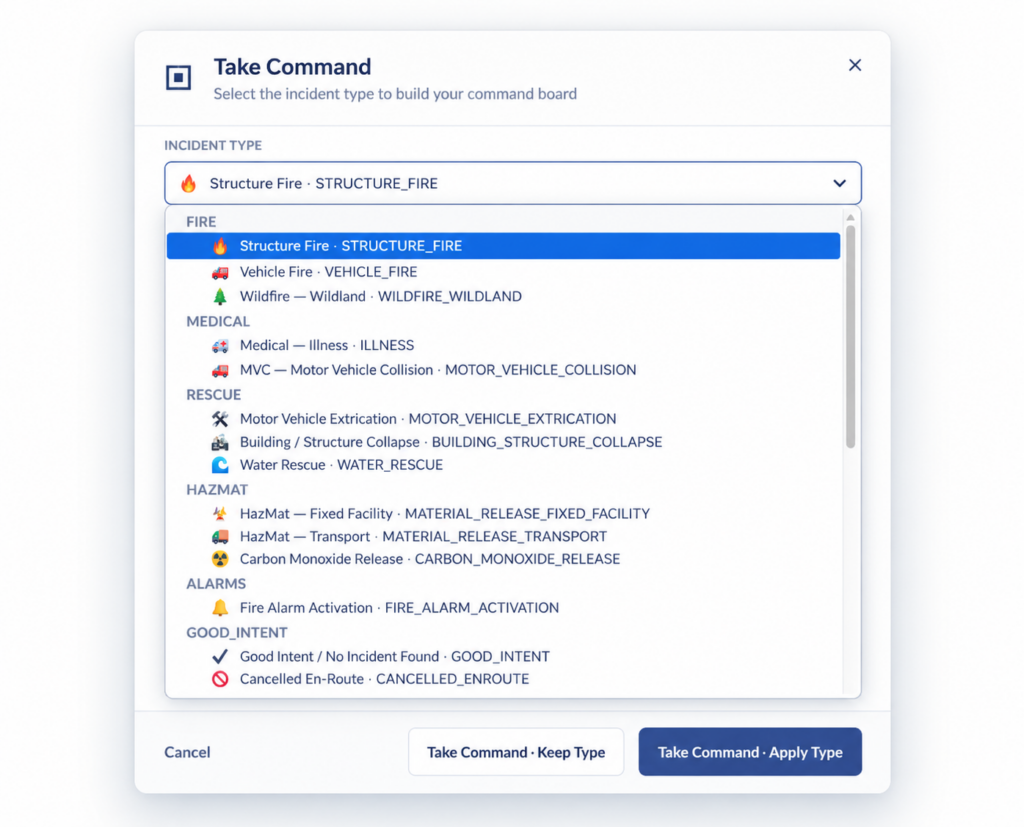
Fireworks Incident Command is an add-on to Fireworks Incidents. It opens from the incident list or the incident's menu, with no second login. Units come in from CAD, and you can add units CAD missed.
Set Up the Structure When You Take Command
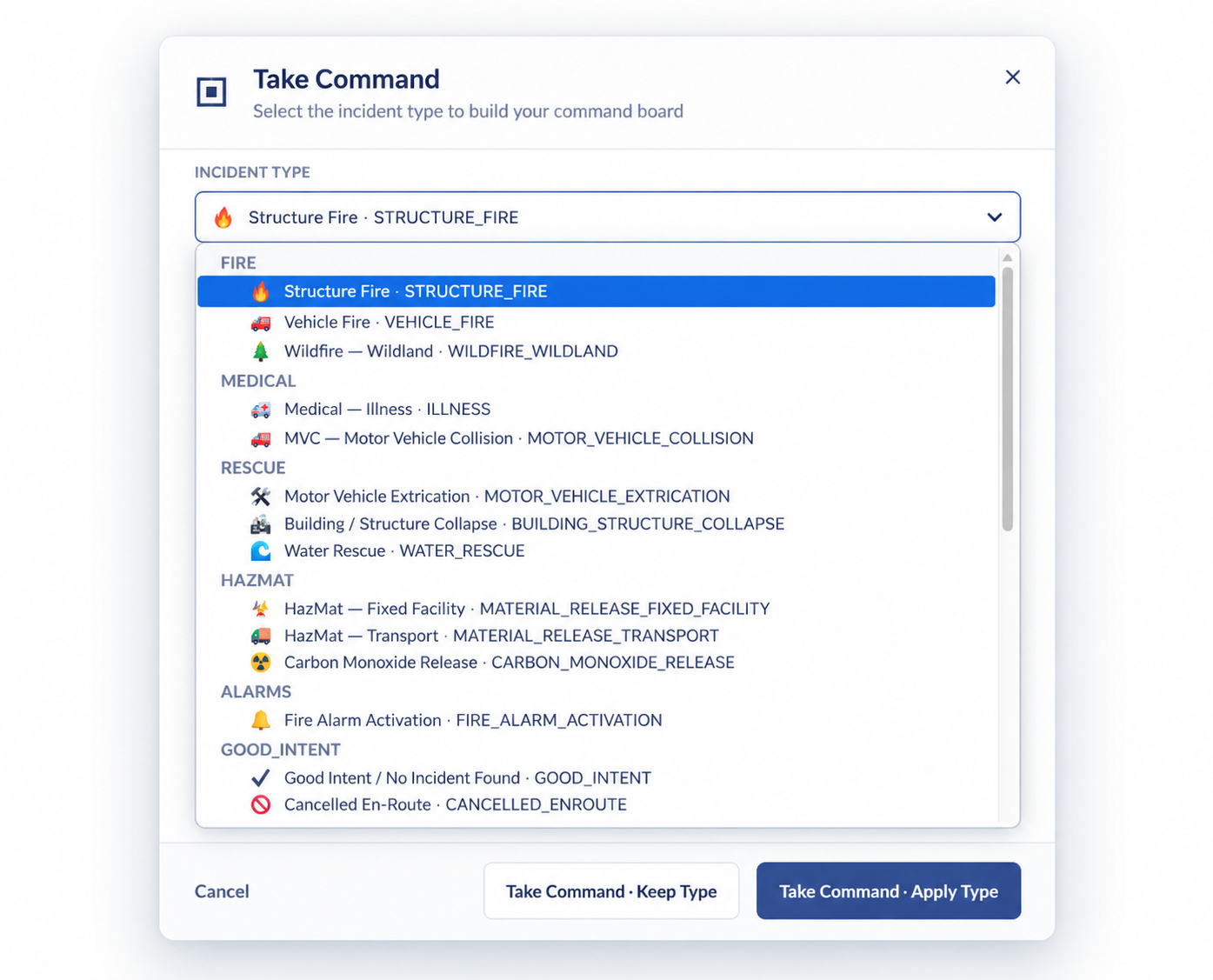
Take Command can apply an incident-type template. The built-in templates follow NERIS incident types and set up divisions, groups and checklists. One-tap benchmarks log times like Sizeup, Water on Fire, Knock Down and Under Control.
Keep Accountability Live
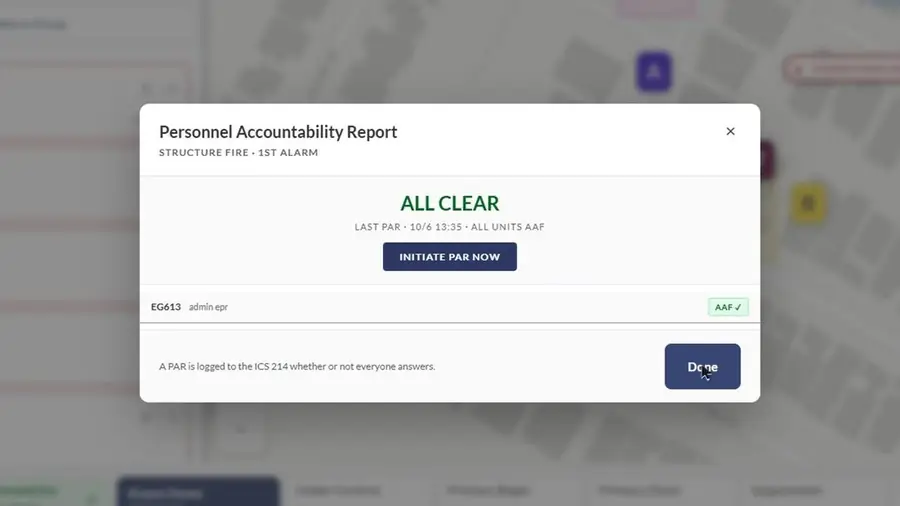
Firefighters answer a PAR from their own device, with re-ping and All Clear. Every PAR is logged to the ICS 214, whether or not everyone answers. A Mayday reaches every device and starts a PAR, and only Command resolves it.
Close the Call With the Record Already Written
When you transfer command, the incoming IC gets the board, and every request and takeover is logged. Fireworks prints an ICS 201 briefing and a real ICS 214 Activity Log in the FEMA layout. It also prints an After-Action Report with automated insights.
Complete Command writes benchmark times, completed tactical actions mapped to NERIS codes and rehab entries into the incident report. It never overwrites what the records officer already entered. See the Incident Command solution for the full picture.
Frequently Asked Questions About the Incident Command System
What are the five functional areas of ICS?
FEMA's NIMS doctrine lists Command, Operations, Planning, Logistics and Finance/Administration. Each is staffed only when the incident needs it.
What is the recommended span of control in ICS?
NIMS calls one supervisor to five subordinates optimal. It is a guideline, and the right ratio depends on the incident and the people.
What is the difference between a division and a group?
A division covers a geographic area, such as one side of a building. A group covers a function, such as ventilation or RIT, wherever it is needed.
Can mutual-aid crews join a digital command board?
In Fireworks, yes. The host department shares a time-limited join code, and guests need no Fireworks account. Guests cannot take command or print reports.
Take the Next Step Toward One Incident, One Record
ICS gives your fireground its structure. Running it in Fireworks keeps every unit tracked and the record written as the call happens. Command and the incident report live on one platform, with no second system.
See how Incident Command works inside Fireworks, or talk with our team.