Key Takeaways
Fire departments that completed their NERIS transition on schedule are now operating under the new reporting requirements, while those that missed deadlines face immediate challenges accessing federal incident reporting systems.
- The NERIS transition is complete as of February 2026, with NFIRS now permanently offline and unavailable for any submissions or edits
- Departments still experiencing issues should contact their RMS vendor immediately to verify NERIS V1 certification and resolve any outstanding data submission problems
- Successful ongoing compliance requires embedding data quality practices into daily operations with regular monitoring and staff refreshers
- Planning for continuous improvement and staying current with NERIS updates ensures long-term compliance success
Fire chiefs who approach ongoing NERIS compliance systematically will maximize the analytical capabilities this modernized platform provides.
The mandatory shift from NFIRS to NERIS represents the most significant change in fire service data management in over four decades. According to the U.S. Fire Administration, this modernization affects approximately 27,000 fire departments nationwide, and as of February 2026, the transition is now complete. While most departments with modern fire department records management systems successfully completed their migrations, some agencies are still working through challenges or optimizing their new workflows.
This practical guide provides fire chiefs and administrative officers with a clear roadmap for ensuring ongoing NERIS compliance and maximizing the benefits of the new reporting system.
Where Does the NERIS Transition Stand Now?
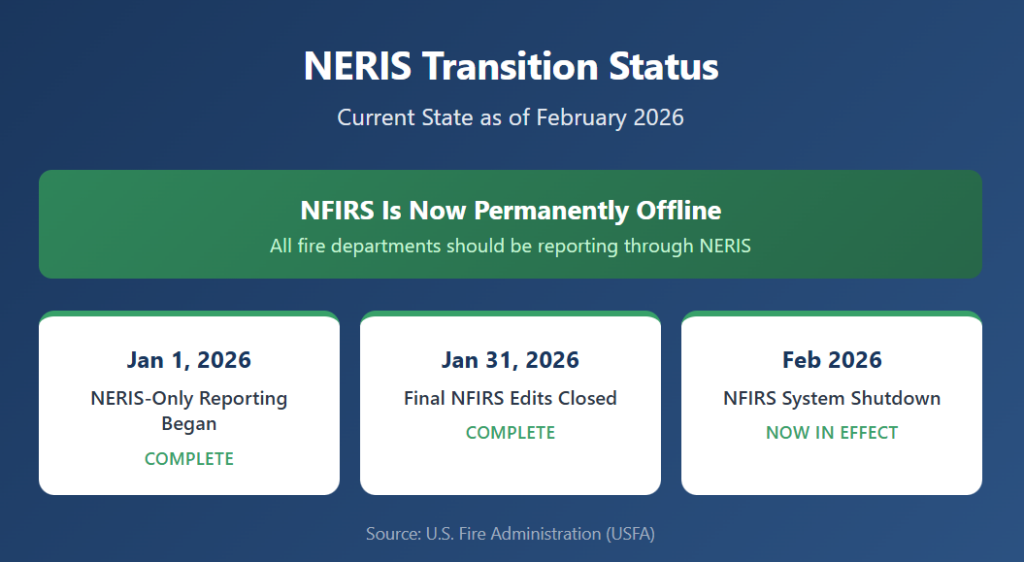
Understanding the current state of NERIS implementation helps departments assess their position and plan accordingly. The U.S. Fire Administration’s transition timeline has reached completion, and all fire departments should now be operating exclusively within NERIS.
What Happened to NFIRS?
The legacy NFIRS system went permanently offline in February 2026 after serving the fire service since 1975. All incident reporting now flows through NERIS, and there is no longer any option to submit data to the old system. Departments that completed their migration on schedule experienced minimal disruption, while those that missed key deadlines may have gaps in their reporting history.
| Milestone | Date | Current Status |
| 2026 Incidents to NERIS Only | January 1, 2026 | Complete |
| Final 2025 NFIRS Data Submission | January 15, 2026 | Deadline Passed |
| Final NFIRS Edits Allowed | January 31, 2026 | Deadline Passed |
| NFIRS System Permanently Offline | February 2026 | Now in Effect |
Historical NFIRS data from 1980 through 2025 remains accessible through OpenFEMA’s Public Data Release, but this data does not integrate directly with NERIS systems. Departments should ensure their local RMS platforms maintain comprehensive historical records consistent with their records retention policies.
What Should Departments Do If They Missed Deadlines?
Departments that missed the NFIRS to NERIS transition deadlines should take immediate action. Contact your RMS vendor to verify your system’s NERIS V1 certification status and ensure you can submit current incidents. While historical 2025 data can no longer be submitted to NFIRS, departments should document any gaps for internal records and focus on ensuring all 2026 incidents are properly captured in NERIS going forward.
For departments experiencing ongoing submission issues, the U.S. Fire Administration provides resources and support through their NERIS help desk. State fire marshal offices can also assist with compliance questions specific to your jurisdiction.
How Should Fire Chiefs Assess Their Current Reporting Infrastructure?
Before implementing any transition plan, fire chiefs need a clear picture of their department’s current capabilities and gaps. This assessment phase prevents costly mistakes and ensures a smoother migration process.
Evaluating Your Existing RMS Platform
The first step involves determining whether your current records management system supports NERIS V1 data exchange. Contact your software vendor directly and ask for documentation of their NERIS V1 certification from the Fire Safety Research Institute. Vendors without this certification cannot transmit data directly to the national system, which means your department would need to explore alternative solutions immediately.
Your assessment should also examine how your current system handles data validation. NERIS includes more stringent data quality requirements than NFIRS, with built-in validation rules that reject incomplete or improperly formatted submissions. Understanding how your software manages these validations prevents frustrating rejections during live reporting.
Identifying Data Quality Issues Before Migration
Historical data quality problems don’t disappear during the NERIS transition. They often become more visible. Conduct a thorough audit of your existing incident records, looking specifically for incomplete fields, inconsistent coding, and missing required elements. Many departments discover that their NFIRS data contains gaps that were previously accepted but won’t pass NERIS validation standards.
Consider using your RMS platform’s business intelligence reporting capabilities to generate data quality reports before migration. These reports can identify patterns of incomplete data entry that need addressing through additional staff training or workflow adjustments. Platforms designed specifically for fire department records management typically include these analytical tools.
What Are the Essential Steps for Completing the NFIRS to NERIS Migration?
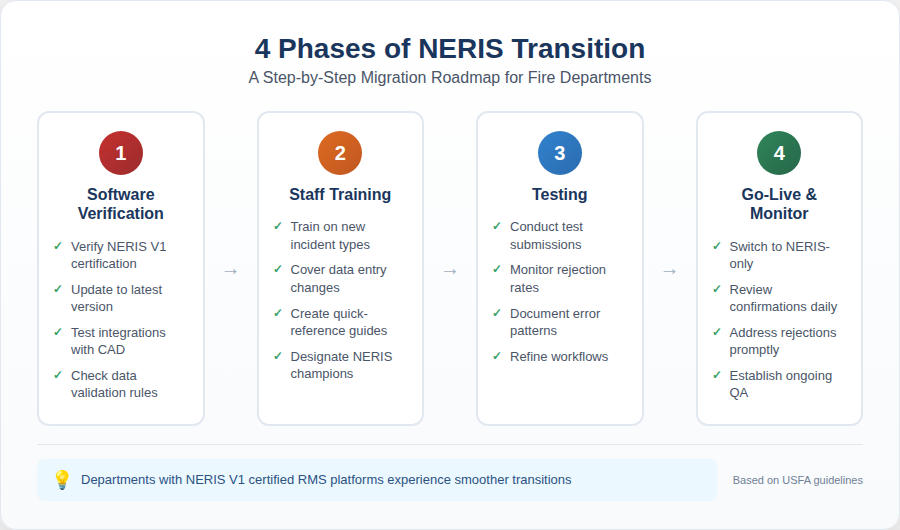
The actual migration process requires careful coordination between technology updates, staff preparation, and operational planning. Breaking this into distinct phases helps departments manage complexity while maintaining daily operations.
Phase 1: Software Verification and Updates
Confirm your RMS vendor’s NERIS V1 certification status and ensure you’re running the latest software version that includes NERIS capabilities. Schedule any necessary updates during low-activity periods to minimize disruption. Many vendors pushed significant updates throughout 2025 to prepare departments for the January 2026 deadline, so departments using outdated versions may need multiple update cycles.
During this phase, also verify that your system’s integration points are functioning correctly. If your department uses computer-aided dispatch systems or other tools that feed into your RMS, test these connections thoroughly in a non-production environment before going live with NERIS submissions.
Phase 2: Staff Training and Workflow Documentation
Personnel at every level need training specific to NERIS requirements. The new system introduces expanded incident type classifications and more detailed data collection fields than NFIRS required. Departments that invest in comprehensive training programs for the NERIS transition typically experience better data quality and fewer rejected submissions during the initial weeks of operation.
Training programs should cover new NERIS incident type classifications, revised data entry requirements, and updated validation rules. Create quick-reference guides that personnel can access during incident documentation. Many departments find that designating NERIS champions at each station helps answer questions and maintain consistency.
Phase 3: Testing Before Full Implementation
Departments with time remaining can conduct test submissions in NERIS to verify accuracy and identify training gaps before relying entirely on the new system. This approach requires additional effort but provides valuable quality assurance.
During testing, pay close attention to rejection rates and error messages. NERIS will likely reject submissions that NFIRS previously accepted, which highlights areas needing additional attention. Document these patterns to refine training materials and workflow adjustments.
Phase 4: Go-Live and Monitoring
Once testing confirms your department’s readiness, transition to NERIS-only submissions. Establish monitoring protocols to catch issues quickly during the initial weeks. Assign a specific individual to review submission confirmations and address any rejections promptly.
What Common Challenges Do Departments Face During the NERIS Transition?
Even well-prepared departments encounter obstacles during major system changes. Understanding common challenges helps fire chiefs prepare mitigation strategies in advance.
Data Mapping Complications
The NERIS system uses different field structures and incident classifications than NFIRS. Mapping existing data categories to new NERIS codes requires careful analysis to ensure historical consistency while meeting new requirements. Some incident types that were straightforward under NFIRS now require additional specificity under NERIS guidelines.
Work closely with your RMS vendor’s implementation team to understand exactly how your existing data maps to NERIS fields. Request documentation of any automated translations the system performs, and verify these translations maintain the accuracy your department requires for internal analytics.
Resistance to Workflow Changes
Personnel who have used NFIRS protocols for years may resist new procedures, especially when NERIS requires additional data collection steps. Address this proactively by explaining the benefits that better data brings to the department. Enhanced analytics capabilities, improved grant applications, and better resource allocation decisions all stem from higher quality incident data.
Integration Challenges With External Systems
Departments that share data with county or regional systems, state fire marshal offices, or mutual aid partners may encounter integration complications. Verify that all connected systems are also NERIS-compatible and that data exchange protocols have been updated accordingly.
Which Features Should Fire Chiefs Prioritize in NERIS-Compatible Software?
For departments evaluating new RMS platforms during this transition, certain capabilities prove particularly valuable for ongoing NERIS compliance.
Five Critical Features for NERIS Success
- Automated validation rules that catch incomplete submissions before they’re transmitted, reducing rejection rates and administrative rework
- Real-time data quality dashboards that identify patterns of incomplete entries and training gaps as they emerge rather than months later during audits
- Mobile-friendly incident entry that allows personnel to complete documentation accurately from any location using tablets or smartphones
- Integrated historical data migration tools that preserve your department’s incident history while converting it to NERIS-compatible formats
- Ongoing compliance monitoring that alerts administrators to changes in NERIS requirements and automatically updates validation rules
Questions to Ask Your Software Vendor
During vendor evaluations, ask specific questions about their NERIS implementation. Request evidence of their NERIS V1 certification. Ask about their update schedule and how quickly they respond to NERIS specification changes. Inquire about their customer support structure for compliance-related questions.
Understanding your vendor’s approach to NERIS helps predict their responsiveness as requirements continue evolving in the coming years. Departments benefit from partners who understand the unique demands of fire department operations and respond quickly to regulatory changes.
How Can Departments Maintain Compliance After the Initial Transition?
Completing the initial NERIS transition marks the beginning, not the end, of ongoing compliance responsibilities. Sustainable compliance requires embedding data quality practices into daily operations.
| Compliance Area | Frequency | Responsible Party | Key Actions |
| Submission Monitoring | Daily | Shift Officers | Review confirmations, address rejections |
| Data Quality Review | Weekly | Administrative Staff | Analyze completion rates, identify training needs |
| System Updates | As Released | IT/Admin | Install vendor updates, verify functionality |
| Training Refreshers | Quarterly | Training Officer | Address emerging issues, reinforce best practices |
| Comprehensive Audit | Annually | Fire Chief/Admin | Full compliance review, policy updates |
Building Sustainable Data Quality Practices
Implement regular data quality reviews that identify issues before they become compliance problems. Many departments establish weekly review processes where administrative staff examine recent submissions for patterns of incomplete data or coding inconsistencies.
Create accountability structures that make data quality everyone’s responsibility. When personnel understand how their incident documentation affects departmental analytics and funding opportunities, they typically give greater attention to accuracy.
Planning for Future NERIS Updates
NERIS will continue evolving as the fire service identifies improvements to national data collection. Select software partners with demonstrated track records of adapting to regulatory changes. Platforms built on modern, cloud-based architecture typically implement updates more rapidly than legacy systems with on-premise dependencies.
Frequently Asked Questions About the NERIS Transition
What happens if our department hasn’t completed the transition yet?
Departments that haven’t completed their NERIS transition should act immediately. All 2026 incidents must be reported through NERIS, and the deadline to submit 2025 NFIRS data is January 15, 2026. Contact your RMS vendor today to verify your system is NERIS-ready and begin training personnel on the new requirements.
Can we access our historical NFIRS data after the transition?
Historical NFIRS data from 1980 through 2025 will remain available through OpenFEMA’s public data releases. However, this data won’t integrate directly with NERIS systems, so departments should ensure their local RMS platforms maintain comprehensive historical records for internal use and comply with local records retention policies.
How do we verify our software vendor’s NERIS certification?
Ask your vendor for documentation of their NERIS V1 Data Exchange Compatible certification from the Fire Safety Research Institute. Legitimate certifications can be verified through FSRI’s published registry of compliant platforms.
What training resources are available for our personnel?
Training resources include vendor-specific programs tailored to your RMS platform, U.S. Fire Administration webinars, state fire marshal office sessions, and Fire Safety Research Institute materials. Many RMS vendors offer integrated training modules within their platforms that simplify the learning process.
Take the Next Step Toward NERIS Compliance Success
The NERIS transition represents both a compliance requirement and an opportunity to modernize your department’s incident documentation and analytics capabilities. Departments that complete this transition thoughtfully position themselves for better data quality, enhanced reporting capabilities, and improved operational insights.
Fire departments seeking NERIS-compatible solutions that integrate incident reporting with comprehensive records management, training documentation, and community risk reduction tools should explore what EPR Fireworks offers. Their cloud-based platform includes NERIS V1 certification and ongoing compliance support. Schedule a conversation to discuss how their solutions can support your department’s transition and long-term operational excellence.