Key Takeaways
Fire department data quality directly determines compliance outcomes, grant eligibility, and operational decision-making accuracy across every level of your organization.
- Incomplete or inconsistent incident records can disqualify departments from federal grant programs and negatively impact ISO ratings
- Modern RMS platforms with built-in validation tools reduce data entry errors by flagging missing fields before report submission
- The transition from NFIRS to NERIS has introduced stricter data standards that demand immediate attention
- Establishing clear data entry protocols and regular auditing processes transforms reporting from a compliance burden into a strategic asset
Departments that invest in fire RMS data integrity now will be best positioned for regulatory changes and data-driven operations.
Fire chiefs understand that records management touches every aspect of department operations. What often gets overlooked is how the quality of data within those systems ripples outward to affect everything from federal funding eligibility to insurance classifications. Fire department data quality has become a critical operational concern as regulatory requirements tighten and agencies increasingly rely on incident data to justify budgets, allocate resources, and demonstrate community value.
The U.S. Fire Administration has emphasized the importance of accurate fire incident reporting for decades, yet studies consistently show significant inconsistencies in how departments record and submit their data. These gaps create real consequences. Missing fields, inconsistent coding, and delayed submissions compound into systemic problems that undermine analytical accuracy and compliance standing. With NERIS now in effect and stricter data standards being enforced, addressing data quality has become more urgent than ever.
Why Does Fire Department Data Quality Matter for Compliance?
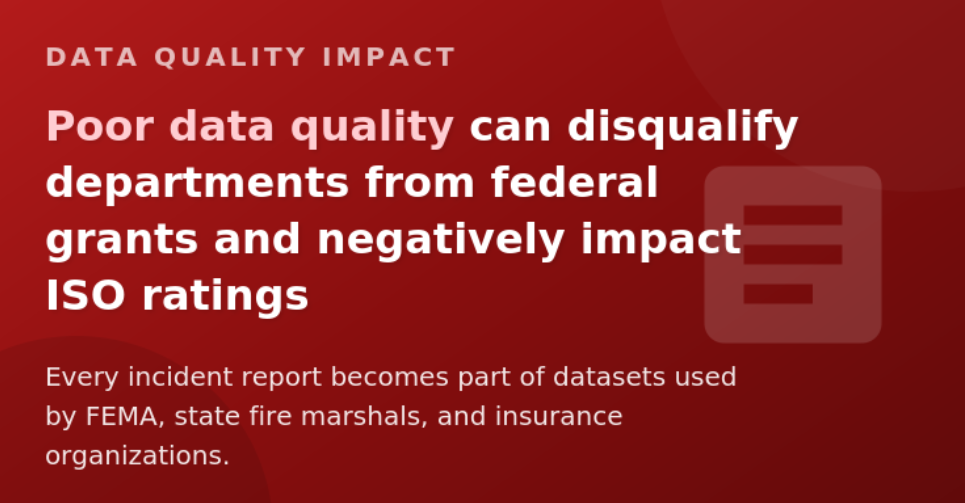
Data quality sits at the intersection of operational efficiency and regulatory compliance. Every incident report your department submits becomes part of a larger dataset used by federal agencies, state fire marshals, and insurance rating organizations to make decisions affecting your department and community.
Grant Eligibility and Federal Funding
The Assistance to Firefighters Grant program explicitly requires participating departments to submit complete and accurate incident data through NERIS. Departments with poor submission histories or incomplete records face reduced competitiveness when applying for critical equipment and staffing grants. The Federal Emergency Management Agency reviews reporting compliance as part of grant evaluation, meaning fire department data quality directly influences your ability to secure funding for apparatus, protective equipment, and training programs.
Beyond AFG considerations, comprehensive incident data strengthens any grant application by providing documented evidence of community need. Departments that can demonstrate response patterns, incident types, and resource utilization through clean data tell a compelling story that reviewers can verify and support.
ISO Rating Implications
Insurance Services Office evaluations examine multiple aspects of fire department operations, including how effectively departments maintain records and document their activities. Departments maintaining ISO compliance demonstrate organizational competence through accurate, accessible data. While ISO ratings involve many factors beyond data management, poor recordkeeping signals broader operational issues that evaluators notice.
Communities with favorable ISO classifications benefit from reduced insurance premiums. Fire chiefs advocating for department resources can point to strong data practices as evidence of professional management that protects community interests. Industry research consistently emphasizes that departments with comprehensive data capabilities demonstrate stronger overall operational performance.
NFIRS Data Quality and NERIS Transition
The National Fire Incident Reporting System has collected incident data since 1975, but inconsistent submission quality has limited its analytical value. NERIS addresses these concerns through mandatory field requirements, standardized coding structures, and real-time validation that prevents incomplete submissions.
Departments accustomed to looser NFIRS data quality standards face a significant adjustment under NERIS. Fields that were previously optional are now required. Coding categories that allowed broad interpretation now demand specific selections. This transition represents both a challenge and an opportunity to establish better practices that serve long-term operational needs.
| Data Quality Issue | NFIRS Impact | NERIS Impact |
| Missing required fields | Accepted with gaps | Rejected at submission |
| Inconsistent incident coding | Submitted but skews analysis | Standardized categories required |
| Delayed report submission | May miss reporting deadlines | Real-time tracking enforced |
| Incomplete address data | Reduces mapping accuracy | GIS integration mandates precision |
| Vague narrative descriptions | Limited analytical value | Structured data supplements narratives |
What Causes Poor Data Quality in Fire Reporting?
Understanding the root causes of data quality problems helps departments develop targeted solutions rather than applying generic fixes that fail to address underlying issues.
Workflow and Timing Challenges
Firefighters complete incident reports after responding to emergencies, often while fatigued or immediately before their next call. This operational reality creates conditions where thorough documentation becomes a lower priority than immediate service delivery. Reports completed hours or days after incidents suffer from memory gaps that introduce inaccuracies.
Departments without established reporting workflows leave decisions about when and how to document incidents to individual discretion. This approach creates inconsistency across shifts, stations, and personnel that aggregates into systemic quality problems.
Training Gaps and Institutional Knowledge
New personnel often receive minimal training on incident reporting requirements beyond basic software navigation. They learn by observation and correction rather than systematic instruction, perpetuating errors across generations of department members. When experienced personnel retire or transfer, institutional knowledge about proper coding and documentation practices leaves with them.
NERIS coding structures contain hundreds of options across multiple categories. Without regular training refreshers, even experienced personnel make coding selections based on habit rather than current guidelines. Departments investing in reporting and analytics training see measurable improvements in data consistency and completeness.
Software Limitations
Legacy fire department software often lacks the validation tools that prevent incomplete submissions. Systems that accept any input without verification allow errors to accumulate unchallenged. Personnel may not realize they are making mistakes because the software provides no feedback.
Integration gaps between CAD systems, RMS platforms, and state reporting portals create additional opportunities for data loss or corruption. Manual data re-entry between systems introduces transcription errors that automated integration eliminates.
How Can RMS Tools Improve Fire RMS Data Integrity?
Modern records management systems include features specifically designed to address data quality challenges. Departments evaluating software options should prioritize these capabilities.
Built-In Validation and Error Prevention
Effective RMS platforms validate data at entry, flagging missing required fields, inconsistent coding combinations, and format errors before personnel complete their submissions. This real-time feedback allows immediate correction while incident details remain fresh, rather than requiring later review and amendment.
Validation rules can be customized to match state reporting requirements and department-specific standards. Platforms that support configurable validation help departments enforce their unique documentation requirements without limiting software functionality.
Automated Data Population
Integration with CAD systems allows RMS platforms to automatically populate incident reports with dispatch information including timestamps, addresses, and unit assignments. This automation eliminates manual entry errors while reducing the documentation burden on responding personnel.
Address validation against GIS databases ensures location data matches standardized formats, improving mapping accuracy and enabling geographic analysis. Departments using integrated systems report significant time savings and reduced error rates compared to manual entry workflows.
Reporting and Quality Monitoring
Quality improvement requires visibility into current performance. RMS platforms with built-in analytics dashboards allow supervisors to monitor completion rates, identify personnel who may need additional training, and track improvement over time. Reports highlighting common errors guide targeted training investments.
Departments committed to fire department data quality establish regular review cycles where supervisors examine submissions, provide feedback, and recognize improvement. Software that facilitates these workflows encourages sustained attention to data practices.
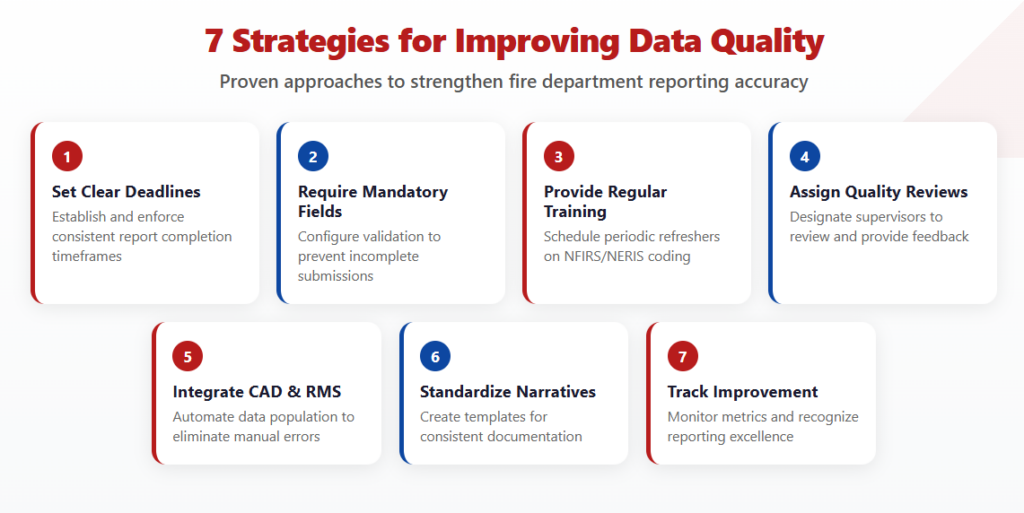
7 Strategies for Improving Fire Department Data Quality
Departments serious about data improvement combine technology solutions with process changes and cultural shifts that prioritize accurate documentation.
- Establish clear reporting deadlines. Set expectations for when incident reports must be completed, whether end-of-shift, within 24 hours, or another standard that balances thoroughness with timeliness. Enforce deadlines consistently across all personnel and shifts.
- Implement mandatory field requirements. Configure RMS validation to require completion of all fields necessary for state reporting and internal analysis. Prevent submission of incomplete reports rather than correcting them later.
- Provide regular coding training. Schedule periodic refresher training on NERIS coding categories, focusing on commonly confused options and recent updates. Include hands-on exercises using realistic scenarios.
- Assign quality review responsibilities. Designate personnel to review submitted reports daily or weekly, checking for completeness, coding accuracy, and narrative quality. Provide constructive feedback that helps personnel improve.
- Integrate CAD and RMS systems. Eliminate manual data transfer between dispatch and reporting systems. Automated population reduces errors while freeing personnel time for meaningful documentation.
- Create standardized narrative templates. Develop guidance for narrative sections that ensures personnel capture essential information consistently. Templates help less experienced members document incidents thoroughly.
- Track and celebrate improvement. Monitor quality metrics over time and recognize personnel and shifts that demonstrate improvement. Positive reinforcement sustains attention to data practices.
How Should Departments Prepare for NERIS Data Requirements?
The transition to NERIS introduced data standards that exceed previous NFIRS requirements. Departments that haven’t yet fully transitioned should act immediately, while those already submitting to NERIS should focus on optimizing their data quality practices.
Assess Current Data Practices
Review recent incident submissions to identify patterns of missing data, inconsistent coding, or other quality issues. Understanding your current fire department data quality baseline helps prioritize improvement efforts and measure progress. Many departments discover they have been accepting lower quality than they realized.
Evaluate Software Readiness
Confirm that your RMS platform supports NERIS data structures and validation requirements. Vendors should provide clear timelines for NERIS compatibility updates and migration support. Departments using older systems may need to plan for software transitions that could affect data quality during implementation.
Update Documentation Procedures
Revise standard operating procedures to reflect NERIS requirements, including all mandatory fields and coding standards. Personnel should understand how these requirements differ from previous practices and why accurate data matters for department operations and community safety.
| Preparation Activity | Timeline | Responsible Party |
| Audit current NERIS submission quality | Immediate | Records Manager |
| Confirm RMS vendor NERIS compatibility | Immediate | IT/Administration |
| Update reporting SOPs for NERIS standards | Q1 2026 | Training Officer |
| Conduct NERIS coding training | Q1 2026 | Training Officer |
| Test NERIS submission workflows | Q1 2026 | Records Manager |
| Monitor early NERIS submissions for quality | Ongoing | Quality Review Team |
What Role Does Leadership Play in Data Quality?
Sustainable fire department data quality improvement requires visible leadership commitment that establishes expectations and allocates resources for success.
Setting Organizational Priorities
Chiefs who communicate that accurate documentation matters create cultural expectations that influence daily behavior. When leadership treats data quality as a professional standard rather than administrative overhead, personnel respond accordingly. This messaging should extend beyond formal announcements to include consistent reinforcement in daily operations.
Allocating Training Resources
Quality improvement requires investment in training time, software tools, and supervisor capacity for review and feedback. Departments that claim data matters but fail to provide resources for improvement send mixed messages that undermine compliance efforts.
Recognizing Excellence
Acknowledging personnel who consistently submit complete, accurate reports reinforces desired behavior while demonstrating leadership attention to data practices. Recognition can be formal or informal, but should be specific enough that personnel understand what standards they achieved.
Frequently Asked Questions
How long does it take to see improvements in fire department data quality after implementing new practices?
Most departments observe measurable fire department data quality improvements within three to six months of implementing systematic changes, though full cultural shifts may take longer. Initial gains often come quickly as obvious errors get corrected, while sustained improvement requires ongoing attention to training and process refinement.
What should departments do about historical data with quality problems?
Focus resources on improving current and future submissions rather than extensively correcting historical records. Note known data quality limitations when using historical data for analysis, and establish clear documentation practices going forward.
How does fire RMS data integrity affect mutual aid relationships?
Departments that share consistent, high-quality data build trust with mutual aid partners and regional planning agencies. Poor data reflects on departmental professionalism and can complicate resource sharing arrangements where accurate incident documentation matters.
Can small or volunteer departments achieve the same data quality standards as larger career departments?
Yes, though approaches may differ based on available resources. Volunteer departments often benefit significantly from automated data population and validation tools that reduce documentation burden on members with limited time. The key is establishing realistic expectations and consistent practices regardless of department size.
Transform Your Reporting Into a Strategic Asset
Fire department data quality represents an opportunity to strengthen every aspect of department operations, from grant competitiveness to resource allocation decisions. With NERIS now in effect, the practices and tools that ensure data integrity position departments for successful compliance and data-driven decision making that serves their communities effectively.
EPR Fireworks provides cloud-based records management solutions designed by fire service professionals who understand operational realities and compliance requirements. Our platform includes built-in validation, automated data population, and comprehensive analytics that support fire department data quality improvement at every level. Contact our team today to learn how we can support your department’s reporting excellence.