Key Takeaways
Community risk reduction inspection software transforms how fire departments identify, prioritize, and address hazards before they become incidents.
- Data-driven inspection scheduling focuses limited resources on the highest-risk properties rather than spreading efforts thin across entire jurisdictions.
- Integrated CRR platforms connect historical incident data, occupancy classifications, and community demographics to build dynamic risk profiles.
- Departments using risk-based inspection software report significant improvements in compliance rates and measurable reductions in preventable fires.
Departments ready to move beyond calendar-based inspection cycles should explore platforms that combine robust analytics with practical field tools.
Fire departments have always understood that prevention saves more lives than response. Yet for decades, inspection scheduling operated on tradition rather than intelligence. Annual cycles covered every commercial property the same way, regardless of actual risk. Tight-staffed prevention bureaus stretched thin trying to reach every building on a spreadsheet while the truly dangerous properties received no special attention.
That approach no longer works in an environment where the U.S. Fire Administration reports that structure fires cause billions in property damage annually, and prevention bureaus face increasing pressure to demonstrate measurable outcomes. Community risk reduction inspection software changes this equation by transforming how departments identify priorities, allocate resources, and document their impact. Modern fire department records management now integrates prevention workflows directly alongside incident reporting and operations, creating unified platforms that support the entire fire prevention planning lifecycle.
What Is Community Risk Reduction and Why Does Inspection Software Matter?
Community Risk Reduction, commonly called CRR, represents a fundamental shift in how fire departments approach their prevention mission. Rather than treating all hazards equally, CRR methodology requires departments to identify their specific community risks, prioritize based on data, and deploy targeted interventions.
The concept emerged from the Vision 20/20 initiative and has since been adopted by major fire service organizations including the International Association of Fire Chiefs and the National Fire Protection Association. NFPA 1730 now requires that fire prevention organizations conduct community risk assessments to guide inspection program deployment.
At its core, CRR acknowledges that no department has unlimited resources. Smart allocation means understanding where fires are most likely to occur, who faces the greatest vulnerability, and which interventions produce the best return.
Community risk reduction inspection software operationalizes this philosophy. Instead of treating inspection scheduling as an administrative checkbox, these platforms analyze multiple data streams to produce actionable risk scores. Properties with high occupant loads, hazardous materials, poor compliance histories, or structural vulnerabilities rise to the top of inspection queues. Properties with strong track records and lower inherent risk receive appropriate but less frequent attention.
Breaking Down Risk Assessment Components
Effective fire prevention planning through software requires analyzing several data categories simultaneously.
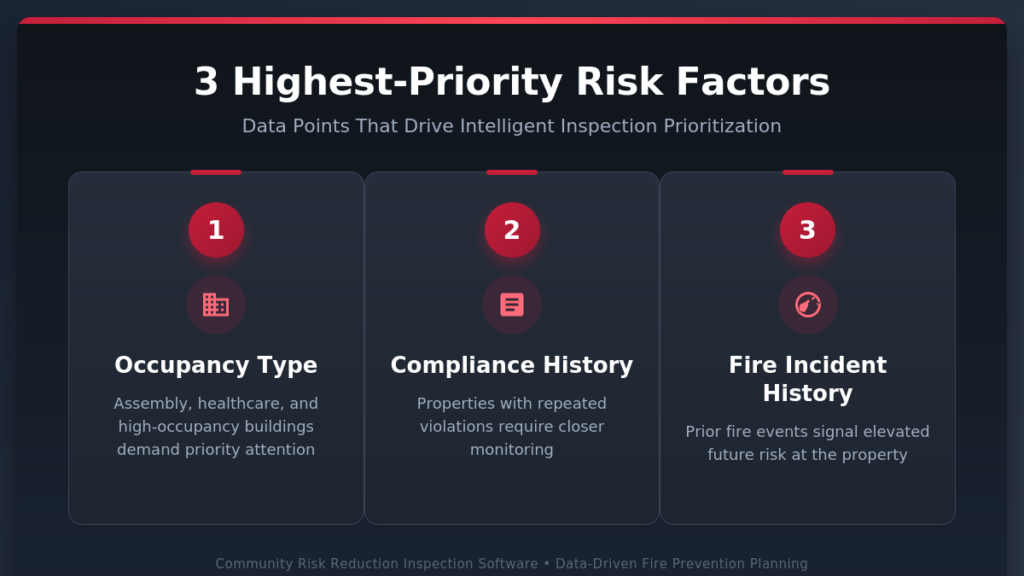
The first category involves occupancy classification and use. Assembly occupancies with high occupant loads present different risks than single-tenant office buildings. Healthcare facilities require different considerations than retail spaces. Software platforms assign baseline risk factors based on these classifications, then adjust scores as additional information becomes available.
Historical compliance data forms the second major component. Properties with repeated violations, especially those involving life safety systems like sprinklers and fire alarms, warrant closer monitoring. Risk-based inspection software tracks this history automatically, flagging problem properties before their next scheduled visit.
Geographic and demographic factors round out the analysis. Neighborhoods with aging housing stock, higher poverty rates, or limited fire department access often experience elevated fire risk. Community risk reduction inspection software can incorporate these factors into scheduling algorithms, ensuring vulnerable areas receive appropriate prevention attention.
How Does Risk-Based Inspection Software Change Daily Operations?
Prevention bureaus using traditional methods spend enormous time on scheduling logistics. Inspectors pull lists from spreadsheets, manually route their days, handwrite findings, and return to the station to enter data. The process wastes hours that could go toward actual prevention work.
Modern community risk reduction inspection software automates much of this burden. Intelligent scheduling tools generate optimized routes based on risk scores, geographic clustering, and inspector availability. Mobile applications allow field completion of inspection forms with automatic population of property data from previous visits. Digital signatures and photo documentation create defensible records without paperwork delays.
Mobile Field Tools and Real-Time Sync
Field mobility transforms inspection efficiency. Inspectors access complete property histories, including past violations, special hazards, and contact information, directly on tablets or phones. They photograph violations, annotate floor plans, and generate correction notices before leaving the property. All data syncs immediately to the central system, giving supervisors real-time visibility into bureau activity.
This immediacy matters for follow-up scheduling as well. When an inspector identifies a critical violation requiring reinspection, the system can automatically schedule that return visit based on correction deadlines. No more sticky notes or memory-dependent processes that allow dangerous conditions to slip through cracks.
Connecting Inspections to Pre-Planning
The most powerful fire prevention software platforms connect inspection data directly to operational pre-planning. Hazards identified during commercial inspections, such as chemical storage locations, unusual building construction, or locked security gates, flow automatically into pre-plan databases accessible by suppression crews.
This integration serves dual purposes. Response personnel receive more complete intelligence about buildings they may encounter during emergencies. Prevention staff gain visibility into operational concerns that should influence future inspection focus. The silos between prevention and operations dissolve when data lives in a unified records management platform.
What Data Points Drive Intelligent Inspection Prioritization?
Building a meaningful risk score requires combining multiple data sources into weighted algorithms. The best community risk reduction inspection software platforms allow departments to customize these weightings based on local priorities and risk profiles.
| Risk Factor | Data Source | Typical Weight |
| Occupancy Type | Property records, building permits | High |
| Compliance History | Previous inspection findings | High |
| Time Since Last Inspection | Scheduling system | Medium |
| Fire Incident History | Incident reporting module | High |
| Building Age | Property records | Medium |
| Life Safety System Status | Inspection records | High |
| Geographic Risk Factors | GIS integration, census data | Medium |
| Special Hazards | Permits, pre-plans | Variable |
This table illustrates how platforms might structure their scoring, though each department’s configuration will differ based on community characteristics and leadership priorities.
The Role of Historical Incident Data
Fire incident data provides perhaps the most compelling input for inspection prioritization. Properties with prior fire history, especially multiple incidents, clearly warrant increased prevention attention. But the analysis extends beyond individual addresses.
Smart platforms analyze incident patterns across property types, neighborhoods, and time periods. If a jurisdiction sees a spike in cooking fires within a particular apartment complex demographic, fire prevention planning can target similar properties for educational interventions alongside traditional inspections. If electrical fires cluster in buildings of a certain age, code enforcement can prioritize those structures.
This pattern recognition requires integrated systems where incident reporting and prevention modules share data seamlessly. Departments running separate systems for response documentation and inspection tracking miss these analytical opportunities.
Five Essential Capabilities in Community Risk Reduction Inspection Software
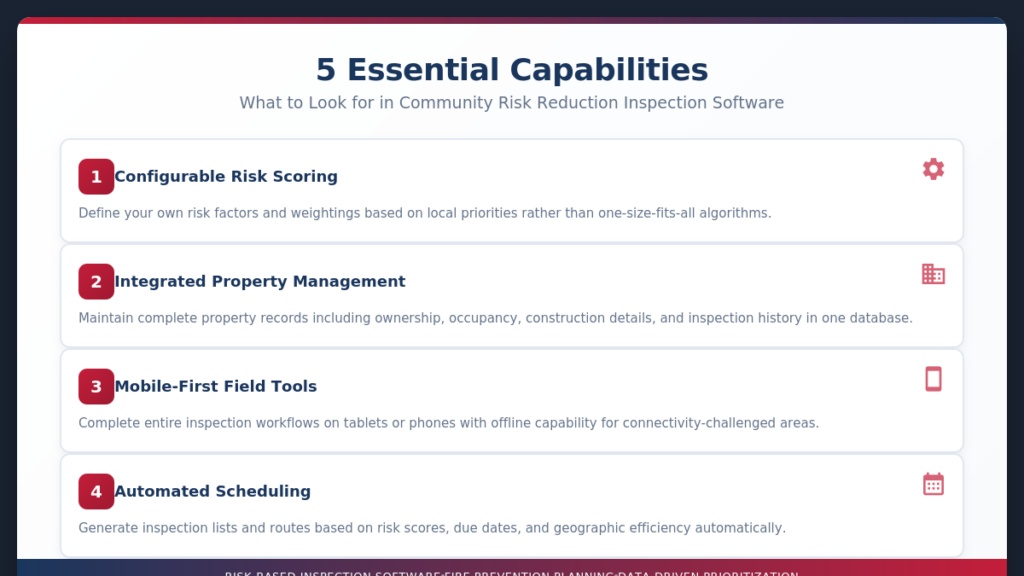
When evaluating risk-based inspection software, prevention leaders should prioritize platforms offering these core capabilities:
- Configurable Risk Scoring allows departments to define their own risk factors and weightings rather than accepting one-size-fits-all algorithms. Local priorities differ, and software should accommodate those differences.
- Integrated Property Management maintains complete property records including ownership, occupancy classification, construction details, permits, and inspection history in a single accessible database.
- Mobile-First Field Tools ensure inspectors can complete their entire workflow on tablets or phones without paper dependency. Offline capability matters for areas with connectivity challenges.
- Automated Scheduling Intelligence generates inspection lists and routes based on risk scores, due dates, and geographic efficiency rather than requiring manual queue management.
- Compliance Tracking and Reporting provides dashboards showing bureau productivity, compliance rates by property type, violation trends, and other metrics needed to demonstrate CRR program effectiveness.
Departments researching options should also consider how inspection modules connect to broader fire department software ecosystems. Standalone inspection tools create data silos that limit analytical value.
How Does CRR Software Support NERIS and Regulatory Compliance?
The fire service faces significant reporting changes as NFIRS sunsets in February 2026 and NERIS becomes the new national standard. This transition affects prevention bureaus alongside suppression operations. Departments must track and report prevention activities in new formats, and the data requirements have expanded considerably.
Modern community risk reduction inspection software builds NERIS compatibility into its foundation. Inspection records automatically capture the data elements required for national reporting. Prevention activities map to appropriate codes without requiring inspectors to understand reporting technicalities.
| Compliance Requirement | How CRR Software Helps |
| NERIS Prevention Data | Automatic field mapping, compliant data capture |
| State Reporting | Configurable export formats, scheduled submissions |
| Insurance (ISO) Audits | Comprehensive activity documentation, searchable records |
| Internal Accountability | Real-time dashboards, productivity metrics |
Beyond national requirements, departments face state-specific mandates and insurance rating considerations. Platforms with flexible reporting tools accommodate these varied needs without custom development.
What Results Can Departments Expect from Risk-Based Approaches?
Quantifying prevention effectiveness has historically challenged fire departments. Unlike suppression, where response times and outcomes provide clear metrics, prevention success often means fires that never happened. Community risk reduction inspection software helps departments demonstrate value through several measurable indicators.
Compliance rate improvements often appear first. When inspections target the highest-risk properties consistently, those properties face regular accountability. Violation correction rates typically improve as reinspection scheduling becomes automatic rather than discretionary.
Inspection efficiency gains follow as mobile tools and automated scheduling reduce administrative overhead. Prevention bureaus report completing more inspections with the same staffing once they eliminate paper processes and manual routing. That increased capacity allows coverage expansion without budget increases.
Connecting Prevention to Response Outcomes
The ultimate measure of prevention success is fire reduction, though attribution remains complex. Departments using sophisticated analytics can track fire incidence by property type, neighborhood, and other factors over time. Meaningful CRR programs should produce declining trends in preventable fires within targeted risk categories.
Incident reporting integration makes this analysis possible. When inspection and incident data live in the same platform, departments can query relationships between prevention activities and response events. Which inspected properties later experienced fires? What was the average time since last inspection? Did recent violation categories correlate with incident causes?
These questions matter for data-driven fire service decision making beyond individual property management. They inform strategic allocation of prevention resources and justify budget requests with evidence.
Common Challenges When Implementing CRR Software
Adopting community risk reduction inspection software involves more than purchasing a platform. Departments should anticipate several implementation considerations that influence success.
Data migration from legacy systems often presents the first hurdle. Historical inspection records, property databases, and violation histories contain valuable information that should transfer to new platforms. Vendors with fire service experience understand these data structures and provide migration support that preserves institutional knowledge.
Workflow change management requires attention as inspectors adapt from familiar paper processes to mobile tools. Training investments and phased rollouts help staff build confidence before full deployment. Choosing platforms with intuitive interfaces reduces the learning curve.
Risk scoring calibration takes iteration. Initial algorithm configurations may not perfectly reflect local risk realities. Departments should plan for refinement cycles where scoring weightings adjust based on observed outcomes and feedback from experienced prevention personnel.
Frequently Asked Questions
What is community risk reduction in the fire service? Community risk reduction is a strategic framework that helps fire departments identify local risks, prioritize based on data, and deploy targeted interventions. Rather than treating all hazards equally, CRR focuses resources on the people, properties, and situations facing the greatest fire risk.
How does risk-based inspection software determine property priority? These platforms analyze multiple data points including occupancy classification, compliance history, time since last inspection, incident history, building characteristics, and geographic risk factors. Configurable algorithms weight these factors to produce risk scores that drive scheduling queues.
Can CRR software integrate with existing fire department systems? Yes, modern platforms are designed for integration with incident reporting, pre-planning, training management, and other fire department modules. Unified systems provide the greatest analytical value by connecting prevention data with operational information.
What reporting capabilities should prevention bureaus expect? Quality platforms offer compliance tracking dashboards, productivity metrics, violation trend analysis, and export tools for state and national reporting requirements including NERIS. Custom report builders accommodate unique local needs.
Take the Next Step Toward Smarter Fire Prevention Planning
The traditional calendar-based inspection approach served fire departments for generations, but resource constraints and accountability expectations demand more intelligent methods. Community risk reduction inspection software provides the analytical foundation and operational tools that modern prevention bureaus need.
Departments that embrace risk-based inspection software position themselves to demonstrate measurable prevention outcomes, satisfy expanding compliance requirements, and focus their limited resources where they matter most. The technology exists today to transform how fire prevention planning operates. The question is whether departments are ready to move beyond tradition.
EPR Fireworks delivers community risk reduction inspection software designed specifically for the fire service, with integrated prevention modules that connect seamlessly to incident reporting, pre-planning, and training management. Schedule a demo to see how risk-based inspection tools can strengthen your prevention program.