Key Takeaways
Fire departments face increasing compliance complexity across NFIRS, NEMSIS, NFPA, and soon NERIS standards, making manual processes a significant liability.
- Incomplete or inaccurate incident reports remain the leading cause of compliance failures, with many departments discovering errors only during state audits
- Certification tracking gaps create both legal exposure and operational risk when personnel respond without current qualifications
- Documentation silos between fire operations, EMS, and prevention programs prevent unified compliance management and accurate reporting
- The transition to NERIS by January 2026 introduces new data requirements that will expose weaknesses in legacy reporting workflows
Departments that implement fire department compliance software with automated validation and integrated tracking can reduce reporting errors significantly while freeing administrative staff for higher-value work.
Fire and EMS leaders understand the weight of compliance obligations. Every incident report, certification renewal, equipment inspection, and training record carries regulatory implications. When errors slip through, departments face audit findings, potential funding impacts, and legal exposure that could have been prevented with better systems.
The fire service faces a growing data management challenge as reporting requirements expand across multiple regulatory frameworks simultaneously. According to the U.S. Fire Administration, fire departments must maintain accurate records across NFIRS reporting, state-specific requirements, and NFPA standards while preparing for the mandatory NERIS transition in 2026. This convergence of compliance demands exposes the limitations of spreadsheet-based tracking and paper-dependent processes.
Modern fire department compliance software addresses these challenges through automation, validation, and integration capabilities that transform compliance from a reactive burden into a manageable operational function. Understanding where departments most frequently stumble helps leaders prioritize their software evaluation criteria and implementation planning.
What Are the Most Common Fire Department Compliance Failures?
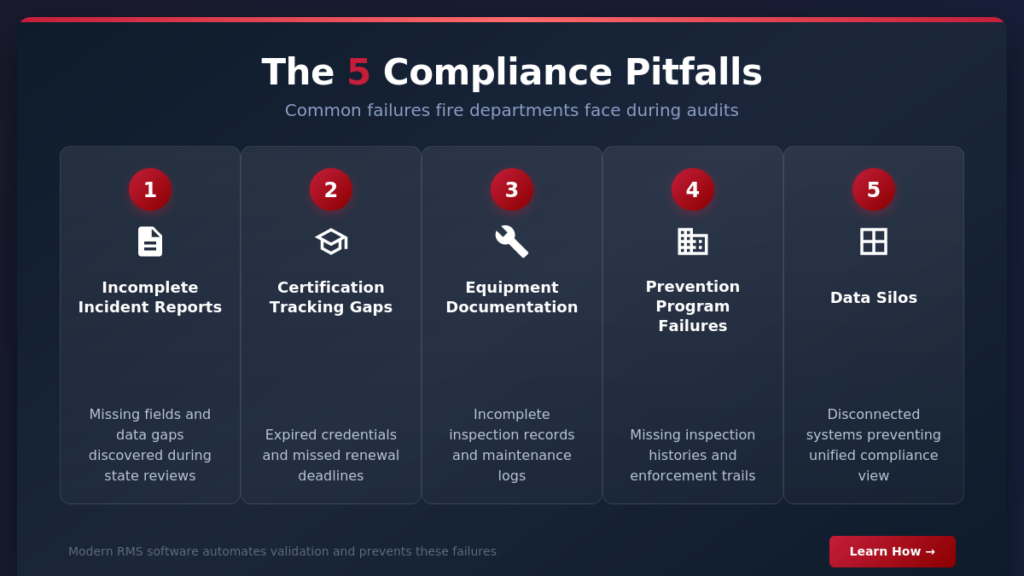
Compliance failures rarely stem from negligence. More often, they result from overwhelmed administrative staff, disconnected systems, and processes designed for simpler times. The five pitfalls examined below represent the most frequent issues identified during state audits and accreditation reviews.
Pitfall 1: Incomplete Incident Reporting Data
Incident reports form the foundation of fire department compliance, yet incomplete data remains stubbornly common. Fields left blank, narratives that lack required details, and timing inconsistencies create problems that compound over time. State fire marshal offices routinely flag submissions for missing apparatus information, incomplete address data, and narrative sections that fail to document required incident elements.
The NFIRS compliance challenge intensifies because many departments only discover reporting gaps when state agencies reject submissions or request corrections months after incidents occurred. By then, firefighters struggle to recall specific details, and the corrections themselves may introduce new inconsistencies.
Compliance software with built-in validation prevents submissions until required fields contain appropriate data. Real-time error checking catches problems immediately when details remain fresh, rather than during a state review six months later. Integrated incident reporting systems also auto-populate standard fields from CAD data, reducing manual entry errors and ensuring consistency between dispatch records and final reports.
Pitfall 2: Certification and Training Documentation Gaps
Personnel certification tracking presents a deceptively difficult compliance challenge. Firefighters hold multiple certifications with varying renewal cycles, from basic EMT credentials that require biennial renewal to specialized rescue certifications with annual requirements. Volunteer departments face particular difficulty tracking part-time personnel who may train with multiple agencies.
The consequences of certification gaps extend beyond audit findings. Departments have faced legal challenges when personnel responded to incidents without current qualifications. Insurance implications can follow when uncertified personnel provide patient care or operate specialized equipment during emergencies.
| Certification Type | Typical Renewal Cycle | Common Tracking Failure |
| EMT-Basic | 2 years | Missed CE requirements before deadline |
| Paramedic | 2-3 years | Incomplete skills verification documentation |
| Firefighter I/II | Varies by state | Lost or incomplete training records |
| Hazmat Operations | Annual refresher | Unclear tracking of refresher completion |
| Driver/Operator | Varies | Equipment-specific qualifications not linked to apparatus |
Manual tracking systems inevitably produce gaps. Spreadsheets require someone to remember to check expiration dates, send reminders, and verify renewal completion. When that person takes leave, retires, or simply gets overwhelmed with other responsibilities, certifications lapse.
Modern RMS platforms automate the entire certification lifecycle. Systems can alert personnel and supervisors of approaching expirations, track CE credits as they accumulate, and block scheduling assignments for members with lapsed credentials. Some platforms integrate with learning management capabilities that allow departments to deliver required training and automatically record completion.
Pitfall 3: Equipment Inspection and Maintenance Documentation
NFPA standards require systematic inspection, testing, and maintenance of fire apparatus and equipment. SCBA testing, pump certifications, ladder inspections, and hose testing all carry documentation requirements that extend beyond simply performing the work. Departments must demonstrate not only that inspections occurred but that results were properly recorded, deficiencies were addressed, and equipment was returned to service only after meeting all applicable standards.
The documentation chain matters as much as the inspection itself. Litigation following firefighter injuries has turned on whether departments could produce evidence that equipment was properly maintained. Accreditation reviews examine whether inspection schedules are maintained consistently and whether out-of-service periods are properly documented.
NEMSIS compliance tools add another layer for EMS equipment. Ambulance equipment inventories, medication expiration tracking, and controlled substance documentation require precise records that connect to patient care reports and regulatory oversight.
Paper-based inspection logs create predictable problems. Pages go missing, handwriting proves illegible, and locating historical records requires physical searches through filing cabinets. When audit requests arrive, staff spend hours assembling documentation that a properly configured RMS could produce in minutes.
Modern compliance software centralizes equipment records with digital inspection checklists, automated scheduling, and searchable archives. Mobile access allows firefighters to complete inspections at the apparatus and upload documentation immediately. Equipment status displays across the platform ensure everyone knows which units are in service and fully compliant.
Pitfall 4: Prevention Program Documentation Failures
Fire prevention bureaus face distinct compliance requirements that often operate separately from suppression operations. Inspection schedules, code enforcement actions, permit issuance, and violation follow-up all require documentation that supports legal proceedings if property owners challenge enforcement actions.
Many departments discover documentation gaps only when cases reach administrative hearings or court proceedings. An inspector may remember conducting multiple visits to a problem property, but without proper documentation, that history cannot support enforcement escalation. Streamlined inspection and reporting processes connect field observations to formal compliance actions with clear audit trails.
Prevention programs also generate data that departments should be analyzing for community risk reduction planning. Inspection findings reveal patterns in code compliance issues across property types and geographic areas. Without systems that capture and organize this data, valuable intelligence remains buried in individual inspection files.
Compliance software with dedicated prevention modules maintains inspection histories by property, tracks violation abatement timelines, and generates the documentation needed for legal proceedings. Integration with operations data allows analysis of how prevention activities correlate with incident patterns, supporting data-driven resource allocation decisions.
How Does Fire Department Compliance Software Reduce Risk?
Understanding common pitfalls is helpful, but departments need practical solutions. The right RMS platform addresses compliance challenges through several key capabilities that transform how agencies manage regulatory obligations.
Automated Validation and Error Prevention
The most effective compliance strategy prevents errors before they enter the system. Fire department compliance software with field-level validation ensures reports cannot be submitted with missing required data. Business rules can enforce consistency, flagging when incident times don’t align with CAD records or when selected incident types require specific data elements.
Validation rules adapt to regulatory requirements. As states implement NERIS reporting standards, platforms can update validation logic to ensure submissions meet new data element requirements. This proactive approach prevents the scramble many departments faced when previous NFIRS updates changed reporting requirements.
Integrated Compliance Dashboards
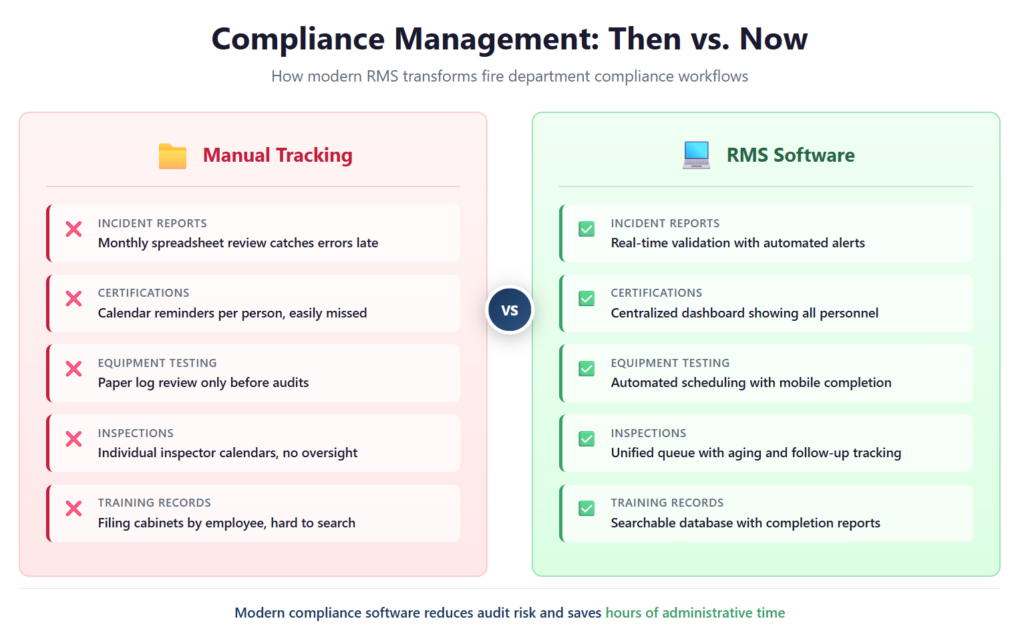
Compliance management requires visibility across multiple areas simultaneously. Dashboard displays can show certification expiration status, equipment inspection due dates, incomplete incident reports, and prevention program metrics in unified views. Leaders identify emerging issues before they become audit findings.
| Compliance Area | Manual Tracking Approach | RMS Software Approach |
| Incident Reports | Monthly spreadsheet review | Real-time completion tracking with automated alerts |
| Certifications | Calendar reminders per person | Centralized dashboard showing all personnel status |
| Equipment Testing | Paper log review before audits | Automated scheduling with mobile completion |
| Prevention Inspections | Individual inspector calendars | Unified queue with aging and follow-up tracking |
| Training Records | Filing cabinets by employee | Searchable database with completion reports |
Audit-Ready Documentation
When state audits or accreditation reviews arrive, departments using integrated compliance software respond with confidence. Rather than assembling records from multiple sources, staff generate comprehensive reports directly from the system. Complete incident histories, certification records, equipment documentation, and training logs export in formats reviewers expect.
This capability saves significant administrative time while reducing the stress associated with audit preparation. More importantly, it allows departments to conduct their own internal reviews using the same tools external reviewers will use, identifying and correcting issues before official audits occur.
What Should Departments Look for in Compliance Software?
Selecting fire department compliance software requires evaluating capabilities against specific compliance challenges. The following checklist highlights essential features that support comprehensive compliance management.
Incident Reporting Features:
- NFIRS compliance with current state requirements
- NERIS V1 compatibility for January 2026 transition
- Field-level validation with required data enforcement
- CAD integration for auto-population of response data
- Narrative templates that guide complete documentation
Personnel Management Features:
- Certification tracking with automated expiration alerts
- CE credit accumulation tracking
- Scheduling integration that blocks unqualified assignments
- Training record management with completion verification
Equipment Management Features:
- Inspection scheduling with overdue alerts
- Mobile inspection completion with photo documentation
- Maintenance history tracking by apparatus
- NEMSIS compliance tools for EMS equipment requirements
Prevention Program Features:
- Property-based inspection history
- Violation tracking with abatement timeline management
- Permit issuance and fee tracking
- Integration with operations data for risk analysis
Reporting and Analytics:
- Pre-built compliance reports matching regulatory requirements
- Customizable dashboards for leadership oversight
- Export capabilities for audit response
- Trend analysis for proactive compliance management
5 Steps to Strengthen Your Compliance Posture
Implementing new software represents one component of compliance improvement. Departments should approach compliance enhancement systematically.
First, conduct an honest assessment of current compliance gaps. Review recent audit findings, examine processes for certification tracking and equipment documentation, and identify where manual workarounds have developed.
Second, establish clear ownership for compliance functions. Designate personnel responsible for monitoring each compliance area, even when software automates much of the tracking work.
Third, implement RMS software with capabilities matched to your specific challenges. A department struggling with NFIRS compliance has different priorities than one focused on certification tracking.
Fourth, train personnel thoroughly on new systems. Software only improves compliance when staff use it consistently and correctly. Invest in onboarding and ongoing training to ensure adoption.
Fifth, establish regular compliance reviews rather than waiting for external audits. Monthly dashboard reviews catch emerging issues while corrections remain straightforward.
Frequently Asked Questions
How long does it take to implement compliance software for fire departments? Implementation timelines vary based on department size and data migration requirements. Most agencies complete initial deployment within two to four months, with additional modules and integrations following over subsequent quarters. The key is phased implementation that maintains operational continuity while transitioning to new systems.
Will compliance software work with our existing CAD system? Most modern RMS platforms offer CAD integration capabilities, though specific compatibility depends on your CAD vendor and configuration. During software evaluation, request demonstrations of CAD integration with your specific system and verify the vendor has experience with your dispatch platform.
How does NERIS affect our current compliance requirements? NERIS replaces NFIRS beginning January 2026, introducing new data elements and reporting structures. Departments using NERIS-compatible platforms can transition without workflow disruption, while those on legacy systems may face significant adaptation challenges.
What happens to our historical data when switching RMS platforms? Data migration is a standard component of RMS implementation. Quality vendors provide migration services that transfer historical incident reports, personnel records, and equipment documentation to the new platform. Verify migration capabilities and timelines during vendor evaluation.
Build Your Compliance Foundation Now
Compliance challenges will only intensify as NERIS requirements take effect and data-driven accountability expands across the fire service. Departments that address compliance gaps now position themselves for smoother transitions and reduced audit stress in the years ahead.
EPR Fireworks provides comprehensive fire department compliance software with NERIS V1 compatibility, integrated certification tracking, and equipment management capabilities designed by fire service professionals who understand operational compliance requirements. Schedule a conversation to explore how the right RMS platform can transform your compliance management.