Key Takeaways
The NFIRS system officially closed to new incidents on January 1, 2026, making NERIS fire department software with integrated business intelligence capabilities essential for departments navigating this historic transition.
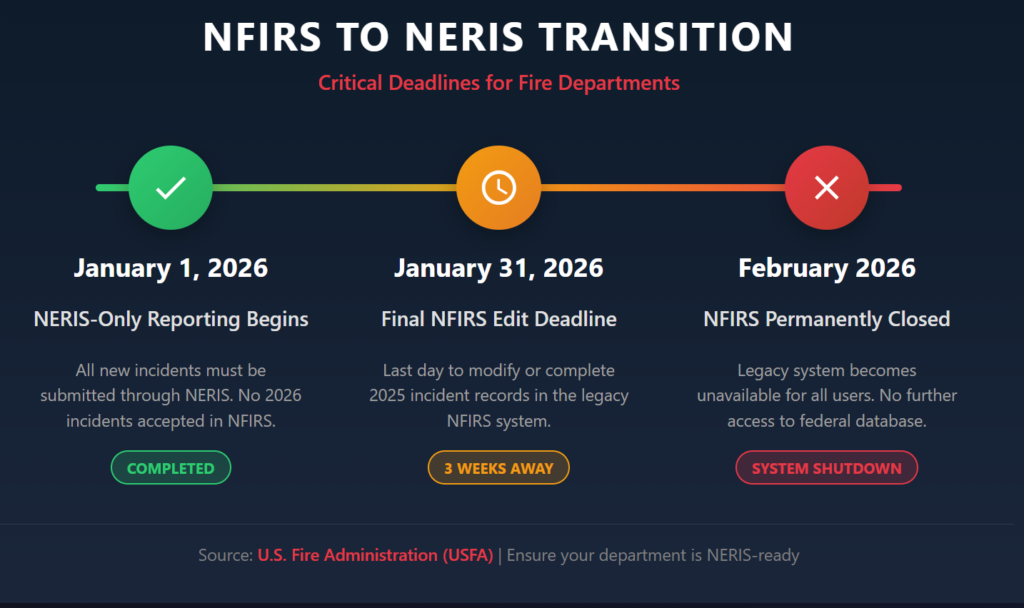
- The January 31, 2026 deadline for final NFIRS edits is just weeks away, after which the legacy system becomes permanently unavailable
- Historical NFIRS data remains valuable when properly migrated into modern analytics platforms that support both legacy records and new NERIS data models
- Fire data visualization tools reveal operational patterns in response times, resource allocation, and community risk that spreadsheets cannot match
- Departments leveraging business intelligence alongside NERIS compliance report stronger grant applications, improved ISO ratings, and more confident budget presentations
Selecting NERIS fire department software with robust analytics capabilities should be the priority for every department finalizing their data infrastructure this month.
Fire departments generate massive amounts of operational data through every shift, every incident, and every training session. Yet for decades, much of that data sat trapped in disconnected systems or paper files, offering little strategic value beyond basic compliance reporting. The mandatory transition from NFIRS to NERIS has fundamentally changed this equation, and with the final NFIRS deadline now just weeks away, departments must act decisively.
Modern NERIS fire department software platforms now include sophisticated business intelligence capabilities that transform how chiefs and administrators understand their operations. Rather than simply meeting federal reporting requirements, forward-thinking departments are using this transition as a catalyst to finally unlock the strategic potential hidden within their incident data. The departments making this connection between compliance and intelligence will gain significant advantages in everything from budget negotiations to community risk reduction.
What Makes NERIS Fire Department Software Different from Legacy Systems?
The shift from NFIRS to NERIS represents far more than a simple software update or reporting format change. NERIS was built from the ground up as a cloud-native platform designed for real-time data exchange, advanced analytics, and seamless integration with modern fire department technology infrastructure.
Legacy NFIRS systems required batch submissions, often through clunky interfaces that frustrated users and limited analytical capabilities. NERIS changes this paradigm entirely. The platform supports real-time API connections that allow data to flow automatically between CAD systems, records management platforms, and the federal repository. This connectivity creates opportunities for fire data visualization tools that simply were not possible under the old architecture.
Enhanced Data Models Support Deeper Analysis
NERIS captures significantly more granular information about each incident than NFIRS ever did. The expanded data model includes enhanced geographic information through polygon mapping, more detailed resource tracking, and comprehensive all-hazards coverage that extends beyond traditional fire incidents. This richer data foundation supports more sophisticated analytics and better decision-making.
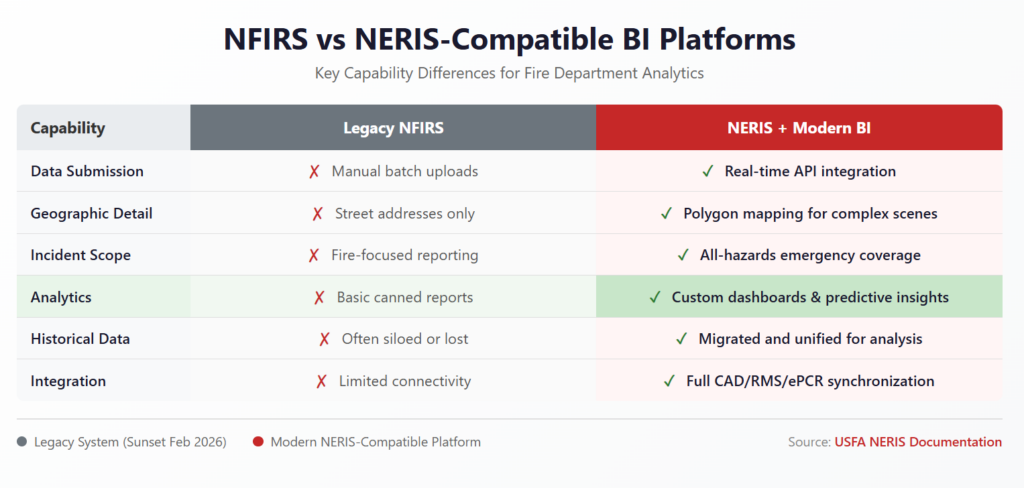
| Capability | NFIRS Era Systems | NERIS-Compatible BI Platforms |
| Data Submission | Manual batch uploads | Real-time API integration |
| Geographic Detail | Street addresses only | Polygon mapping for complex scenes |
| Incident Scope | Fire-focused reporting | All-hazards emergency coverage |
| Analytics | Basic canned reports | Custom dashboards and predictive insights |
| Historical Data | Often siloed or lost | Migrated and unified for trend analysis |
| Integration | Limited connectivity | Full CAD/RMS/ePCR synchronization |
The analytical advantages compound over time. As departments accumulate NERIS-structured data, pattern recognition becomes more powerful and predictions become more accurate.
How Can Departments Preserve Historical NFIRS Data Value?
One concern many fire chiefs express involves their historical NFIRS data. Departments have spent years building incident databases that inform everything from staffing models to community risk assessments. The good news is that properly designed NERIS fire department software preserves this institutional knowledge through intelligent data migration.
Quality software vendors provide automated migration tools that map historical NFIRS fields to their NERIS equivalents while preserving the original data for reference. This approach ensures departments do not lose the analytical value embedded in years of incident documentation. The ability to compare pre-transition and post-transition data within a unified platform creates a continuous operational picture that spans the reporting system change.
According to the U.S. Fire Administration, historical NFIRS data from 1980 through 2025 will remain available through FEMA’s public data release on OpenFEMA, but direct system access ends permanently in February 2026. Departments should ensure their software migrates historical records locally so they remain accessible for internal analysis.
Migration Best Practices for Data Continuity
Successful data migration requires immediate action given the January 31, 2026 deadline for final NFIRS edits. Departments should work with their software vendors now to understand exactly how historical records will transfer, what manual cleanup might be needed, and how the unified dataset will support comparative analysis across the transition boundary.
The departments that prepared for the NERIS transition early gained significant advantages. Early adopters identified data quality issues in their historical records, cleaned up inconsistencies, and ensured their migration produced a solid analytical foundation. For departments still finalizing their transition, focusing on data integrity during these final weeks will pay dividends for years of future analysis.
What Fire Data Visualization Tools Should Departments Prioritize?
Modern business intelligence platforms transform raw incident data into visual insights that communicate far more effectively than spreadsheets or text reports ever could. When evaluating NERIS fire department software, chiefs should look for specific visualization capabilities that support both operational management and strategic communication.
Geographic visualization through integrated GIS mapping reveals spatial patterns in incident distribution, response times, and resource deployment that tables of numbers obscure. Heat maps showing incident density help identify high-risk areas requiring targeted prevention efforts. Time-based animations show how emergency patterns shift across days, seasons, or years.
Essential Dashboard Features for Fire Leadership
Effective fire data visualization tools provide role-specific views tailored to different stakeholders. A battalion chief needs operational dashboards showing current resource status and recent call patterns. An administrative officer needs financial analytics connecting incident data to cost tracking. A fire marshal needs inspection status overviews and compliance trend monitoring.
The best platforms allow these dashboards to be customized without requiring IT expertise or vendor involvement. Drag-and-drop interfaces enable administrators to build exactly the views their leadership team needs, then share those dashboards across the organization with appropriate access controls.
Real-time updating ensures dashboards always reflect current conditions. Unlike static reports generated weekly or monthly, live dashboards show developing trends as they emerge, enabling faster response to unusual patterns or emerging issues.
How Does Business Intelligence Strengthen Grant Applications?
Federal grant programs increasingly emphasize data-driven decision making in their evaluation criteria. The Assistance to Firefighters Grant program expects applicants to demonstrate clear understanding of their operational needs supported by evidence from incident data analysis. Additionally, departments receiving AFG funding must now agree to provide information to NERIS for the grant performance period.
NERIS fire department software with strong analytics capabilities enables departments to build compelling grant narratives backed by concrete evidence. Rather than describing staffing challenges in general terms, chiefs can present specific data showing response time impacts, call volume trends, and resource utilization patterns that justify their requests.
Data-Driven Budget Justification
The same analytics that strengthen grant applications also transform internal budget conversations. City managers and county commissioners respond better to visual data presentations than verbal descriptions of operational challenges. Fire data visualization tools allow chiefs to show elected officials exactly what their investment produces and why additional resources would improve community outcomes.
Comparative analysis features help departments benchmark their performance against regional peers or national standards. Understanding where a department stands relative to similar agencies adds context that strengthens budget requests and helps justify investment priorities.
Five Essential Questions for Evaluating Analytics Capabilities
Departments evaluating software platforms should probe vendors specifically about their business intelligence capabilities. General claims about “reporting” or “analytics” mean little without understanding the specific features available and how well they integrate with daily operations.
Consider asking vendors these key questions during evaluation:
- Can the platform visualize historical NFIRS data alongside new NERIS records in unified analyses?
- What fire data visualization tools are included versus available as add-on modules?
- How customizable are dashboards, and who can modify them?
- Does the analytics engine support predictive modeling or only historical reporting?
- How does the platform handle NERIS transition fire RMS data migration?
The vendors who answer these questions confidently with specific feature demonstrations are more likely to deliver genuine analytical value.
| Evaluation Criteria | Why It Matters | Red Flags to Watch |
| NERIS V1 Compatibility | Ensures seamless federal data exchange | Vague timeline promises without certification |
| Historical Data Migration | Preserves analytical continuity | Manual-only migration processes |
| Dashboard Customization | Enables role-specific views | IT-dependent modifications |
| Real-Time Updates | Supports operational decision-making | Batch-only reporting cycles |
| Pre-Built Reports | Accelerates time-to-value | Limited report library requiring custom builds |

How Should Departments Approach the Final NERIS Transition Fire RMS Steps?
With all new incidents now reporting exclusively through NERIS as of January 1, 2026, departments should focus these final weeks on completing their transition and maximizing the analytical value of their new systems. The January 31 deadline for NFIRS edits represents the final opportunity to ensure historical data accuracy before the legacy system becomes permanently unavailable.
A thoughtful transition strategy considers both immediate compliance requirements and longer-term operational goals around data analytics and business intelligence. Starting with a comprehensive assessment of current data infrastructure helps identify gaps and opportunities.
Final Implementation Checklist
Departments in the final stages of transition should verify several critical elements:
Complete all pending NFIRS edits before January 31, 2026. After this date, no modifications to historical records will be possible through the federal system. Work with your records management system vendor to confirm local storage of historical data.
Verify that all personnel have received adequate training on NERIS reporting workflows. The transition affects everyone from incident commanders to administrative staff entering data. Ensure each user understands how their documentation feeds into the department’s analytical capabilities.
Test dashboard configurations and report generation to confirm the system produces the insights leadership needs. The value of business intelligence depends on having the right views available to the right people at the right time.
What Role Does Data Quality Play in Effective Analytics?
Even the most sophisticated business intelligence platform produces misleading results when fed poor quality data. The NERIS transition fire RMS implementation provides an ideal opportunity to establish data governance practices that ensure ongoing analytical reliability.
Consistent data entry protocols across all shifts and stations create the foundation for valid comparisons and reliable trend detection. When different crews record similar incidents differently, aggregate analysis becomes unreliable and decisions based on that analysis become risky.
Training programs should emphasize why data quality matters for department operations. Firefighters who understand how their incident reports feed into analyses that affect staffing, budgets, and strategic planning take greater care in their documentation.
Automated validation rules built into NERIS fire department software catch errors at the point of entry rather than discovering them months later during analysis. Real-time feedback helps users correct mistakes immediately while incident details remain fresh in their memory.
Frequently Asked Questions
Will my department lose access to historical NFIRS data after the transition?
Historical NFIRS data from 1980 through 2025 will remain available through FEMA’s public data release on OpenFEMA, but direct system access ends permanently in February 2026. Departments should ensure their NERIS fire department software has migrated historical records locally so they remain accessible for internal analysis without depending on federal archives.
How do fire data visualization tools help with ISO ratings?
ISO evaluations consider multiple factors including response time performance, resource deployment, and operational readiness documentation. Analytics dashboards that track these metrics help departments identify improvement opportunities and demonstrate compliance with ISO requirements during evaluations. Better documentation often correlates with improved ratings.
What happens if our department missed the January 1, 2026 NERIS start date?
The legacy NFIRS system no longer accepts new incident reports for 2026. Departments must immediately transition to NERIS-compatible software to maintain federal reporting compliance. Contact your software vendor urgently to expedite onboarding. Missing this transition can affect grant eligibility and state reporting requirements.
Can small departments with limited budgets afford effective analytics software?
Cloud-based NERIS fire department software typically uses subscription pricing models that scale with department size, making sophisticated analytics accessible to smaller agencies that could never afford enterprise software purchases. Many vendors offer tiered pricing that provides essential features at lower cost points with premium analytics available as upgrades.
Transform Your Data Strategy in the Post-NFIRS Era
The convergence of mandatory NERIS compliance and advancing business intelligence technology has created a pivotal moment for fire department data strategy. Departments that are approaching this transition as merely a compliance exercise will meet the deadline but risk missing the larger opportunity. Those who recognized the analytical potential embedded in modern NERIS fire department software platforms will emerge with capabilities that strengthen every aspect of their operations.
EPR Fireworks provides comprehensive NERIS V1 compatible solutions with integrated business intelligence designed specifically for fire and EMS agencies navigating this critical transition. Our unified Records Management System ensures seamless compliance while delivering the analytical insights that transform data into strategic advantage.
Ready to see how data-driven fire service operations work in practice? Schedule a demonstration with our team and experience the difference modern analytics make for departments like yours.