
Key Takeaways
Modern fire department software delivers measurable improvements in emergency response by eliminating manual bottlenecks and accelerating every stage of incident management.
- Over 60% of fire departments now use digital solutions, with 52% integrating real-time data platforms to speed decision-making
- Cloud-based RMS systems reduce documentation time by enabling field access and eliminating duplicate data entry
- Integrated ePCR and incident reporting tools streamline the handoff between dispatch, response, and patient care
- Departments investing in unified software platforms report improved turnout times and better resource allocation
If your department struggles to meet NFPA 1710 benchmarks, prioritizing software modernization may deliver faster results than adding apparatus or stations.
Every second counts in emergency response. When a structure fire reaches flashover within minutes and cardiac arrest outcomes deteriorate rapidly without intervention, the difference between a four-minute response and a six-minute response becomes the difference between a save and a tragedy. Fire chiefs nationwide recognize this reality, yet many departments still rely on fragmented systems that slow everything from dispatch to documentation.
The fire service is experiencing a digital transformation that fundamentally changes how departments manage information, allocate resources, and track performance. According to recent market analysis, over 60% of fire departments have now adopted digital solutions, with 52% integrating real-time data platforms into daily operations. This shift reflects a growing understanding that fire department software efficiency directly impacts response capability, operational costs, and community outcomes.
This guide examines seven specific ways modern software solutions improve emergency response times and operational performance. Whether your department serves a rural community or a metropolitan area, these principles apply across the board.
How Does Fire Department Software Efficiency Reduce Response Times?
Response time consists of several discrete phases: call processing, turnout, travel, and scene setup. NFPA 1710 establishes clear benchmarks for career departments, including an 80-second turnout time and 240-second travel time for the first arriving engine. Meeting these standards requires optimization at every stage, and software plays a critical role in each one.
Traditional paper-based systems and disconnected software applications create friction that accumulates throughout the response process. A dispatcher manually re-entering address information, a crew searching for pre-plan details on arrival, or a captain completing paperwork hours after an incident all represent delays that compound over time. Fire department software efficiency eliminates these friction points through automation, integration, and real-time data access.
The relationship between technology adoption and operational performance is well documented. Departments implementing comprehensive records management systems report improvements across multiple metrics, from reduced documentation time to faster turnout and improved resource utilization.
Real-Time Dispatch Integration
Modern fire RMS software connects directly with computer-aided dispatch systems, eliminating the delay between call receipt and crew notification. When a 911 call comes in, integrated systems automatically push incident details to station alerting systems, mobile devices, and apparatus displays simultaneously.
This integration removes manual steps that traditionally added significant time to the dispatch process. Address verification, unit selection, and incident typing happen automatically based on predetermined protocols. Crews receive complete incident information before they leave the station, reducing scene arrival uncertainty and improving initial tactical decisions.
Mobile Access to Pre-Incident Plans
Pre-incident planning represents one of the most valuable resources for improving on-scene effectiveness. Detailed building layouts, hazard locations, utility shutoffs, and tactical considerations can dramatically improve crew safety and incident outcomes. The challenge has always been getting this information into firefighters’ hands when they need it most.
Cloud-based fire incident management software solves this problem by making pre-plans accessible from any device with an internet connection. Responding crews can review building layouts, hydrant locations, and known hazards while en route. Integrated hydrant management ensures flow rates, test history, and precise locations display alongside building pre-plans, giving crews complete tactical awareness before arrival. This preparation time translates directly into faster water on fire and more effective rescue operations.

What Role Does Integrated Data Play in Improving EMS Software Efficiency?
Fire departments running EMS operations face unique documentation challenges. Patient care reports require detailed information captured under time pressure, and the handoff between field providers and hospital staff demands accuracy. Fragmented systems that separate ePCR software from the department’s RMS create duplicate data entry, inconsistent records, and compliance risks.
Integrated platforms eliminate these problems by sharing data automatically between incident documentation and patient care modules. Scene address, unit assignments, response times, and personnel information flow directly into the patient care record without manual re-entry. This integration improves documentation accuracy while reducing the administrative burden on crews.
| Software Capability | Operational Benefit | Strategic Impact |
| CAD Integration | Faster crew notification, reduced manual entry | Consistent response time data for benchmarking |
| Mobile Pre-Plans | En-route tactical preparation | Improved ISO ratings through documentation |
| Integrated ePCR | Single data entry, NEMSIS compliance | Better clinical outcome tracking |
| Automated Alerting | Redundant notification channels | Reduced missed responses |
| Cloud Architecture | Access from any location | Eliminated server maintenance costs |
The efficiency gains extend beyond individual incidents. Departments using integrated systems build comprehensive databases that support trend analysis, quality improvement, and strategic planning. When fire RMS software and ePCR documentation share a common platform, chiefs gain visibility into patterns that would be invisible with disconnected systems.

NEMSIS Compliance and Data Quality
National EMS Information System (NEMSIS) compliance requires accurate, complete documentation submitted in standardized formats. Manual processes frequently result in rejected submissions, incomplete records, and administrative rework. Modern EMS software efficiency depends on built-in validation that catches errors before submission and maintains compliance automatically.
Integrated systems also support better clinical outcomes through complete documentation. When patient care records connect to incident data, quality reviewers can correlate response times with patient outcomes, identify training needs, and benchmark performance against regional and national standards.
How Do Automated Alerts and Notifications Speed Department Operations?
Automation represents one of the most significant opportunities for improving fire department software efficiency. Routine tasks that previously required manual attention can happen automatically, freeing personnel to focus on higher-value activities while ensuring nothing falls through the cracks.
Certification and Training Management
Personnel readiness directly impacts emergency response capability. Expired certifications, missed training requirements, and scheduling conflicts all create operational risks that compound over time. Modern training management modules automatically track individual credentials, send renewal reminders, and flag compliance gaps before they become problems.
Automated training management ensures departments maintain the qualified workforce necessary for effective emergency response. When certification tracking happens automatically, training officers can focus on curriculum development and hands-on instruction rather than administrative tracking.
Equipment Maintenance Scheduling
Apparatus and equipment failures during emergency response create dangerous situations and operational delays. Preventive maintenance programs reduce these risks, but manual tracking often results in missed service intervals or unnecessary downtime.
Automated maintenance scheduling based on hours of operation, mileage, or calendar intervals ensures equipment stays response-ready. Integration with inventory management modules tracks parts availability and service history, supporting both reliability and budget planning.
What Features Should Chiefs Look for in Fire Incident Management Software?
Selecting the right software platform requires understanding both immediate needs and long-term strategic objectives. The fire department software efficiency gains possible today will look different five years from now as technology continues advancing. Chiefs should prioritize platforms that balance current functionality with future adaptability.
Look for vendors with actual fire service experience on staff. Platforms designed by people who have worn the gear understand operational workflows in ways generic software developers simply cannot replicate. This expertise shows up in intuitive interfaces, practical feature design, and support teams that speak your language.
Cloud-Based Architecture
Cloud deployment eliminates the need for on-site servers, reduces IT burden, and enables access from any location with internet connectivity. For departments with multiple stations, volunteer responders, or mutual aid agreements, cloud access ensures everyone works from the same information regardless of physical location.
The best cloud platforms work directly in your browser without requiring separate mobile app downloads, simplifying deployment across career staff and volunteers alike. This approach reduces training requirements and ensures crews can access critical information from any device without compatibility concerns.
Cloud platforms also simplify updates and maintenance. Rather than scheduling downtime for software upgrades, cloud providers implement improvements automatically. This approach ensures departments always have access to current features and security protections without disrupting operations.
Business Intelligence and Reporting
Data-driven decision making requires access to accurate, timely information presented in formats chiefs and administrators can act on. Pre-built reports covering common metrics provide immediate value, while customizable reporting tools support unique analytical needs.
| Report Category | Examples | Decision Support Value |
| Response Performance | Turnout times, travel times, total response | Identify delays, justify staffing requests |
| Incident Analysis | Call types, locations, temporal patterns | Guide prevention programs, station placement |
| Personnel Metrics | Training completion, certification status | Ensure readiness, support career development |
| Resource Utilization | Apparatus usage, equipment deployment | Optimize fleet sizing, balance workload |
| Compliance Status | NFIRS/NERIS submission, regulatory requirements | Avoid violations, support grant applications |
NERIS Compatibility
The transition from NFIRS to the National Emergency Response Information System represents a significant shift in federal reporting requirements. According to the U.S. Department of Homeland Security, NERIS launched in November 2024 as a secure, cloud-based platform developed in collaboration with the U.S. fire service to capture all-hazards incident data and provide analytic tools for departments at all levels.
Departments selecting fire RMS software today must ensure compatibility with NERIS requirements. Platforms already certified for NERIS data exchange simplify the transition and protect departments from compliance gaps during the mandatory changeover period.

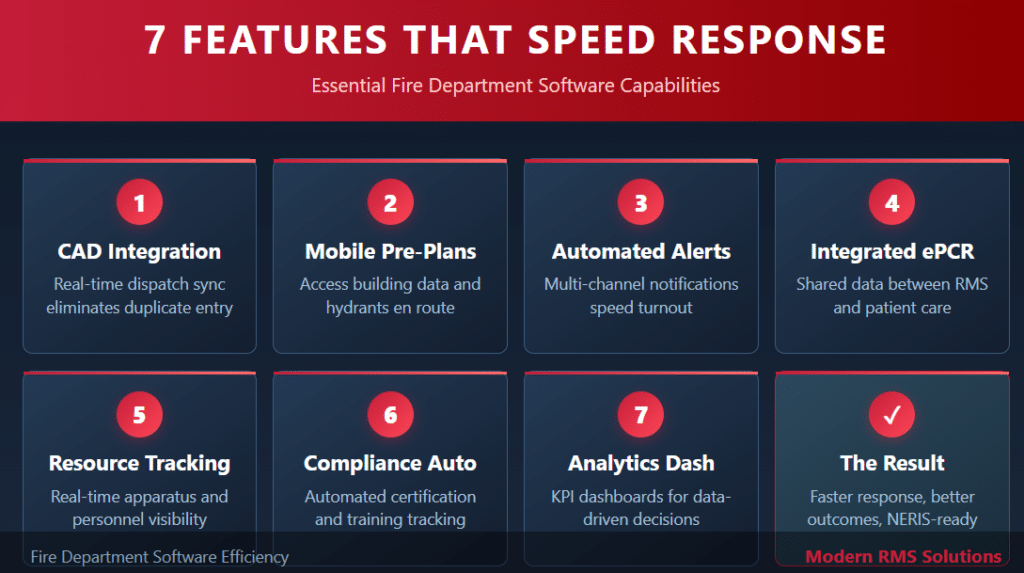
7 Essential Software Features That Improve Response Times
Understanding specific capabilities helps chiefs evaluate potential solutions and prioritize implementation efforts. These seven features consistently deliver measurable improvements in emergency response operations.
- CAD Integration eliminates duplicate data entry and ensures crews receive complete incident information from initial dispatch through incident closeout. Real-time unit status updates improve situational awareness for dispatch and command.
- Mobile Pre-Plan Access puts critical building information in firefighters’ hands during response. Hydrant locations, structural features, hazard notes, and tactical considerations improve on-scene decision making.
- Automated Alerting speeds crew notification through multiple channels including station systems, personal devices, and apparatus displays. Redundant notification reduces missed alerts and improves turnout consistency.
- Integrated ePCR streamlines EMS documentation by sharing incident data automatically. Patient demographics, response information, and unit assignments populate without manual entry.
- Resource Tracking provides real-time visibility into apparatus location, personnel assignments, and equipment status. Dispatch optimization ensures closest appropriate unit response.
- Compliance Automation maintains training records, certification tracking, and reporting requirements without manual intervention. Proactive alerts prevent lapses before they create operational problems.
- Analytics Dashboards present key performance indicators in formats that support both daily operations and strategic planning. Response time trends, workload distribution, and resource utilization inform continuous improvement efforts.

How Does the NERIS Transition Affect Software Selection?
Fire departments face a mandatory transition as the National Emergency Response Information System rolls out to 27,000 fire departments nationwide, with full operation expected by the end of 2026. This timeline creates urgency for departments still using legacy systems or platforms without NERIS certification.
The transition represents more than a simple reporting format change. NERIS introduces standardized data definitions, direct vendor interfaces, and geospatial capabilities that fundamentally improve how departments collect and utilize incident information. Early adopters report significant improvements in data quality and analytical capability.
Chiefs evaluating fire department records management options should prioritize NERIS-certified vendors to avoid compliance disruptions. Platforms with established certification have demonstrated compatibility with federal requirements and can support smooth transitions for departments making the switch.
Data Migration Considerations
Moving from legacy systems to modern platforms requires careful planning for data migration. Historical incident records, personnel files, and equipment inventories represent valuable institutional knowledge that must transfer accurately.
Reputable vendors include comprehensive data migration services as part of implementation. The migration process typically involves exporting data from existing systems, mapping fields to new structures, validating accuracy, and confirming completeness before going live.
Frequently Asked Questions
How quickly can fire department software efficiency improvements be measured?
Most departments see immediate improvements in documentation time and data quality following implementation. Response time improvements typically become measurable within three to six months as crews adapt to new workflows and automated processes reach full adoption. Long-term strategic benefits from improved analytics and trend identification continue building over several years.
What is the typical implementation timeline for modern fire RMS software?
Implementation timelines vary based on department size, data migration complexity, and integration requirements. Small departments with straightforward needs may complete implementation in four to eight weeks. Larger departments or those requiring extensive data migration and custom integrations should plan for three to six months from contract signing to full deployment.
How does cloud-based software handle internet outages during emergencies?
Quality cloud platforms include offline capability that allows continued operation during connectivity disruptions. Data entered offline synchronizes automatically when connection restores. Critical functions like pre-plan access and incident documentation remain available even without real-time cloud connectivity, ensuring operational continuity during the emergencies when systems matter most.
What training is required for crews to effectively use new software?
Modern fire department software prioritizes intuitive interfaces that minimize training requirements. Most platforms require a few hours of initial training for basic users, with additional instruction for advanced features and administrative functions. Ongoing training needs are minimal once crews become familiar with standard workflows.
Take the Next Step Toward Faster Response
Fire department software efficiency has moved from competitive advantage to operational necessity. Departments that embrace modern platforms gain measurable improvements in response times, documentation accuracy, and resource utilization. Those that delay face growing compliance challenges as NERIS requirements take effect and community expectations for emergency response continue rising.
The technology investments departments make today will shape operational capabilities for years to come. EPR Fireworks provides the integrated, cloud-based platform fire and EMS agencies need to meet current demands while preparing for future challenges. Schedule a demo today to see how a unified RMS can transform your department’s response capability.

