Key Takeaways
Choosing the right fire RMS vendor requires asking pointed questions that go far beyond feature checklists and pricing quotes.
- NERIS compliance by January 2026 makes vendor readiness a non-negotiable evaluation criterion for any department considering new software
- Data ownership, integration capabilities, and hidden costs often determine long-term satisfaction more than initial feature sets
- True cloud architecture versus hosted solutions creates significant differences in scalability, updates, and total cost of ownership
- Vendor industry expertise and ongoing support quality directly impact implementation success and user adoption rates
Before signing any contract, create a structured RMS evaluation checklist that addresses compliance timelines, integration needs, and your department’s growth trajectory.
Selecting fire department records management software ranks among the most consequential technology decisions your department will make this decade. The wrong choice means years of workarounds, frustrated personnel, compliance headaches, and wasted budget. The right choice transforms how your department operates, reports, and serves your community.
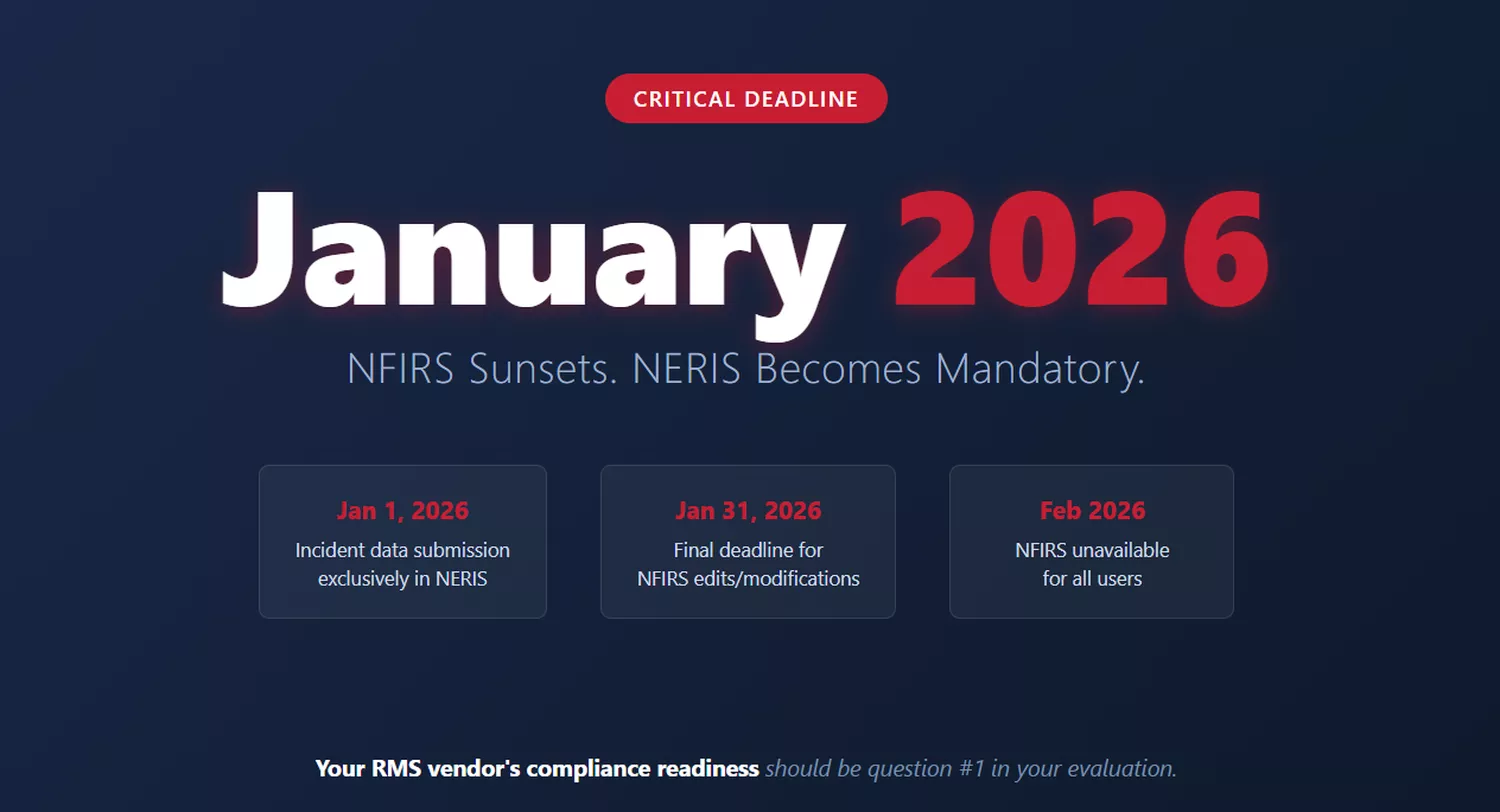
With the National Fire Incident Reporting System (NFIRS) sunsetting in February and NERIS becoming mandatory, departments across the country face unprecedented pressure to evaluate their current systems. This transition window has sparked a flurry of vendor marketing, making a thorough fire RMS vendor comparison more critical than ever.
The questions that follow cut through sales presentations to reveal what actually matters for your department’s success.
How Does Your Fire RMS Vendor Comparison Stack Up on Compliance Readiness?
The transition to NERIS represents the most significant shift in fire service data reporting since NFIRS launched decades ago. As of January 1, 2026, incident data submission is now exclusively in NERIS, with no calendar year 2026 incidents accepted in the legacy system. Departments that haven’t transitioned are already behind, and the January 31 deadline for final NFIRS edits is just weeks away.
Your first question in any fire RMS vendor comparison should be direct: What is your current NERIS certification status, and can you demonstrate validated data exchange with the federal repository? Vendors who hem and haw or offer future promises deserve immediate skepticism. Those with proven certification can show you exactly how their platform handles the expanded incident type coding, enhanced data validation, and near real-time analytics that NERIS demands.
Beyond certification status, dig into how the vendor handled previous compliance transitions. NEMSIS updates, state reporting changes, and regulatory shifts happen regularly. A vendor with a track record of proactive compliance updates demonstrates the technical capability and organizational commitment you need for long-term partnership.
Questions to Ask About Compliance
When evaluating fire department software vendors, press for specific answers on compliance readiness. Ask to see their NERIS validation testing results and their timeline for transitioning existing customers. Request references from departments already using their NERIS-compliant modules in production environments.
The U.S. Fire Administration emphasizes that NERIS will provide the community with reliable predictive analytics to support enhanced preparedness and response. Your chosen vendor should explain exactly how their platform positions you to leverage these new capabilities rather than simply meeting minimum requirements.
What Does True Cloud Architecture Mean for Your Department?
The term “cloud-based” has become nearly meaningless in fire department software marketing. Some vendors use it to describe legacy desktop applications repackaged with web access. Others apply it to hosted solutions that still require scheduled maintenance windows and version upgrades. True cloud architecture operates fundamentally differently, and understanding this distinction matters enormously for your fire department’s technology strategy.
Genuine multi-tenant cloud platforms deliver continuous updates without disrupting your operations. When the vendor improves a feature or addresses a security concern, every customer benefits immediately. There are no version numbers to track, no scheduled upgrade windows that pull your IT resources away from other priorities, and no compatibility concerns between different modules.
Ask vendors to explain their deployment architecture in plain language. True cloud solutions run entirely in web browsers without requiring local software installation. They scale automatically to handle increased load during major incidents. They maintain your data in redundant, geographically distributed facilities with enterprise-grade security that most fire departments could never afford independently.
| Deployment Model | Update Frequency | IT Burden | Scalability | Typical Cost Structure |
| True Cloud | Continuous | Minimal | Automatic | Subscription-based |
| Hosted/Managed | Quarterly/Annual | Moderate | Manual upgrades | Subscription + fees |
| On-Premise | Manual | Significant | Hardware-limited | License + maintenance |
How Will Integration Capabilities Affect Your Daily Operations?
Fire departments rarely operate with a single software system. Your CAD feeds incident data that your RMS must capture. Your ePCR platform generates patient care reports that connect to billing systems. Your scheduling software tracks who worked which shift, information that matters for exposure tracking and certification management. Effective integrated fire and EMS records management requires these systems to communicate seamlessly.
During your fire RMS vendor comparison, document every system your department currently uses and ask each vendor about their integration approach. Some vendors maintain established partnerships with major CAD providers, offering turnkey data exchange that works immediately upon implementation. Others require custom development work that extends timelines and inflates costs.
Critical Integration Points to Evaluate
Pay particular attention to how vendors handle the following integration scenarios:
- CAD-to-RMS data flow for automatic incident creation
- ePCR linkage for unified fire and EMS reporting
- GIS and mapping integration for pre-planning and response
- Scheduling system connections for personnel tracking
- Asset management synchronization for equipment records
The best vendors build their platforms with integration as a core architectural principle rather than an afterthought. They use modern APIs that facilitate data exchange and actively collaborate with other fire service technology providers. Ask for a list of their current integration partners and request references from departments running similar system configurations to yours.
What Hidden Costs Will Surface After You Sign the Contract?
Initial pricing rarely tells the complete financial story for fire department software vendors. The RMS that looks most affordable in the proposal stage sometimes becomes the most expensive option over a five-year horizon when you account for implementation fees, training costs, per-user charges, and support tier pricing.
Build your RMS evaluation checklist to capture total cost of ownership rather than just licensing fees. Ask vendors to itemize every potential charge, including:
- Implementation and data migration fees
- Training costs for initial rollout and ongoing education
- Per-user or per-seat licensing for additional personnel
- Premium support tier pricing
- Custom report development charges
- Integration development for systems not covered by standard partnerships
- Hardware requirements or recommendations
Some vendors offer attractively low base pricing while charging premium rates for features most departments consider essential. Others include comprehensive functionality in their standard offering. Without apples-to-apples cost comparison that accounts for your department’s actual feature requirements, you cannot make an informed budget decision.
| Cost Category | Questions to Ask | Red Flags |
| Implementation | Is data migration included? What’s the average timeline? | Vague estimates, hourly billing |
| Training | How many sessions included? Is ongoing training available? | Limited initial training, paid refreshers |
| Support | What response times are guaranteed? Is support US-based? | Tiered support with slow free response |
| Growth | How are additional users priced? Any module add-on fees? | Per-user fees that scale linearly |
Does the Vendor Genuinely Understand Fire Service Operations?
Software engineers who have never stepped foot in a fire station build some fire RMS platforms. Others come from vendors with fire service professionals embedded throughout their organization, from product design through customer support. This distinction shapes everything from user interface design to feature prioritization to the quality of support you receive.
Ask vendors about their company background and leadership team. Platforms designed by firefighters for firefighters incorporate operational realities that pure technology companies miss. They understand why certain data fields matter during incident documentation. They recognize the workflow differences between career, volunteer, and combination departments. They anticipate the reporting needs that chiefs and administrative officers face without requiring extensive customization.
Evaluating Support Quality
Customer support quality often determines user adoption success more than initial feature sets. During your fire RMS vendor comparison, request support tier details and response time commitments. Ask about the support team’s fire service experience and whether you will have dedicated account management.
The best indicator of support quality comes from references. Request contact information for departments similar in size and structure to yours. Ask those references pointed questions: How quickly does the vendor respond to critical issues? Do support staff understand fire service terminology and workflows? Has the vendor been responsive to feature requests and feedback?
7 Common Pitfalls to Avoid During Your Fire RMS Vendor Comparison
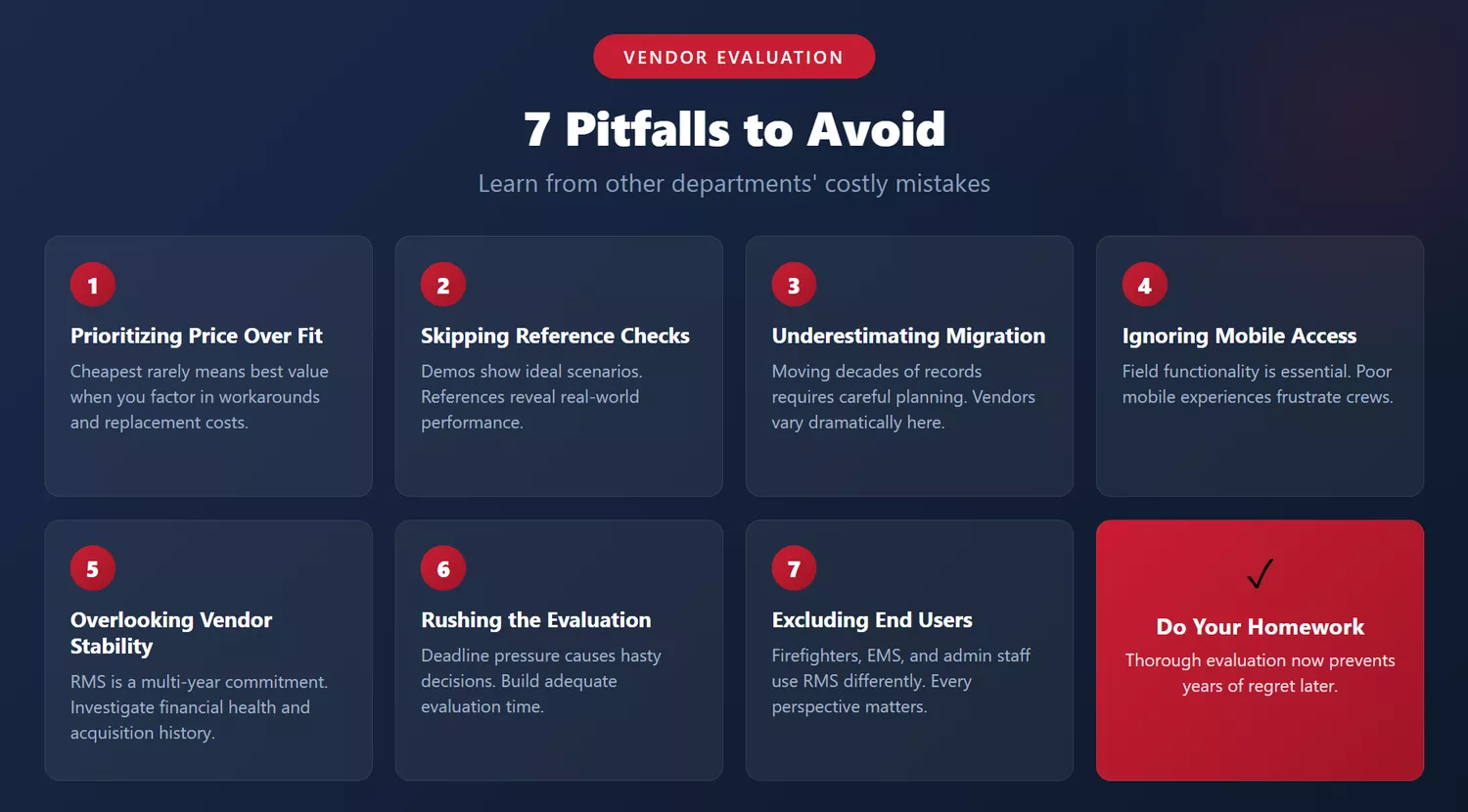
Learning from other departments’ missteps saves time and prevents costly errors. These mistakes surface repeatedly in fire service technology discussions:
- Prioritizing price over fit: The cheapest option rarely delivers the best value when you account for implementation struggles, workarounds, and eventual replacement costs.
- Skipping reference checks: Vendor-provided demonstrations show ideal scenarios, not real-world performance under pressure. References reveal the truth.
- Underestimating data migration complexity: Moving decades of historical records requires careful planning, and vendors vary dramatically in migration capability.
- Ignoring mobile functionality: Field access has become essential, yet some platforms offer mobile experiences that frustrate rather than enable personnel.
- Overlooking vendor stability: Fire RMS represents a multi-year commitment, so investigate vendor financial health and acquisition history before choosing.
- Rushing the evaluation timeline: NERIS deadlines create urgency, but hasty decisions lead to regret. Build adequate evaluation time into your process.
- Failing to involve end users: Administrative staff, firefighters, and EMS personnel interact with your RMS differently. Each perspective matters for selection.
What Will This Partnership Look Like Five Years From Now?
Fire service technology continues evolving rapidly. The RMS you select today must adapt to challenges you cannot fully anticipate. Your fire RMS vendor comparison should evaluate each vendor’s innovation trajectory alongside their current capabilities.
Examine the vendor’s product roadmap and release history. How frequently do they introduce meaningful improvements? Do they respond to customer feedback with new features and enhancements? Are they investing in emerging capabilities like advanced analytics, mobile optimization, and interoperability standards?
Consider also how the vendor handles the inevitable challenges that arise. When integration breaks, when compliance requirements shift, when your department’s needs change, you want a partner who responds proactively. The vendor’s track record during previous industry transitions, like the NEMSIS updates or state-specific reporting changes, indicates how they will handle future challenges.
Frequently Asked Questions
How long does a typical fire RMS implementation take? Implementation timelines vary based on department size, data migration complexity, and integration requirements. Straightforward implementations can complete in weeks, while larger departments with extensive historical data and multiple system integrations may require several months. During your fire RMS vendor comparison, ask each vendor for average timelines and references from similar-sized departments.
Should we wait until the NERIS deadline gets closer to evaluate new RMS options? Waiting is no longer an option. The NFIRS sunset date of January 31, 2026 for final data submissions is just weeks away, and the system goes dark entirely in February. Departments still evaluating options should prioritize vendors with proven rapid deployment capabilities and immediate NERIS compliance to minimize operational disruption.
What role should end users play in the RMS selection process? End user involvement dramatically improves adoption success. Include representatives from each user group in vendor demonstrations and evaluation discussions. Firefighters, EMS personnel, inspectors, and administrative staff all interact with RMS differently, and their perspectives reveal usability issues that leadership might miss.
How important is vendor industry specialization versus general software capability? Fire service specialization matters considerably. Vendors focused exclusively on fire and EMS understand operational nuances, compliance requirements, and workflow realities that general software providers miss. This specialized knowledge translates into more intuitive interfaces, relevant feature sets, and support staff who speak your language.
Take the Next Step Toward Modern Fire RMS
Your department deserves software that simplifies compliance, streamlines operations, and empowers your personnel to focus on what matters most: protecting your community. The questions outlined here provide a framework for evaluating fire department software vendors with the rigor this consequential decision demands.
EPR Fireworks delivers the integrated, cloud-based fire and EMS records management platform that departments nationwide trust for NERIS compliance, operational efficiency, and exceptional support. When you are ready to see how purpose-built fire service technology transforms daily operations, schedule a demo with our team to experience the difference firsthand.